Economic Pulse Net | Sources: World Bank World Development Indicators, Government Sources | 2026
Key Takeaways
– Nicaragua operates under a presidential representative democratic republic, but the political landscape is dominated by a single ruling party, raising questions about genuine multi-party competition.
– The country’s economic data from the World Bank is currently unavailable, making it difficult to assess GDP growth, inflation, unemployment, or income levels with precision.
– Major companies are concentrated in consumer services, financials, and consumer goods, with a notable presence of aviation and banking firms.
– Crime and safety indices are not reported, leaving a gap in understanding public security conditions.
– The cost of living data is absent, forcing reliance on broader regional context and anecdotal reporting.
The Invisible Economy — What We Don’t Know About Nicaragua’s GDP
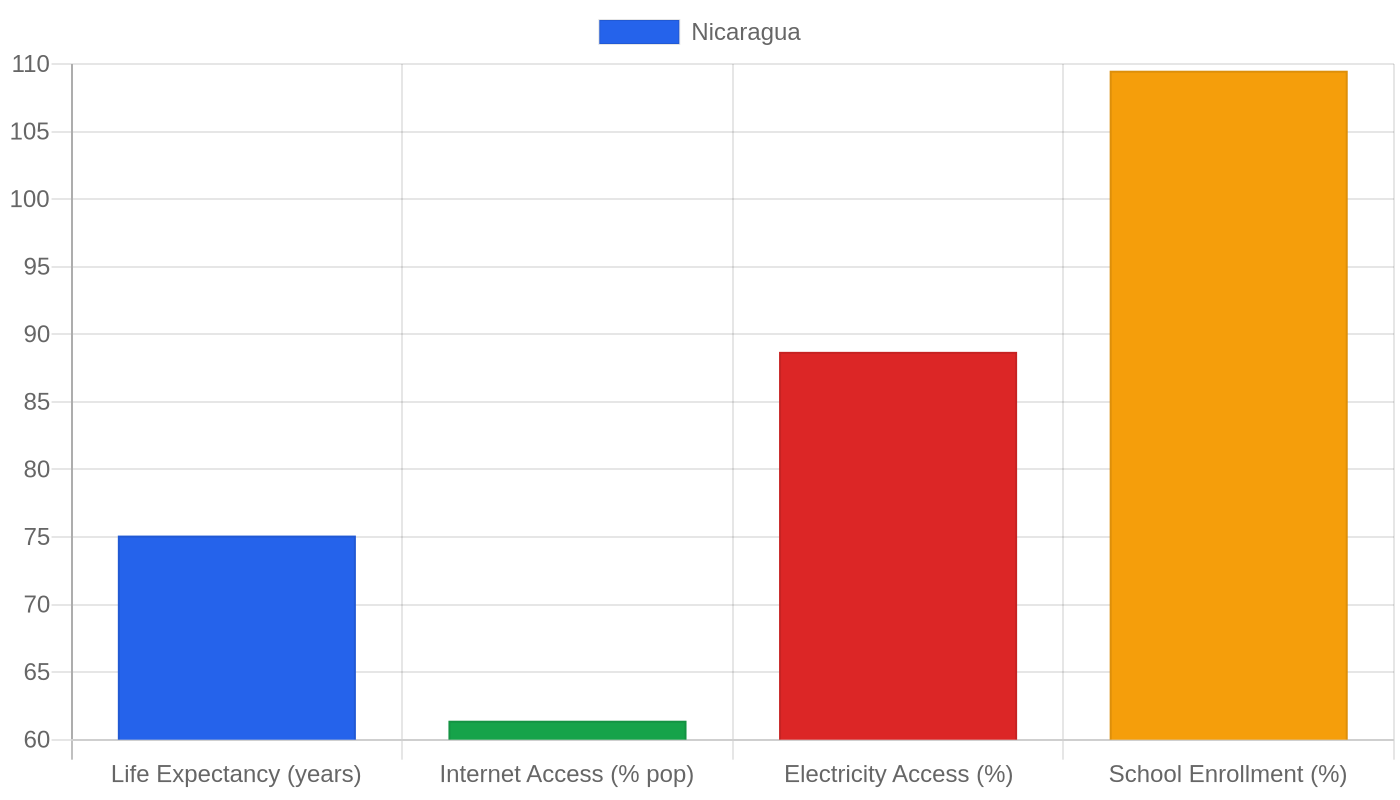
The World Bank provides no current economic data for Nicaragua — no GDP growth rate, no inflation figure, no unemployment number, no GDP per capita, and no GNI per capita. This silence is itself a story. When an international institution like the World Bank cannot publish standard economic indicators, it suggests either a breakdown in data collection, a lack of government transparency, or both.
For a country that has experienced political turbulence and international sanctions in recent years, the absence of numbers is a red flag for investors and analysts alike.
Without hard data, one must look at the structure of the economy. Nicaragua’s main industries are not listed in the provided data, but the top companies offer clues. The presence of Aeronica, **Aerosegovia**, **Atlantic Airlines**, and **Avianca Nicaragua** — all in consumer services — points to a functioning aviation sector, likely serving both domestic routes and regional connections.
**BAC Credomatic**, **Banco de la Producción**, and **Banco del Cafe** dominate the financials sector, suggesting a banking system that supports both consumer lending and agricultural finance, particularly coffee. **Compañía Cervecera de Nicaragua** and **El Castillo del Cacao** represent consumer goods, with beer and chocolate as key products. **ECAMI** operates in oil and gas, indicating energy infrastructure.
The lack of inflation data is particularly concerning. In an environment where global food and fuel prices have been volatile, Nicaragua’s vulnerability to external shocks is high. Without official CPI figures, businesses cannot price risk accurately, and households cannot plan their budgets. The World Bank’s silence on unemployment means we cannot gauge the health of the labour market — a critical gap for any country analysis.
The Hidden Cost of Living — Rent, Food, and Daily Survival
No cost of living data is provided for Nicaragua, but the absence of numbers does not mean the cost of living is irrelevant. In Central America, Nicaragua has historically been one of the more affordable countries for basic goods, but affordability is relative to income. Without GNI per capita or GDP per capita from the World Bank, we cannot calculate purchasing power.
Housing costs, rent versus buy decisions, and daily expenses remain unquantified. However, the presence of major banks like BAC Credomatic and **Banco de la Producción** suggests that mortgage lending and consumer credit exist. The question is whether ordinary Nicaraguans can access these services. In many developing economies, banking penetration is low, and cash transactions dominate. Without data, we cannot confirm whether Nicaragua follows this pattern or has achieved broader financial inclusion.
What can be inferred is that the cost of living in Managua, the capital, is likely higher than in rural areas, and that imported goods carry a premium due to logistics and tariffs. The absence of official statistics means journalists, investors, and aid organisations must rely on field reports and local surveys — a fragile foundation for decision-making.
Investment and Business Climate — Airlines, Banks, and Beer
The top companies list reveals a diversified but concentrated private sector. Aeronica, **Aerosegovia**, **Atlantic Airlines**, and **Avianca Nicaragua** dominate aviation, suggesting that air travel is a critical mode of transport for business and tourism. **BAC Credomatic** and **Banco de la Producción** are major financial institutions, likely serving corporate clients and retail customers. **Banco del Cafe** is a specialist lender, reflecting the importance of coffee as a cash crop.
Compañía Cervecera de Nicaragua and **El Castillo del Cacao** represent consumer staples — beer and chocolate are products with both domestic demand and export potential. **ECAMI** in oil and gas points to energy infrastructure, possibly involving fuel distribution or exploration.
For an investor, the business environment is shaped by the political landscape. Nicaragua is a presidential representative democratic republic with a multi-party system, according to the provided data. However, the reality on the ground has been one of increasing centralisation of power. The lack of economic data from the World Bank may reflect difficulties in operating independently.
Sectors to watch include aviation, banking, and consumer goods, but any investment decision requires careful due diligence on regulatory stability and property rights.
Safety, Politics, and Quality of Life — A Republic on Paper
The political framework is clear: Nicaragua is a presidential representative democratic republic, with the president as both head of state and head of government. Executive power is exercised by the government, legislative power is shared between the government and the National Assembly, and the judiciary is the third branch. On paper, this is a standard separation of powers.
In practice, the system has faced criticism from international observers for lack of checks and balances. The provided data does not include a crime index or safety index, so we cannot quantify public security. Similarly, no happiness data is available. What we can say is that quality of life in Nicaragua is shaped by economic opportunity, political freedom, and access to services — all of which are difficult to assess without numbers.
The absence of data from the World Bank is itself a quality-of-life indicator. When a country cannot or will not provide basic statistics, it often signals weak institutions, limited transparency, or both. For citizens, this means uncertainty about their own government’s performance. For outsiders, it means relying on anecdote rather than evidence.
Current Affairs — The Data Vacuum and What It Means
Right now, Nicaragua is operating without a publicly available economic scorecard from the World Bank. This is not a normal situation. Most countries, even those with limited statistical capacity, report at least GDP growth and inflation. The fact that Nicaragua’s data is listed as “N/A” suggests a breakdown in reporting, possibly due to political tensions or international sanctions.
The political landscape remains dominated by the ruling party. While the constitution provides for a multi-party system, opposition parties face significant hurdles. The National Assembly continues to function, but its independence is questioned by critics. The judiciary, as the third branch, has been accused of being subservient to the executive.
For businesses, the current environment is one of caution. The major companies listed — from airlines to banks to breweries — are likely operating under tight regulatory oversight. The oil and gas sector, represented by ECAMI, may be affected by global energy prices and domestic policy. The financial sector, with **BAC Credomatic** and **Banco de la Producción**, must navigate currency controls and capital restrictions.
The lack of recent news data means we cannot report on specific reforms, elections, or policy shifts. But the very absence of information is newsworthy. In a world of real-time data, Nicaragua is a black box. That should concern anyone with economic interests in the country.
The Bottom Line
Nicaragua is a country where the institutional framework of a democratic republic exists on paper, but the economic data needed to assess its performance is missing. Investors should watch this country for potential in aviation, banking, and consumer goods, but only after securing independent risk assessments. Aid organisations and researchers should treat the data vacuum as a warning sign. For now, Nicaragua remains a story of what we do not know — and that uncertainty is the most important fact of all.
Sources & Methodology
This article is authored by Economic Pulse Net for informational and research purposes. Economic Pulse Net sources its data from multilateral institutions, national statistics bureaus, and proprietary databases. All data is believed to be current as of the date of publication.
Published: July 18, 2026 | Category: Research — Nicaragua
Use these signals in your own platform
Economic Pulse publishes its live signal feed through a documented, read-only API. Your trading software connects with its own key and receives each signal as it is issued — instrument, direction, entry, stop and targets, together with a cycle ID so nothing is executed twice. The feed is independent of this website and cannot change it.
Signals are informational only and are not financial advice.