Economic Pulse Net | Sources: World Bank World Development Indicators, Government Sources | 2026
Key Takeaways
– Mexico’s economy, valued at over $1.83 trillion according to the World Bank, is one of Latin America’s largest, yet growth figures remain elusive amid a complex global environment.
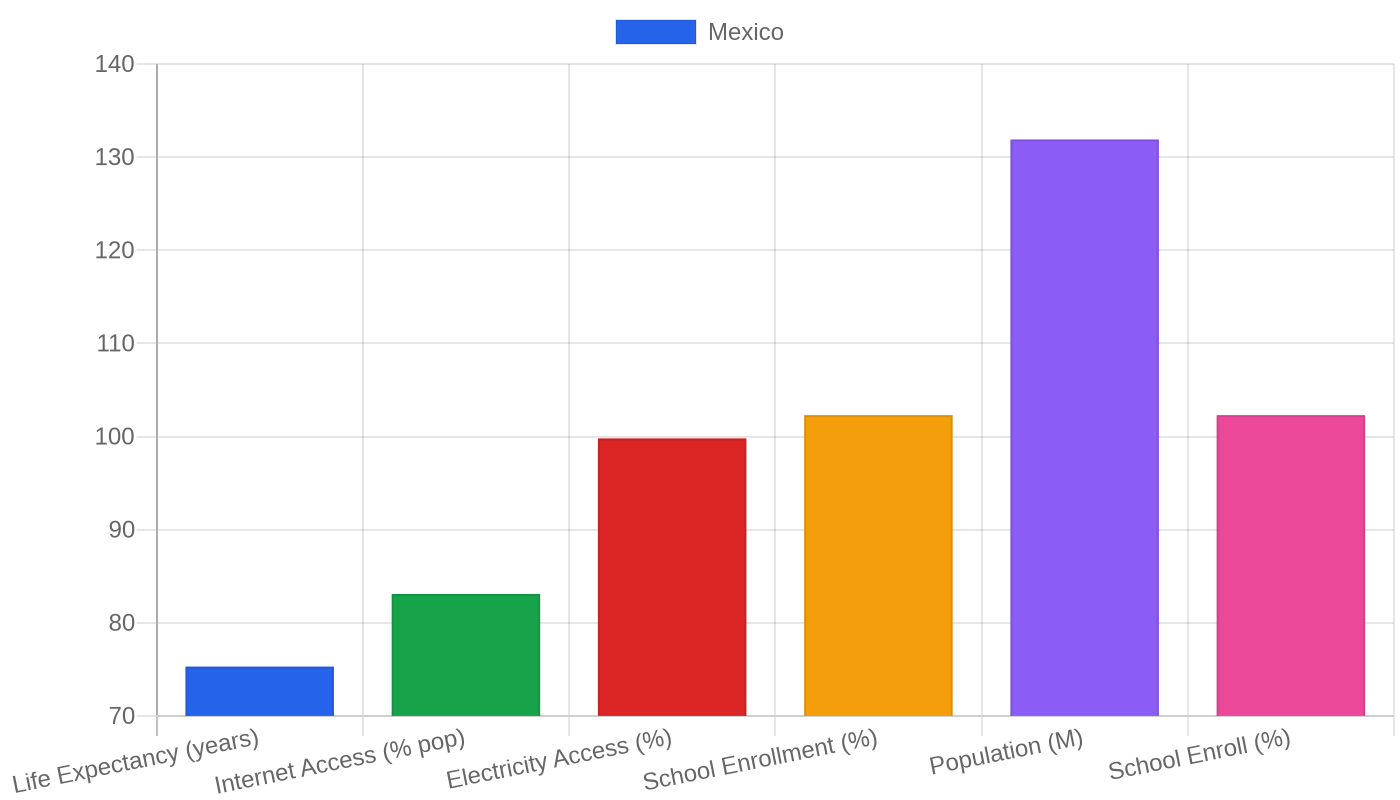
– Inflation stands at 3.81%, a figure that, while lower than recent peaks, continues to erode purchasing power for the nation’s nearly 132 million people.
– The country boasts an extraordinarily low unemployment rate of just 2.67%, signaling a tight labor market that is both a strength and a potential constraint on expansion.
– With a GNI per capita of $13,730 and a GDP per capita (PPP) of $25,868, Mexico sits firmly in the upper-middle-income bracket, but significant inequality persists beneath the aggregate numbers.
– The political landscape, rooted in a federal presidential system under the 1917 Constitution, provides institutional stability even as policy debates shape the business climate.
The Mexican Paradox — Growth Without Expansion
Mexico’s economic story is one of intriguing contradictions. The World Bank reports that the nation’s GDP stands at a formidable $1.83 trillion, placing it among the world’s top 15 economies by nominal output. Yet the latest GDP growth figure is listed as not available, a telling gap that reflects the uncertainty surrounding the country’s near-term trajectory.
What is clear is that Mexico is operating under unusual conditions: an inflation rate of 3.81% that, while not catastrophic, is stubborn enough to keep consumers and businesses cautious.
The unemployment rate of 2.67% is nothing short of remarkable. By global standards, this is effectively full employment — a level that many developed economies would envy. But in Mexico’s context, this figure demands careful interpretation. A rate this low suggests that nearly everyone who wants a job can find one, but it also implies a scarcity of labor that can drive up wages and, paradoxically, fuel further inflationary pressure.
The World Bank data shows a population of nearly 132 million people, meaning the labor force is vast, yet the unemployment numbers indicate that demand for workers is outstripping supply in key sectors.
This tight labor market creates a unique dynamic. Workers have bargaining power, which is positive for household incomes, but businesses face rising costs that may be passed on to consumers. The inflation figure of 3.81%, while below the double-digit crises seen in some emerging markets, still exceeds the central bank’s comfort zone.
It is a delicate balancing act: too much stimulus could reignite price pressures, while too much restraint could cool an economy that is already struggling to post clear growth numbers.
The Price of Living — Navigating Mexico’s Cost Challenge
For the average Mexican household, the cost of living is a daily calculation shaped by that 3.81% inflation figure. While the World Bank data does not provide specific housing or rent costs, the broader economic indicators tell a story of pressure on family budgets. Food, transportation, and utilities — the essentials that dominate spending for lower- and middle-income families — have seen prices rise steadily, even as the headline inflation number appears moderate compared to global peers.
Housing in Mexico varies dramatically by region. In major urban centers like Mexico City, Monterrey, and Guadalajara, rental costs have climbed as demand from both domestic migrants and foreign remote workers has increased. The tight labor market, with unemployment at just 2.67%, means that more people have steady incomes to compete for limited housing stock.
This dynamic pushes up rents faster than general inflation in many neighborhoods, creating a wedge between official CPI figures and the real experience of city dwellers.
For those considering buying versus renting, the math is complicated. Mortgage interest rates, while not specified in the data, are influenced by the broader inflation environment. With the central bank maintaining relatively high rates to combat price pressures, borrowing costs remain elevated. This makes homeownership a distant prospect for many younger Mexicans, even as their employment prospects are strong.
The result is a rental market that is increasingly competitive and expensive, particularly in areas near industrial and business hubs.
The Corporate Landscape — Giants of Industry and Commerce
Mexico’s business environment is dominated by a mix of household names and industrial powerhouses. The World Bank data highlights América Móvil, the telecommunications giant, as a flagship of the nation’s corporate sector. Alongside it stand conglomerates like ALFA and basic materials firms such as Altos Hornos de México, reflecting the country’s deep roots in manufacturing, steel, and energy.
The presence of Alpek in oil and gas underscores Mexico’s continued importance as an energy producer, even as the global transition to renewables reshapes the industry.
The consumer sector is equally vibrant. Companies like Aeroméxico and its affiliates dominate air travel, while Alpura and Ah Cacao Real Chocolate represent the food and beverage industry. This diversity is a strength: Mexico’s economy is not dependent on a single sector, but rather benefits from a broad base of industrial, telecommunications, and consumer goods companies. For investors, this diversification offers a hedge against sector-specific shocks.
The business climate, however, is not without challenges. The political landscape, defined by the 1917 Constitution’s federal system, creates a complex regulatory environment where national policies interact with state and municipal rules. Companies operating in Mexico must navigate this layered governance structure, which can slow decision-making and increase compliance costs.
Yet the fundamental stability of the political system — a representative, democratic, republican framework — provides a predictable backdrop for long-term investment.
Security, Stability, and the Quality of Daily Life
The quality of life in Mexico is shaped by factors that go beyond economic data. While the World Bank does not provide a specific crime index or safety index for this report, it is widely understood that public safety remains a significant concern for both residents and businesses. Mexico’s security challenges are well-documented, and they affect everything from where people choose to live to how companies manage their supply chains and employee safety protocols.
Politically, Mexico operates under a framework that has proven remarkably durable. The 1917 Constitution established a system that is representative, democratic, and republican, with power divided among federal, state, and municipal governments. This structure has weathered economic crises, political transitions, and social movements. For citizens, this means that while day-to-day governance can be contentious, the institutional foundations remain solid.
Elections are held regularly, power transfers peacefully, and the rule of law, while imperfect, provides a baseline for economic activity.
For the average Mexican, quality of life is a mixed picture. The low unemployment rate of 2.67% means that job opportunities are relatively abundant, which supports household incomes and consumer confidence. However, the inflation rate of 3.81% eats into those gains, particularly for families that lack savings or assets that appreciate with prices. The GDP per capita (PPP) of $25,868 suggests that, when adjusted for purchasing power, Mexicans have a decent standard of living compared to many emerging markets.
But the GNI per capita of $13,730 tells a different story — one of significant inequality, where aggregate wealth does not translate into universal prosperity.
The Pulse of the Nation — What’s Moving Mexico Right Now
As of early 2026, Mexico is navigating a period of cautious optimism tempered by structural challenges. The inflation rate of 3.81%, as reported by the World Bank, remains a central concern for policymakers. While it has moderated from earlier peaks, it has not fallen fast enough to allow for aggressive monetary easing. Consumers feel this in their daily purchases, and businesses factor it into their pricing and investment decisions.
The tight labor market, with unemployment at just 2.67%, adds another layer of complexity — wage pressures are building, and companies must decide whether to absorb costs or pass them on.
The political landscape is also in focus. Mexico’s federal system means that policy debates at the national level have ripple effects across states and municipalities. Recent discussions around energy policy, regulatory reform, and social spending have created both opportunities and uncertainties for investors. The constitutional framework provides stability, but the pace of reform can be slow, frustrating those who seek rapid change.
On the corporate front, major companies like América Móvil and ALFA continue to adapt to shifting market conditions. The telecommunications sector faces pressure from technological disruption and regulatory changes, while industrial conglomerates are navigating global supply chain realignments. Mexico’s position as a manufacturing hub remains strong, but the country must continuously upgrade its infrastructure and workforce to maintain its competitive edge.
The World Bank data shows a population of nearly 132 million, a demographic advantage that, if properly educated and employed, could drive growth for decades.
The Bottom Line
Mexico is a country of immense potential and persistent challenges. For investors, the low unemployment rate and diversified corporate base offer compelling reasons to take a closer look. For policymakers, the task is clear: manage inflation without choking off growth, improve public safety without sacrificing civil liberties, and leverage the nation’s demographic dividend through education and infrastructure investment.
The World Bank data paints a picture of a resilient economy that is neither booming nor busting — but rather waiting for the right conditions to unlock its next phase of development. Anyone watching global emerging markets should keep Mexico on their radar, not as a story of crisis, but as a test case of whether stability can be translated into sustainable prosperity.
Sources & Methodology
This article is authored by Economic Pulse Net for informational and research purposes. Economic Pulse Net sources its data from multilateral institutions, national statistics bureaus, and proprietary databases. All data is believed to be current as of the date of publication.
Published: July 21, 2026 | Category: Research — Mexico
Use these signals in your own platform
Economic Pulse publishes its live signal feed through a documented, read-only API. Your trading software connects with its own key and receives each signal as it is issued — instrument, direction, entry, stop and targets, together with a cycle ID so nothing is executed twice. The feed is independent of this website and cannot change it.
Signals are informational only and are not financial advice.