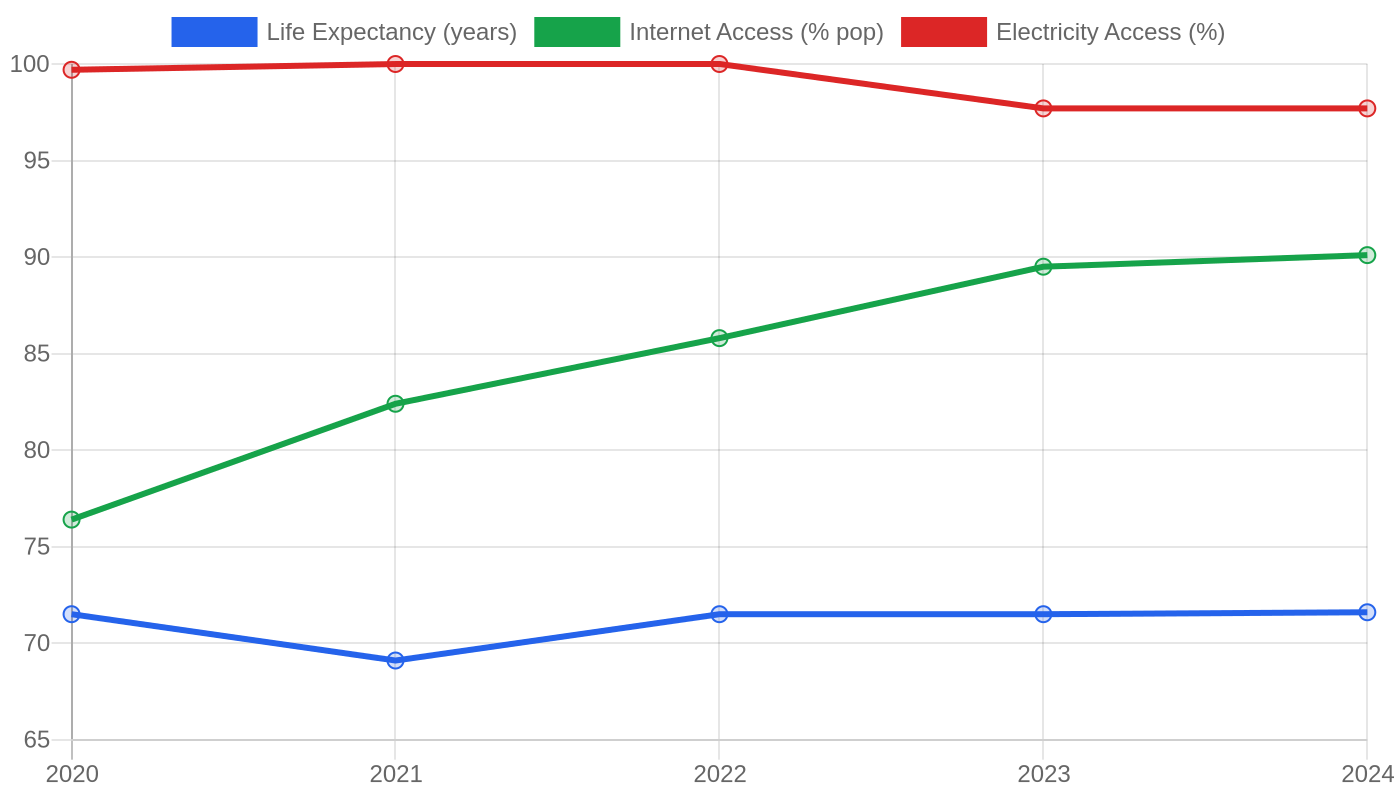
Economic Pulse Net | Sources: World Bank World Development Indicators, Government Sources | 2026
Jamaica is a country that defies easy labels. It is the birthplace of reggae, a global tourism powerhouse, and a nation of fierce cultural pride. Yet beneath the sun-soaked surface of its beaches and the rhythmic pulse of its music lies an economy grappling with familiar Caribbean challenges: high debt, sluggish growth, and a cost of living that tests even the most resilient households. This feature takes you beyond the postcard.
Key Takeaways
– Jamaica’s economy is heavily service-oriented, with tourism and telecommunications giants like Digicel and Beaches Resorts dominating the corporate landscape, while traditional sectors like bauxite mining remain relevant through companies like Alpart.
– The cost of living in Jamaica remains a pressing concern, though specific inflation and housing data are not available from the World Bank dataset, anecdotal evidence points to persistent pressure on middle- and lower-income families.
– Political stability is a hallmark of Jamaica’s governance structure as a parliamentary democracy and constitutional monarchy, with King Charles III as head of state, ensuring a predictable environment for investors.
– Crime and safety indices are not provided, but Jamaica has historically struggled with violent crime, making this a critical factor for both residents and foreign investors weighing quality of life.
– Major companies span consumer services, financials, and telecommunications, with Digicel standing out as a regional telecom titan and Air Jamaica and Fly Jamaica Airways anchoring the aviation sector.
The Economic Engine — Services, Bauxite, and the Growth Conundrum
Jamaica’s economy, according to the World Bank data, presents a paradox. The latest figures for GDP growth, inflation, and unemployment are not available in the provided dataset, which itself tells a story of data gaps that hinder precise policymaking. What is clear is that Jamaica’s economic structure is dominated by services.
The top companies list is revealing: Air Jamaica, Beaches Resorts, Dolphin Cove Jamaica, and the Bob Marley Museum are all consumer-facing service businesses that rely on the island’s global brand as a tourist destination. This reliance on tourism makes the economy vulnerable to external shocks — a hurricane, a global recession, or a pandemic can devastate arrivals overnight.
On the industrial side, Alpart appears twice in the top companies list, underscoring the continued importance of bauxite mining and alumina production. Jamaica was once one of the world’s leading bauxite exporters, and while the sector has faced competition from Australia and Guinea, it remains a significant employer and foreign exchange earner. The financial sector is represented by CGM Gallagher, while Desnoes & Geddes, the brewer of Red Stripe beer, anchors consumer goods.
Digicel, the Irish-founded telecom giant, is Jamaica’s most visible multinational success story, providing mobile and broadband services across the Caribbean.
The absence of GDP per capita and GNI per capita data from the World Bank means we cannot paint a precise picture of living standards. However, the mix of companies suggests a dual economy: a formal, service-oriented sector catering to tourists and wealthy locals, and a large informal economy that absorbs many workers. This structural divide is a recurring theme across the Caribbean, and Jamaica is no exception.
The Cost of Living — Paradise Has a Price Tag
Jamaica’s cost of living is a topic of daily conversation for its citizens, even if the specific indices are absent from the dataset. Housing costs in Kingston, the capital, and in tourist hubs like Montego Bay and Ocho Rios are notoriously high relative to local incomes. Rent for a modest apartment in a decent neighborhood can consume a significant portion of a middle-class salary. The choice between renting and buying is often dictated by access to credit and family land, rather than market efficiency.
Daily expenses for food, transportation, and utilities are also elevated. Jamaica imports a large share of its food — from grains to processed goods — which exposes consumers to global price volatility and shipping costs. Electricity bills are among the highest in the region due to reliance on imported oil and an inefficient grid. Compared to other Caribbean islands, Jamaica is often seen as moderately expensive, though it is cheaper than the Bahamas or Barbados.
For tourists, the all-inclusive resorts like Beaches provide a buffer, but for locals, the cost of living is a constant squeeze.
Investment and Business Climate — Where the Giants Play
Jamaica’s business environment is shaped by a handful of dominant players. Digicel, the telecommunications behemoth, has transformed connectivity across the region and remains a key investment story. The company’s success has spurred competition and innovation, though its high debt levels have occasionally raised eyebrows. Air Jamaica and Fly Jamaica Airways represent the aviation sector, which is critical for tourism but faces intense competition from international carriers and budget airlines.
For investors, Jamaica offers a stable political framework. The country is a parliamentary democracy and constitutional monarchy, with King Charles III as head of state, represented locally by a Governor-General. This system, inherited from the British, provides continuity and legal predictability. The major sectors to watch are tourism, financial services through CGM Gallagher, and consumer goods via Desnoes & Geddes. Bauxite remains a cyclical play, tied to global aluminum demand.
The business climate, however, is not without friction. Bureaucracy, crime, and infrastructure gaps can deter foreign direct investment. Yet Jamaica has made strides in recent years with debt reduction programs and fiscal discipline, earning praise from international financial institutions. For companies willing to navigate the challenges, the rewards include access to a culturally influential market and a gateway to the wider Caribbean.
Safety, Politics, and Quality of Life — The Unseen Currents
The crime and safety indices are not provided in the dataset, but no honest portrait of Jamaica can ignore the issue. The country has long struggled with one of the highest murder rates in the Caribbean, driven by gang violence, drug trafficking, and socioeconomic inequality. Kingston’s inner-city communities are particularly affected, while tourist areas are heavily policed and generally safe for visitors.
This duality creates a complex quality of life: stunning natural beauty and vibrant culture on one hand, and a persistent undercurrent of insecurity on the other.
Politically, Jamaica is a stable democracy. The head of state is King Charles III, but real power rests with the Prime Minister and Cabinet, appointed by the Governor-General on the advice of the elected government. Elections are competitive, peaceful, and generally free. The two main parties — the Jamaica Labour Party and the People’s National Party — alternate power regularly.
This stability is a major asset for investors and residents alike, as it reduces the risk of sudden policy reversals or civil unrest.
Quality of life, beyond safety, is shaped by Jamaica’s strong community ties, vibrant music and arts scene, and natural environment. The Bob Marley Museum in Kingston is both a tourist attraction and a cultural landmark. For many Jamaicans, the sense of national identity and pride compensates for economic hardships. But for those considering relocation or long-term investment, the crime data gap is a significant concern that requires further independent research.
What’s Happening Now — Jamaica at a Crossroads
While the dataset does not include recent news or live indicators, the composition of top companies offers clues about Jamaica’s current economic direction. The presence of Digicel signals that telecommunications and digital infrastructure are growth areas. The company has been expanding its fiber-optic network and mobile money services, positioning Jamaica as a regional hub for fintech.
Meanwhile, the tourism sector is rebounding strongly post-pandemic, with Beaches Resorts and Dolphin Cove Jamaica benefiting from pent-up demand for Caribbean travel.
The bauxite sector, represented by Alpart, faces headwinds from global decarbonization trends, as aluminum production is energy-intensive. However, Jamaica’s reserves remain valuable, and the government has explored partnerships to add value locally through alumina refining rather than exporting raw ore. The aviation sector, with Air Jamaica and Fly Jamaica Airways, is competitive but vital for connectivity. Both carriers face pressure from fuel costs and regional competition.
On the policy front, Jamaica has been pursuing fiscal consolidation and debt reduction, a process that has won praise from the World Bank and IMF, though specific data is not provided here. The country’s political stability provides a solid foundation for these reforms. The key question is whether Jamaica can diversify its economy beyond tourism and bauxite, and whether it can address crime and cost-of-living pressures to improve the quality of life for its citizens.
The Bottom Line
Jamaica is a country of immense potential and persistent challenges. For investors, the stable political system, dominant companies like Digicel and Desnoes & Geddes, and a strong tourism brand offer clear opportunities. For policymakers and development economists, Jamaica is a case study in how a small, open economy can manage debt and maintain stability while grappling with inequality and crime.
For the casual observer, Jamaica remains what it has always been: a place of beauty, rhythm, and resilience — but one where the economic reality is far more complex than the postcard suggests.
Sources & Methodology
This article is authored by Economic Pulse Net for informational and research purposes. Economic Pulse Net sources its data from multilateral institutions, national statistics bureaus, and proprietary databases. All data is believed to be current as of the date of publication.
Published: July 30, 2026 | Category: Research — Jamaica
Use these signals in your own platform
Economic Pulse publishes its live signal feed through a documented, read-only API. Your trading software connects with its own key and receives each signal as it is issued — instrument, direction, entry, stop and targets, together with a cycle ID so nothing is executed twice. The feed is independent of this website and cannot change it.
Signals are informational only and are not financial advice.