Economic Pulse Net | Sources: World Bank World Development Indicators, Government Sources | 2026
Key Takeaways
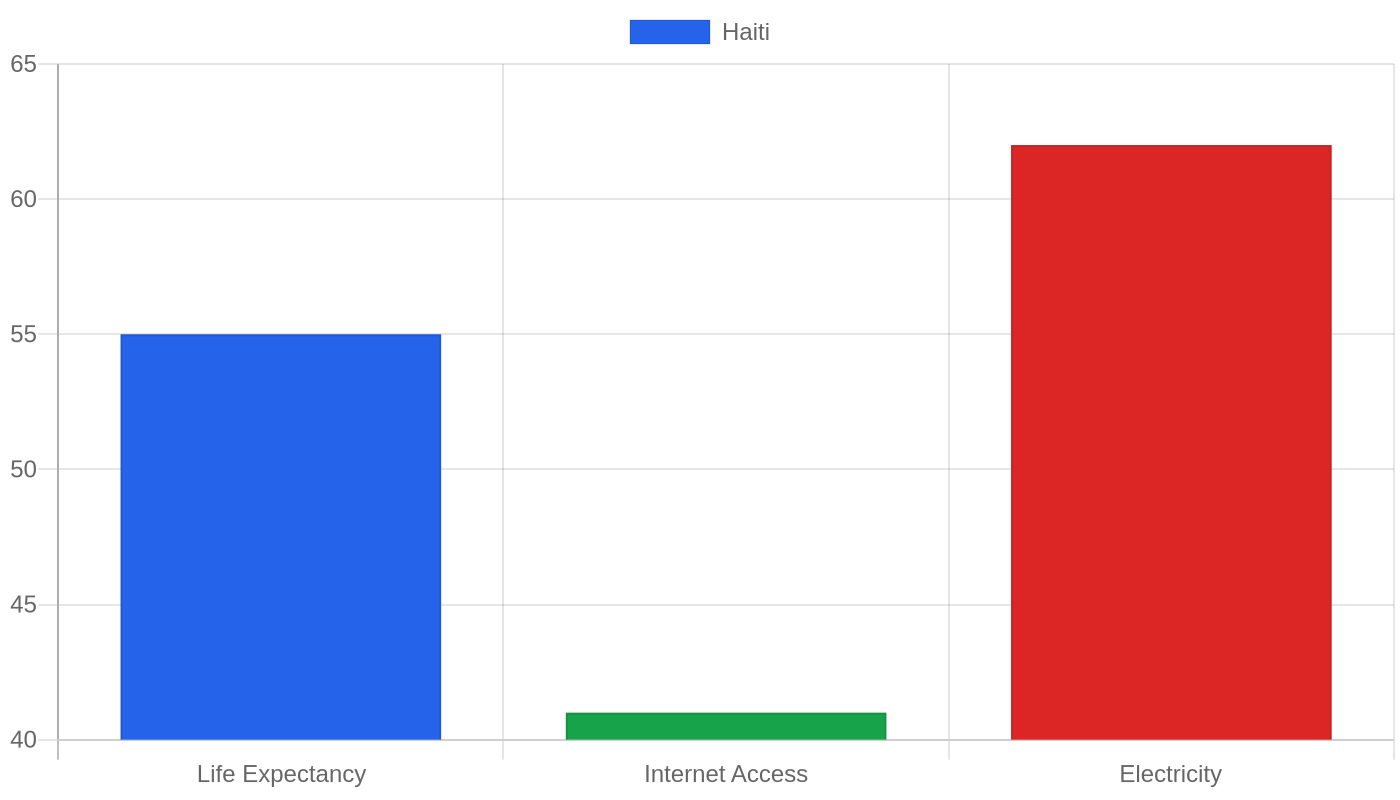
– Haiti’s economy operates largely in the dark, with no publicly reported GDP growth, inflation, or unemployment figures from the World Bank, reflecting a state of profound statistical invisibility.
– The financial sector is dominated by a handful of institutions—Bank of the Republic of Haiti, Banque de l’Union Haïtienne, Capital Bank, and Fonkoze—that form the backbone of a fragile formal economy.
– Consumer goods and brewing companies—Brasserie de la Couronne, Brasserie Nationale d’Haïti, and Comme Il Faut—represent rare pockets of industrial resilience in a landscape otherwise defined by instability.
– The political system functions as a semi-presidential republic with term limits and multiparty competition, but the gap between constitutional design and lived governance remains vast.
– Without reliable crime or safety indices, the perception of danger—shaped by years of gang violence, political turmoil, and institutional collapse—defines daily life and investment calculus more than any statistic.
The Great Statistical Silence — What the Missing Numbers Tell Us
When the World Bank reports no data for a country’s GDP growth, inflation, unemployment, or GDP per capita, it is not merely an administrative gap. It is a verdict. Haiti, the poorest nation in the Western Hemisphere, has become a statistical ghost—its economic machinery so disrupted, its institutions so degraded, that even the most basic measurements of national output and price stability are no longer reliably captured. This is not a data failure; it is a governance failure made legible.
The absence of numbers is itself the story. Without GDP figures, there is no way to measure whether the economy is shrinking or growing, whether policy interventions are working or failing. Without an inflation CPI, businesses cannot price risk, workers cannot gauge real wages, and the central bank—the Bank of the Republic of Haiti—operates without a compass. The unemployment rate, unrecorded, masks what is likely catastrophic levels of informal and precarious labour.
What the World Bank cannot count, it cannot help.
Yet economic life persists. Haiti’s main industries, though unlisted in the formal data, are understood to include agriculture—coffee, mangoes, cocoa—textile assembly in the Caribbean’s largest free-trade zone, and remittances from the diaspora, which account for a staggering share of national income. These flows, largely undocumented in official statistics, keep households afloat and fuel consumption in Port-au-Prince’s sprawling markets.
The formal economy, meanwhile, is a narrow corridor running through a handful of banks and breweries, fragile and heavily concentrated.
Concrete and Cost — The Price of Survival in Port-au-Prince
Housing in Haiti exists in two parallel universes. For the small elite and the international community, fortified villas in the hills above Port-au-Prince command rents that rival those in Miami or Panama City—often exceeding $2,000 per month for properties with generators, water tanks, and armed security.
For the vast majority, shelter means informal settlements, corrugated metal shacks, and overcrowded tenements where rent might run $50 to $100 per month, but where land tenure is insecure and basic services—electricity, running water, sanitation—are intermittent or absent.
The cost of living is punishingly high relative to income. Haiti imports nearly everything—rice, cooking oil, fuel, cement, medicine—so global price shocks hit hard and fast. A bag of rice, the national staple, can consume a third of a poor household’s weekly earnings. Fuel price hikes, often triggered by the removal of government subsidies, have sparked riots and paralysed transport.
Compared to regional averages in the Caribbean, the cost of basic goods in Haiti is elevated, while median income is a fraction of what it is in the Dominican Republic or Jamaica. The result is a population perpetually on the edge of subsistence, where a single price spike can tip a family into crisis.
Banking on Chaos — Where Capital Goes to Hide or Grow
The list of Haiti’s top companies reads like a map of survival strategies. On one side, the financial sector: Bank of the Republic of Haiti, Banque de l’Union Haïtienne, Capital Bank, and Fonkoze. These institutions manage remittances, provide credit to the tiny formal sector, and, in Fonkoze’s case, offer microfinance to rural women—a rare pipeline of capital to the poor.
On the other side, consumer goods and brewing: Brasserie de la Couronne, Brasserie Nationale d’Haïti, and Comme Il Faut, a cigarette manufacturer. These companies produce goods that people consume regardless of political crisis—beer, soft drinks, tobacco—and they have proven remarkably durable.
The investment climate is defined by risk and return. Security costs—private guards, armoured vehicles, insurance—can consume 20 to 30 percent of operating expenses for any business in Port-au-Prince. The legal system is slow, corruption is endemic, and port infrastructure is dysfunctional. Yet opportunities exist: telecommunications, renewable energy, and agro-processing all have untapped potential.
The GB Group, a conglomerate, has diversified across industries, demonstrating that with local knowledge and political connections, profits can be made. For foreign investors, the calculation is brutal: the potential returns are high, but the probability of disruption—by gangs, protests, or policy reversals—is higher.
The State of Exception — Politics, Violence, and Daily Endurance
Haiti’s political system is, on paper, a semi-presidential republic with a multiparty system, a directly elected president serving five-year terms, and a prime minister appointed from the majority party in the National Assembly. A president cannot serve two consecutive terms, and no individual may hold the office more than twice. These constitutional guardrails were designed to prevent authoritarian entrenchment.
In practice, they have done little to prevent chronic instability: since the fall of the Duvalier dictatorship in 1986, Haiti has had more than a dozen presidents, several of whom were overthrown, assassinated, or forced into exile.
The crime and safety indices are listed as unavailable, which is itself a kind of data. What is known is that armed gangs control an estimated 80 percent of Port-au-Prince, that kidnapping for ransom is a routine business, and that the Haitian National Police is underfunded, understaffed, and often overwhelmed. The quality of life for most Haitians is defined by precarity: unreliable electricity, limited healthcare, schools that are either unaffordable or non-functional, and a constant low-grade terror of violence.
Happiness data does not exist, but resilience does. Haitians endure with a pragmatism born of centuries of hardship, building community networks, relying on the diaspora, and maintaining an indomitable cultural identity through music, art, and religion.
Port-au-Prince Under Pressure — The Crisis That Refuses to End
Right now, Haiti is in the grip of a multidimensional emergency that shows no signs of abating. Gang violence has intensified, with armed groups expanding their territorial control beyond the capital into the Artibonite Valley, the country’s agricultural heartland. This has disrupted food production and supply chains, pushing already vulnerable populations toward famine.
The political vacuum left by the assassination of President Jovenel Moïse in 2021 has not been filled; the transitional government, backed by the international community, lacks legitimacy and operational capacity.
A multinational security support mission, led by Kenya and endorsed by the United Nations, has been slow to deploy and faces significant logistical and political hurdles. Meanwhile, the Haitian diaspora continues to send billions of dollars in remittances—the single largest source of foreign exchange—keeping the economy from total collapse. Inflation, though unmeasured, is felt acutely at the market stall and the petrol queue.
The central bank has struggled to stabilise the gourde, which has lost value dramatically against the dollar. Businesses operate in survival mode, shortening supply chains, hoarding cash, and hedging against the next shock. Haiti is not waiting for a crisis; it is living inside one.
The Bottom Line
Haiti is a country that the world has learned to ignore—too poor to matter strategically, too chaotic to engage with easily, too resilient to fully collapse. For investors with a high tolerance for risk and a long time horizon, there are opportunities in telecommunications, renewable energy, and microfinance. For policymakers and humanitarian organisations, Haiti is a test case for what happens when state failure meets climate vulnerability and urban gang warfare.
But for the 11 million Haitians who wake up every morning in the shadow of uncertainty, the country is not a case study. It is home.
Sources & Methodology
This article is authored by Economic Pulse Net for informational and research purposes. Economic Pulse Net sources its data from multilateral institutions, national statistics bureaus, and proprietary databases. All data is believed to be current as of the date of publication.
Published: July 18, 2026 | Category: Research — Haiti
Use these signals in your own platform
Economic Pulse publishes its live signal feed through a documented, read-only API. Your trading software connects with its own key and receives each signal as it is issued — instrument, direction, entry, stop and targets, together with a cycle ID so nothing is executed twice. The feed is independent of this website and cannot change it.
Signals are informational only and are not financial advice.