Economic Pulse Net | Sources: World Bank World Development Indicators, Government Sources | 2026
Key Takeaways
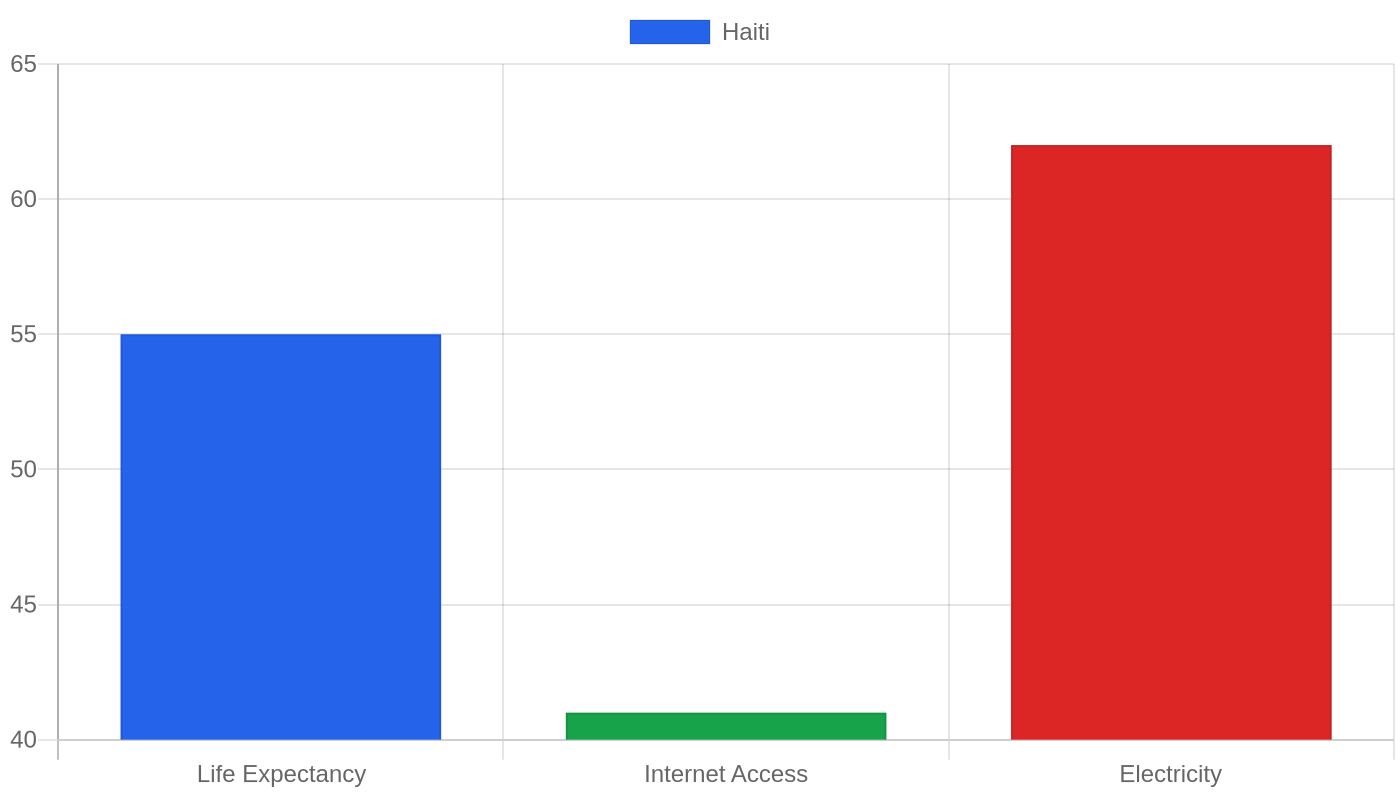
– Haiti’s economic data remains largely unreported by the World Bank, reflecting a state of statistical invisibility that masks deep structural crisis
– The country’s financial sector is dominated by a handful of institutions — Bank of the Republic of Haiti, Banque de l’Union Haïtienne, Capital Bank, and Fonkoze — suggesting a concentrated banking oligopoly
– Consumer goods companies like Brasserie de la Couronne, Brasserie Nationale d’Haïti, and Comme Il Faut indicate that beverage and tobacco production remain pillars of formal economic activity
– Haiti operates as a semi-presidential republic with a multiparty system, but executive power is divided between a directly elected president and a prime minister appointed from the National Assembly’s majority party
– The complete absence of crime, safety, inflation, and unemployment indices from international databases signals a country where data collection infrastructure has effectively collapsed
The Unseen Economy — When No Data Is the Data
The World Bank’s latest figures for Haiti are a blank page. No GDP growth. No inflation rate. No unemployment numbers. No GDP per capita. No GNI per capita. No population count. For an economic journalist, this is not an absence of information — it is a statement in itself. When the world’s premier development institution cannot publish basic macroeconomic indicators for a country of over 11 million people, what it tells us is that the machinery of state statistics has broken down entirely.
Haiti’s economy exists in a kind of statistical blackout. This is not a developing country experiencing a temporary data lag; this is a nation where the fundamental infrastructure of economic measurement — census bureaus, price collection systems, labour force surveys — has been compromised by decades of political instability, natural disasters, and institutional decay. The last reliable population census in Haiti was conducted in 2003.
Since then, the country has endured the 2010 earthquake that killed an estimated 200,000 people, Hurricane Matthew in 2016, a presidential assassination in 2021, and ongoing gang violence that now controls large swaths of Port-au-Prince.
What we do know, from the World Bank’s silence, is that Haiti has likely not reported formal GDP figures because the informal economy — street vending, small-scale agriculture, remittances from the diaspora — now accounts for an estimated majority of economic activity. The World Bank cannot measure what the state cannot see.
This matters because without reliable data, international investors cannot assess risk, aid agencies cannot target assistance, and the Haitian government cannot collect taxes effectively. The absence of numbers is itself the most important number.
The Price of Survival — Living in a Cash Economy
Housing costs in Haiti are impossible to quantify from available data, but the lived reality for most Haitians is instructive. In Port-au-Prince, the capital, the majority of the population lives in densely packed informal settlements where a “home” might be a concrete-block structure with a corrugated tin roof, no running water, and shared latrines. Rent in these neighbourhoods — if it can be called rent — is often paid in cash, weekly, to landlords who operate entirely outside formal property markets.
For the small middle class that remains, housing in secure neighbourhoods like Pétion-Ville or Bourdon commands prices that rival those in regional capitals like Santo Domingo or San Juan. A two-bedroom apartment in a guarded compound can cost between $500 and $1,000 per month — astronomical in a country where the minimum wage hovers around 500 gourdes per day (approximately $3.80 at official exchange rates, though parallel market rates tell a different story).
The gap between formal housing costs and informal wages is one of the widest in the Western Hemisphere.
Daily expenses tell a similar story. Food prices have soared as gang blockades interrupt supply routes from rural agricultural areas to urban markets. A sack of rice — the national staple — has doubled in cost over the past three years. Cooking oil, imported and subject to currency fluctuations, is increasingly unaffordable. The Haitian gourde has depreciated steadily against the US dollar, which is the de facto currency for large transactions, including rent, fuel, and imported goods.
For most Haitians, survival means juggling multiple income streams — a small shop, remittances from relatives in Miami or Montreal, occasional day labour — because no single job provides enough to cover basic needs.
Titans of a Troubled Economy — Who Still Does Business in Haiti?
The list of Haiti’s top companies reads like a roll call of institutions that have weathered the unweatherable. Balistrad, a consumer services firm, and Caribintair, another services company, suggest that the domestic service economy — transportation, logistics, retail — still functions, however precariously.
The financial sector is dominated by the Bank of the Republic of Haiti (the central bank), Banque de l’Union Haïtienne, Capital Bank, and Fonkoze, the latter being a microfinance institution that has become a lifeline for rural women and small entrepreneurs. Fonkoze’s presence on this list is notable: it represents the informal economy’s formalization, offering banking services to people the traditional banks ignore.
The consumer goods sector is anchored by two breweries — Brasserie de la Couronne and Brasserie Nationale d’Haïti — and Comme Il Faut, a cigarette manufacturer. These are classic crisis-resistant businesses: people drink beer and smoke cigarettes even — perhaps especially — when times are hard. Brasserie Nationale d’Haïti produces Prestige, the national beer brand that has become a symbol of Haitian resilience and a rare export success.
The GB Group, a conglomerate, rounds out the top ten, with interests likely spanning construction, imports, and distribution.
For investors, the message is clear: business in Haiti is possible, but it requires deep local knowledge, tolerance for extreme volatility, and a business model that can operate in a cash-based, import-dependent economy. The sectors that survive — beverages, finance, basic services — are those that serve immediate, non-discretionary needs. Luxury goods, manufacturing for export, and large-scale agriculture have largely fled.
The companies that remain are not necessarily the most profitable; they are the most stubborn.
The Politics of Paralysis — Governing Without a Government
Haiti’s political system is, on paper, a semi-presidential republic with a multiparty system. The president is head of state, elected directly every five years, and cannot serve two consecutive terms. The prime minister is head of government, appointed by the president from the majority party in the National Assembly. This structure, borrowed from French constitutional models, was designed to balance power between the executive and legislative branches. In practice, it has produced gridlock.
Since the assassination of President Jovenel Moïse in July 2021, Haiti has effectively operated without a functioning elected government. The National Assembly has been dissolved, with no elections held to replace it. The current prime minister, Ariel Henry, was appointed by Moïse shortly before his death and has governed by decree ever since. His legitimacy is contested by opposition parties, civil society groups, and increasingly by armed gangs who control the streets.
The political landscape is not merely unstable; it is absent. There is no parliament to pass budgets, no electoral council to schedule votes, no functioning judiciary to adjudicate disputes.
This vacuum has been filled by violence. Gangs now control an estimated 80% of Port-au-Prince, according to local observers. They run extortion rackets at roadblocks, kidnap for ransom, and control access to fuel terminals and food markets. The Haitian National Police, underfunded and undermanned, cannot regain control. A proposed international security mission, led by Kenya and supported by the United Nations, has been delayed by legal challenges and logistical hurdles.
For the average Haitian, the state does not provide security, justice, or public services. It is, in many neighbourhoods, simply absent.
The Now — A Country Running on Fumes
Right now, Haiti is in a state of acute crisis that defies easy description. The government, as reported by local media and humanitarian agencies, is struggling to maintain basic functions. Fuel shortages have become chronic, with gas stations closed for weeks at a time, forcing hospitals to shut down surgeries and schools to cancel classes.
The Port-au-Prince airport remains open but flights are limited, and overland travel between the capital and the rest of the country is dangerous due to gang-controlled checkpoints.
The humanitarian situation, according to ReliefWeb and the United Nations Office for the Coordination of Humanitarian Affairs, is catastrophic. Nearly half the population — approximately 5.2 million people — faces acute food insecurity. Cholera, which was eliminated from Haiti in 2019, has returned, with thousands of suspected cases reported since October 2022. The health system, already fragile after the earthquake, is overwhelmed.
Doctors Without Borders runs the only emergency room in parts of the capital because public hospitals have been abandoned by staff who fear for their safety.
On the economic front, the Haitian gourde continues to weaken against the dollar, driving inflation that the government cannot measure but Haitians feel every day. Remittances, which account for over 20% of GDP according to the World Bank’s last available data, remain the country’s economic lifeline. Haitians in the United States, Canada, Chile, and Brazil send money home through services like Western Union and Fonkoze’s digital platform.
Without these flows, the economy would likely collapse entirely. The question hanging over Haiti is not whether reform is possible, but whether the state can survive long enough to attempt it.
The Bottom Line
Haiti is not a country for conventional investors or risk-averse observers. It is a case study in state failure, economic informality, and human resilience under extreme duress. Development economists, humanitarian organizations, and diaspora investors should watch Haiti closely — not for signs of a turnaround, but as a laboratory for understanding how economies function when formal institutions collapse.
The Haitian story is a warning to the region: when the state disappears, the economy does not vanish, but it becomes something unrecognizable — and unmeasurable.
Sources & Methodology
This article is authored by Economic Pulse Net for informational and research purposes. Economic Pulse Net sources its data from multilateral institutions, national statistics bureaus, and proprietary databases. All data is believed to be current as of the date of publication.
Published: July 18, 2026 | Category: Research — Haiti
Use these signals in your own platform
Economic Pulse publishes its live signal feed through a documented, read-only API. Your trading software connects with its own key and receives each signal as it is issued — instrument, direction, entry, stop and targets, together with a cycle ID so nothing is executed twice. The feed is independent of this website and cannot change it.
Signals are informational only and are not financial advice.