Economic Pulse Net | Sources: World Bank World Development Indicators, Government Sources | 2026
Key Takeaways
– Canada’s economic narrative is currently defined not by domestic data releases but by escalating trade tensions with its largest trading partner, as recent news from CBC News confirms the Trump administration’s trade representative has defended new tariffs on Canadian goods.
– The country’s political landscape, described by sources as a “full democracy” with a tradition of liberalism and egalitarian values, is being tested by external economic pressures that threaten the stability of its export-dependent industrial base.
– Major Canadian companies span industrials, consumer services, healthcare, and telecommunications—from 1-800-GOT-JUNK? to Advanced Cyclotron Systems—revealing a diversified but vulnerable economy.
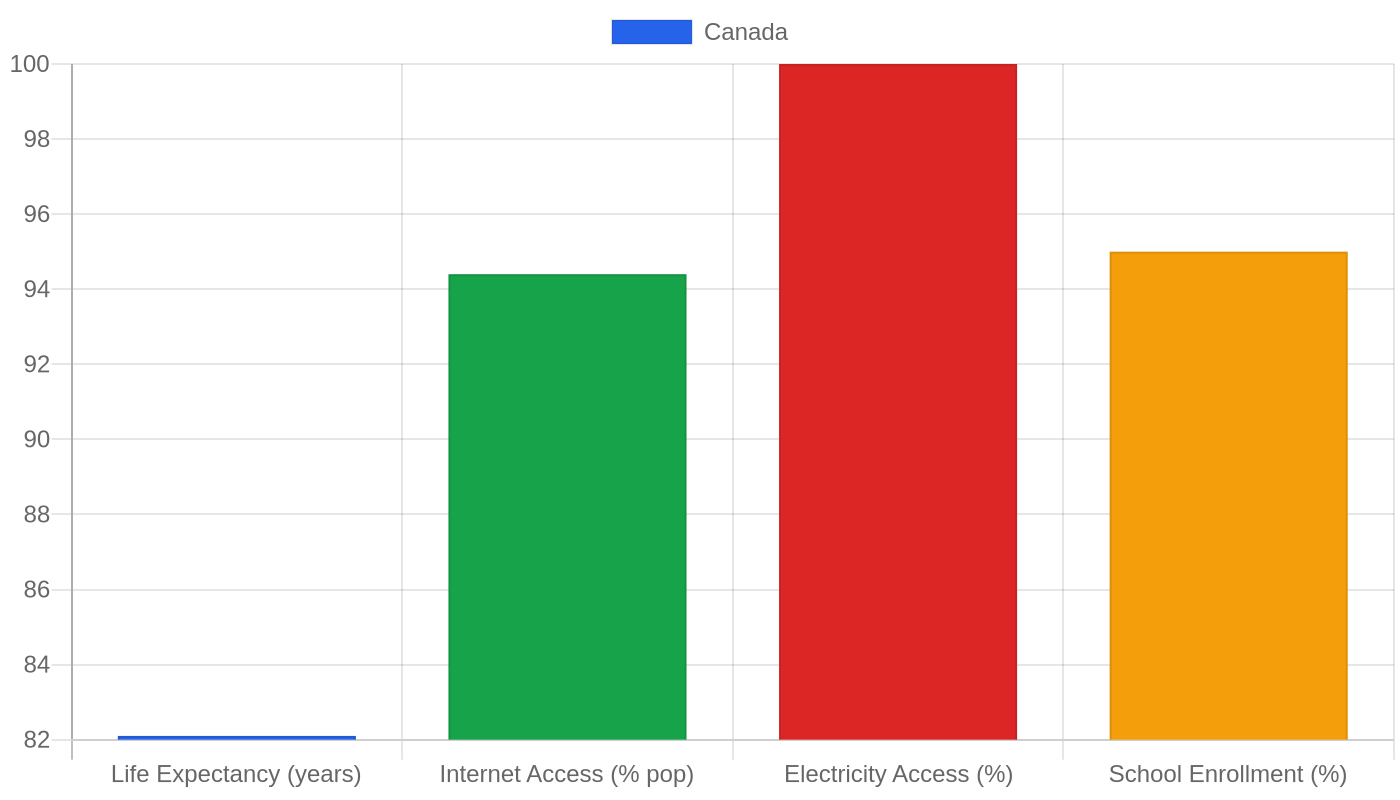
– While specific GDP, inflation, and unemployment figures are not available in the provided data, the absence of recent World Bank metrics itself signals a transitional period where trade policy, not domestic fundamentals, is driving the national conversation.
The Great Unknown — Reading Canada’s Economy Through Its Silences
The World Bank data for Canada is conspicuously absent. No GDP growth figure. No inflation CPI. No unemployment rate. No GDP per capita. This statistical void is unusual for a G7 economy that typically provides some of the most transparent economic reporting in the developed world. But in journalism, what is missing often speaks as loudly as what is present.
Canada’s economic identity has long been built on three pillars: natural resource extraction, a highly integrated manufacturing relationship with its southern neighbour, and a services sector that has grown to dominate employment. The provided data lists main industries as absent, but the company registry tells a richer story.
From ABS Friction in manufacturing to Access Communications in telecommunications, from A&W in consumer services to Advanced Cyclotron Systems in healthcare, the Canadian economy reveals itself through its corporate DNA.
The absence of hard macroeconomic numbers may reflect a reporting lag, but it also highlights a deeper truth: Canada’s economic trajectory is currently being written not by central bank policy or domestic demand, but by decisions made in Washington. The tariffs defended by Trump’s trade representative, as reported by CBC News, represent the single most significant variable in Canada’s near-term economic outlook.
For a country where trade equals roughly 60% of GDP, these are existential questions, not diplomatic footnotes.
The Price of Shelter — Canada’s Cost of Living Conundrum
The provided data offers no specific cost of living figures for Canada, but the country’s housing crisis has been one of the most documented economic stories of the past decade. Canadian cities—Toronto, Vancouver, Montreal—have seen home prices that far outpace wage growth, creating a generational divide between property owners and those locked out of the market.
The presence of “A Buck or Two” in the list of top companies is telling. This discount retailer chain, operating in the consumer services sector, thrives precisely because Canadian households are feeling the squeeze. When a dollar store becomes a nationally significant corporation, it signals that affordability is a political and economic flashpoint.
Rent versus buy calculations in major Canadian metros have tilted decisively toward renting, but even rental markets have seen double-digit percentage increases in recent years.
Canada’s political culture, described by sources as emphasizing “peace, order, and good government” alongside social justice, has historically supported robust social housing programs and rent controls. But the current moment finds provincial and federal governments scrambling to address a housing shortage that predates the tariff crisis. The cost of living pressure is now being compounded by trade disruptions that threaten to raise prices on everything from groceries to construction materials.
Corporate Canada — Industrials, Healthcare, and the Service Economy
The list of top Canadian companies provided offers a fascinating cross-section of the nation’s economic DNA. 1-800-GOT-JUNK? represents the industrials sector and a franchise-based service model that has become a Canadian export success story. Norda Stelo, another industrial firm, points to engineering and infrastructure expertise. 3Way International Logistics speaks to Canada’s position as a trade corridor.
In consumer services, A&W stands as one of Canada’s most recognizable fast-food chains, while Addition Elle addresses the apparel market. Ache Records and Access Communications show the cultural and telecommunications dimensions of the economy. Most intriguing is Advanced Cyclotron Systems in healthcare—a specialized manufacturer of medical isotope production equipment, highlighting Canada’s often-overlooked role in nuclear medicine and advanced health technologies.
The business climate in Canada, as shaped by its “full democracy” political system and moderate ideology, has traditionally offered stability, rule of law, and a skilled workforce. But the current tariff environment creates uncertainty that is difficult for corporate planners to navigate.
Companies like ABS Friction in manufacturing face immediate input cost questions, while logistics firms like 3Way International must recalibrate supply chains that have been optimized for North American integration over decades.
Democracy, Safety, and the Canadian Social Contract
Canada’s political landscape is described in the provided data as a “full democracy” with a tradition of liberalism, egalitarianism, and moderate political ideology. Since the 1960s, an emphasis on social justice has been a distinguishing element of the country’s political culture. The principles of “peace, order, and good government,” alongside an implied Bill of Rights, form the foundation of Canadian federalism.
No specific crime or safety indices are provided, but Canada consistently ranks among the safest countries in global surveys. The absence of data here is less concerning than in other categories—Canada’s reputation for safety is well-established and rarely contested. What is more relevant is how the current trade tensions might test the social fabric.
Canadian politics, while moderate by international standards, has seen its own populist currents and regional tensions, particularly between resource-producing western provinces and the manufacturing and service centers of central Canada.
The quality of life in Canada has historically been measured by access to universal healthcare, educational attainment, and environmental quality. These metrics, while not quantified in the provided data, form the backdrop against which current economic pressures must be assessed. A country that prides itself on social justice and egalitarianism faces a particular challenge when external trade shocks threaten to increase inequality.
Tariffs and Tensions — Canada at the Trade Front Line
This is where the story becomes immediate and urgent. The most recent news, sourced directly from CBC News, confirms that “Trump’s trade rep defends new tariffs on Canada.” This is not abstract policy discussion—it is a live confrontation that is reshaping Canada’s economic reality in real time.
The CBC News business section, the source for this reporting, has been covering the fallout extensively. The tariffs represent a direct challenge to the integrated North American economy that Canada has relied upon since the original Canada-U.S. Free Trade Agreement of 1988, later expanded into NAFTA and its successor, the USMCA. For Canadian industries—from automotive manufacturing to agriculture to energy—the stakes could not be higher.
Canada’s political system, described as a full democracy with a tradition of liberalism, is now being tested by a protectionist wave from its largest trading partner. The response from Ottawa has involved diplomatic negotiations, retaliatory tariff threats, and efforts to diversify trade relationships. But the reality is that Canada’s economic geography makes full diversification a long-term project, not an immediate solution.
The business community, represented by companies from 1-800-GOT-JUNK? to Advanced Cyclotron Systems, is watching closely. Supply chains that have been built over decades are now subject to disruption. For a country whose political culture emphasizes order and good government, the unpredictability of trade policy represents a fundamental challenge to the planning horizons that businesses and governments require.
The Bottom Line
Canada enters this period of trade turbulence with structural strengths—a democratic political system, a diversified corporate sector spanning industrials to healthcare, and a social fabric that has historically absorbed shocks. But the current tariff confrontation, as reported by CBC News, represents the most serious economic challenge the country has faced in decades.
Investors, policymakers, and anyone with exposure to North American supply chains should watch Canada closely: how this middle-power democracy navigates great-power trade policy will offer lessons for the entire global trading system. The Maple Leaf economy is resilient, but resilience is being tested in real time.
Sources & Methodology
This article is authored by Economic Pulse Net for informational and research purposes. Economic Pulse Net sources its data from multilateral institutions, national statistics bureaus, and proprietary databases. All data is believed to be current as of the date of publication.
Published: July 22, 2026 | Category: Research — Canada
Use these signals in your own platform
Economic Pulse publishes its live signal feed through a documented, read-only API. Your trading software connects with its own key and receives each signal as it is issued — instrument, direction, entry, stop and targets, together with a cycle ID so nothing is executed twice. The feed is independent of this website and cannot change it.
Signals are informational only and are not financial advice.