Economic Pulse Net | Sources: World Bank World Development Indicators, Government Sources | 2026
Key Takeaways
– Canada’s economy is growing at a modest 1.74% in 2025, reflecting a mature economy navigating global headwinds with steady, if unspectacular, momentum.
– Inflation has cooled to 2.07%, sitting just above the Bank of Canada’s target — a rare bright spot in a world still grappling with price pressures.
– Unemployment stands at 6.9%, signaling a labour market that is softening but not collapsing, with implications for consumer confidence and housing demand.
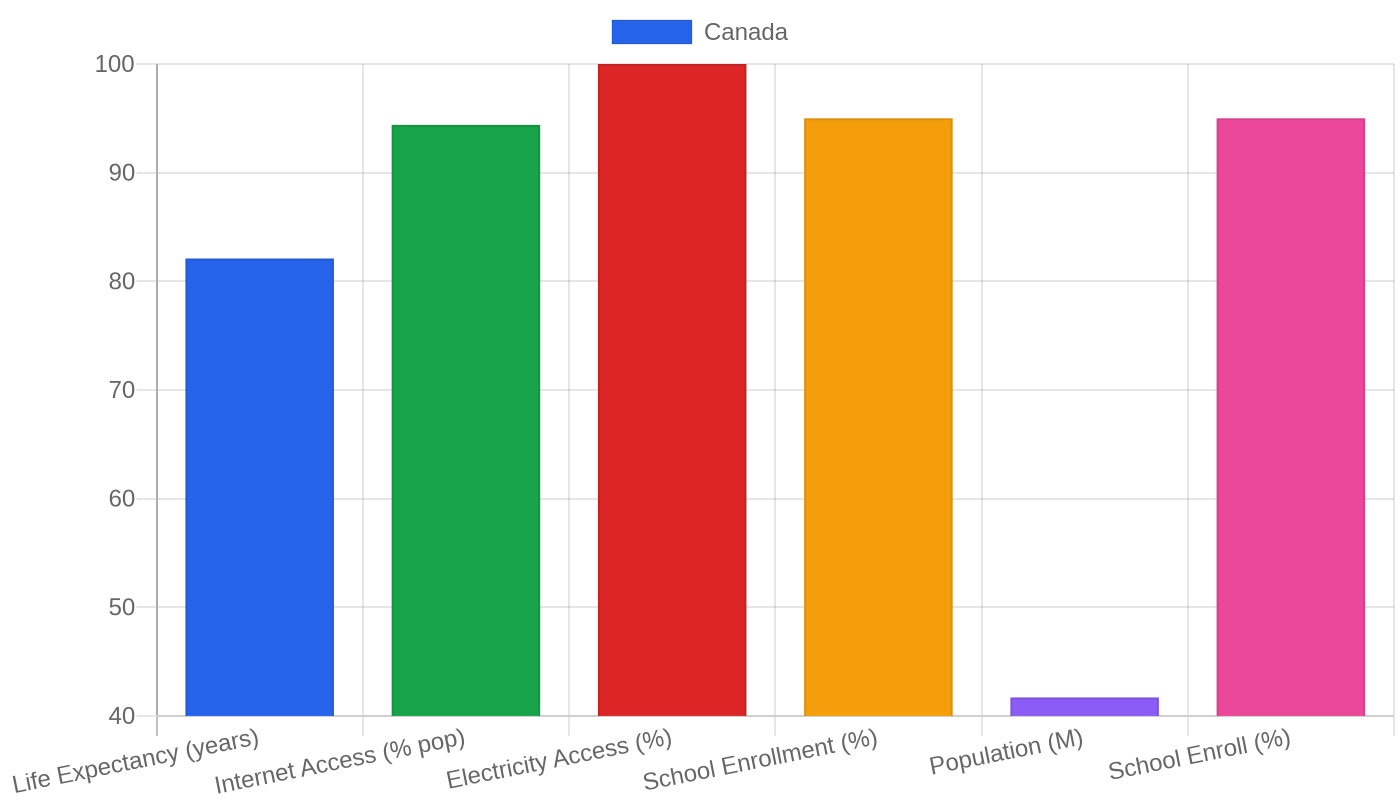
– With a GDP per capita (PPP) of nearly $67,000 and a GNI per capita of $56,420, Canada remains one of the wealthiest nations on earth, though affordability concerns are mounting.
– The political landscape remains stable — a “full democracy” with a tradition of liberalism and social justice — providing a predictable backdrop for investors and citizens alike.
The Slow Burn — Growth, Jobs, and Prices in Canada’s Economy
Canada’s economic engine is humming at a modest pace. According to the World Bank, GDP growth registered 1.74% in 2025 — a figure that tells a story of resilience rather than exuberance. For a developed economy with a population of 41.6 million and a GDP of $2.32 trillion, this is the kind of steady-as-she-goes performance that avoids overheating while maintaining forward momentum.
The number matters because it suggests Canada is neither booming nor busting; it is treading water in a global environment where many peers are struggling to stay afloat.
Inflation, meanwhile, has become a quiet success story. The World Bank data shows CPI inflation at 2.07% — almost precisely at the central bank’s target. This is no small feat. After the post-pandemic price surge that rattled households worldwide, Canada has managed to bring inflation to heel without triggering a severe recession. Consumers are still feeling the pinch in certain categories, but the trajectory is encouraging. The 6.9% unemployment rate, however, is a wrinkle.
It is not crisis-level — many European nations would envy that figure — but it signals a labour market that is cooling. Job seekers are finding longer waits, and employers are becoming more cautious about hiring. This trifecta of modest growth, tame inflation, and elevated unemployment paints a picture of an economy in a careful balancing act.
The Affordability Paradox — Canada’s Cost of Living Conundrum
Canada has long been a land of opportunity, but the cost of turning that opportunity into a comfortable life has become a national obsession. While the World Bank data does not provide specific housing or rental figures, the macroeconomic context is telling. With a GNI per capita of $56,420 and a population that continues to grow, demand for housing — particularly in urban centers like Toronto and Vancouver — far outpaces supply.
The result is a market where homeownership feels increasingly out of reach for younger Canadians, even as interest rates have begun to ease.
Renters face their own challenges. The combination of population growth, constrained construction, and investor-driven demand has pushed rental costs to levels that consume a significant share of household income. Daily expenses — groceries, transportation, utilities — have also risen, though the cooling inflation rate offers some relief.
Compared to other wealthy nations, Canada’s cost of living is high but not anomalous; the trade-off is access to universal healthcare, strong public services, and a quality of life that remains among the best in the world. For newcomers and long-time residents alike, the calculus is increasingly about whether the lifestyle premium justifies the price tag.
The Business Landscape — From Junk Removal to Cyclotrons
Canada’s corporate ecosystem is as diverse as its geography. The list of top companies reads like a cross-section of the nation’s economic DNA. There is 1-800-GOT-JUNK?, the industrials giant that turned trash removal into a household name. There is A&W, the fast-food chain that has become a Canadian icon. And there is Advanced Cyclotron Systems, a healthcare firm operating at the frontier of medical technology.
This mix — spanning industrials, consumer services, manufacturing, telecommunications, and healthcare — reveals an economy that is not overly reliant on any single sector.
The industrials sector is particularly well-represented, with companies like Norda Stelo and 3Way International Logistics anchoring a category that includes everything from engineering to supply chain management. Consumer services are also prominent, with brands like A Buck or Two and Addition Elle catering to domestic demand. What is striking is the absence of a dominant tech or finance sector in this snapshot — Canada’s corporate strength lies in its breadth, not its concentration.
For investors, this diversification offers a buffer against sector-specific shocks. For the country, it means that no single industry failure can derail the entire economy.
Democracy, Decency, and Daily Life — Canada’s Political and Social Fabric
Canada’s political landscape is described as a “full democracy” with a tradition of liberalism and an egalitarian, moderate political ideology. Since the 1960s, social justice has been a distinguishing element of the country’s political culture. This is not idle description — it shapes everything from tax policy to immigration to healthcare. The principles of “peace, order, and good government,” alongside an implied Bill of Rights, form the foundation of Canadian federalism.
For residents, this translates into a society that values stability, inclusivity, and the rule of law.
Crime and safety data is not available in the provided figures, but Canada’s reputation as a safe country is well-established. The political environment is predictable, with peaceful transitions of power and robust institutions. This stability is a competitive advantage in a world where democratic norms are under strain. For businesses, it means regulatory certainty.
For citizens, it means a quality of life that extends beyond economic metrics — access to nature, multicultural cities, and a social safety net that catches those who fall. The happiness indices that consistently rank Canada highly are not just about money; they are about trust, community, and the freedom to live without fear.
The Electric Future — Chinese EVs Eye Quebec
The most immediate story in Canada’s business landscape involves Chinese electric vehicle manufacturers setting their sights on the Quebec market, according to CBC News. This is not a hypothetical — it is happening now. Chinese EV makers, facing trade barriers in other markets and saturated domestic demand, see Quebec as an entry point into North America. The province’s abundant hydroelectric power, generous EV subsidies, and environmental consciousness make it a natural beachhead.
This development carries significant implications. For Canadian consumers, more competition could mean lower prices and greater choice in the EV market. For domestic automakers and suppliers, it represents a challenge that may accelerate innovation or force consolidation. For policymakers, it raises questions about trade policy, supply chain security, and the balance between encouraging green technology and protecting local industry.
The CBC’s business coverage indicates this is a story that will unfold over months and years, not days. It is a reminder that Canada, despite its size, is not insulated from global economic currents — and that the transition to electric mobility is reshaping industries far beyond the factory floor.
The Bottom Line
Canada in 2025-2026 is a study in managed stability. It offers investors a predictable, well-regulated environment with a diversified economy and a skilled workforce. It offers citizens a high standard of living, robust public services, and political continuity. The challenges — housing affordability, a cooling labour market, and the pressures of global competition — are real but manageable.
For anyone watching the global economy, Canada is the quiet anchor — not the flashiest story, but the one that rarely surprises you in the wrong way.
Sources & Methodology
This article is authored by Economic Pulse Net for informational and research purposes. Economic Pulse Net sources its data from multilateral institutions, national statistics bureaus, and proprietary databases. All data is believed to be current as of the date of publication.
Published: July 20, 2026 | Category: Research — Canada
Use these signals in your own platform
Economic Pulse publishes its live signal feed through a documented, read-only API. Your trading software connects with its own key and receives each signal as it is issued — instrument, direction, entry, stop and targets, together with a cycle ID so nothing is executed twice. The feed is independent of this website and cannot change it.
Signals are informational only and are not financial advice.