Economic Pulse Net | Sources: World Bank World Development Indicators, Government Sources | 2026
Key Takeaways
– Belize operates as a parliamentary constitutional monarchy under King Charles III, with governance modeled on the British system and law rooted in English common law — a unique political framework in Central America.
– The economy remains heavily dependent on consumer services and financial sectors, with major players like Belize Bank and Belize Electricity Limited dominating the corporate landscape.
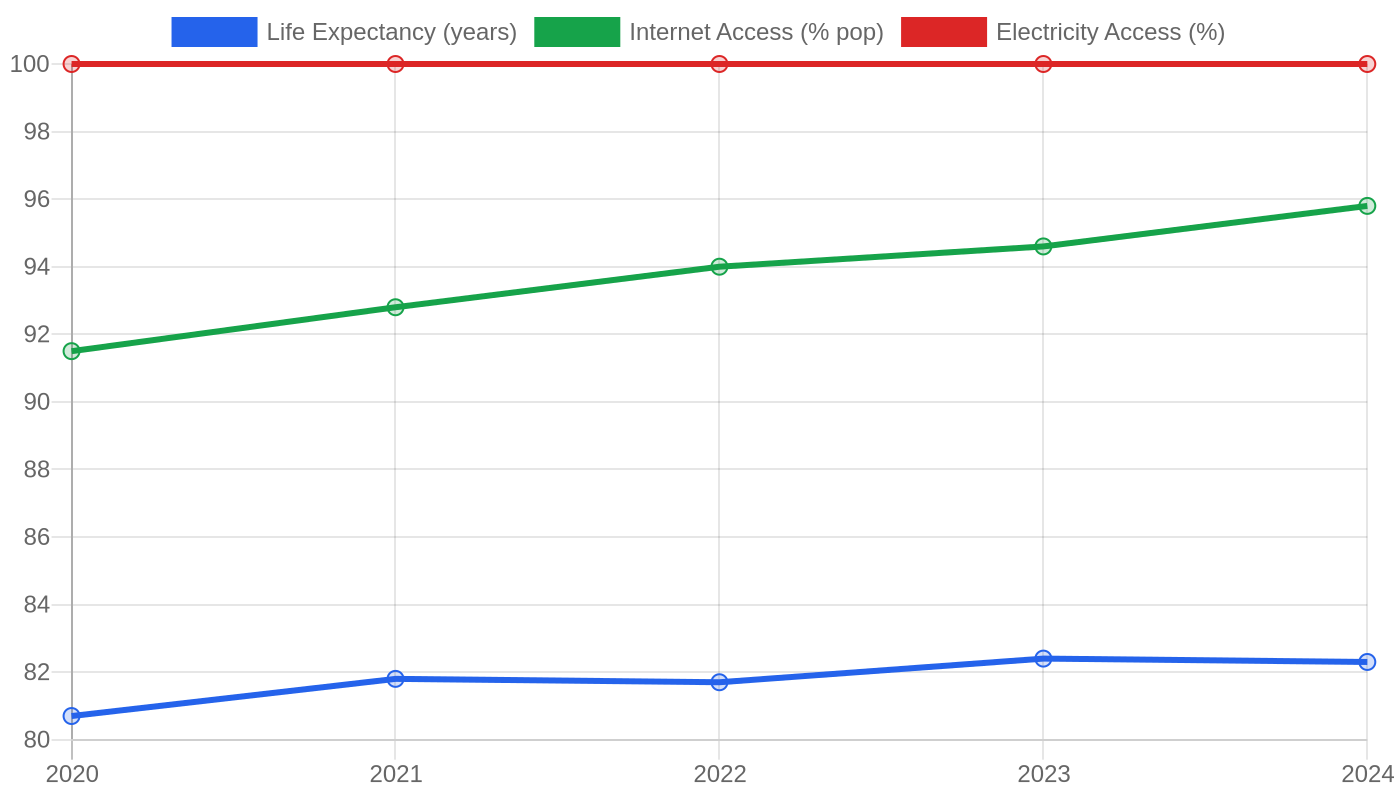
– Despite limited publicly available macroeconomic data from the World Bank, the country’s business environment is shaped by a small but active group of telecommunications, media, and utility companies.
– Political stability is anchored by a Westminster-style system, with executive authority resting in a cabinet led by a prime minister and advised by a governor-general representing the Crown.
– Citizens and investors face a mixed picture: a familiar legal framework and English-speaking population offer advantages, while gaps in economic data make precise assessments of inflation, employment, and growth challenging.
The Economic Landscape — A Quiet Engine in the Caribbean Basin
Belize’s economy, while not extensively documented in the latest World Bank datasets, operates within a framework that blends tourism, agriculture, and a growing services sector. The absence of specific GDP growth, inflation, and unemployment figures from the World Bank should not be mistaken for economic inactivity. Rather, it reflects the challenges of data collection in a small, developing nation where informal economic activity often runs alongside formal channels.
The country’s main industries, though not enumerated in the available data, are widely understood to include tourism, citrus and sugar production, and offshore financial services — sectors that collectively drive employment and foreign exchange earnings.
What the data does reveal is a corporate landscape dominated by consumer services and financial institutions. The presence of the Central Bank of Belize at the top of the country’s company list signals a financial system that is both regulated and centralised, with monetary policy managed domestically rather than outsourced to a regional central bank. This gives Belize a degree of economic sovereignty, but also places the burden of inflation control and currency stability squarely on local institutions.
The Belize Bank, as a major financial player, likely serves as a primary conduit for credit, savings, and investment flows within the economy.
The lack of a GDP per capita figure from the World Bank is a notable gap, but it does not preclude analysis. Belize’s economy is small by global standards, and its growth trajectory is heavily influenced by external factors — hurricane seasons, commodity prices, and tourist arrivals from neighbouring regions.
Without precise numbers, the narrative shifts to structural observation: Belize has a service-oriented economy, a stable currency pegged to a major trading partner’s dollar, and a population that relies on remittances and tourism receipts to supplement domestic production.
The Cost of Living — Balancing Paradise with Practicality
Housing costs in Belize present a study in contrasts. While the available data does not provide specific rental or purchase price indices, anecdotal evidence from regional comparisons suggests that Belize City and tourist hubs like San Pedro and Placencia command premium prices, particularly for waterfront properties and vacation rentals.
The cost of living in Belize is generally considered moderate by Caribbean standards, though imported goods — from electronics to vehicles — carry significant markups due to tariffs and shipping costs.
Daily expenses such as food, utilities, and transportation are shaped by the country’s geography and import dependency. Belize imports a substantial portion of its consumer goods, meaning that global supply chain disruptions and fuel price fluctuations have an outsized impact on household budgets. Electricity costs, managed by Belize Electricity Limited, are a recurring concern for residents, as the country relies on a mix of imported fossil fuels and renewable sources.
Renting is more common than buying in urban areas, particularly among expatriates and temporary workers, while land ownership remains a goal for many Belizean families.
The absence of a formal cost-of-living index from the provided data means that comparisons to regional averages must be drawn cautiously. However, Belize’s status as a English-speaking nation with a familiar legal system makes it attractive to retirees and remote workers from other English-speaking countries, who often find that their incomes stretch further here than in their home nations — even if local wages for Belizeans tell a different story.
Investment and Business Climate — A Small Market with Big Players
Belize’s business environment is defined by its scale. The top companies list reads like a who’s who of a small, interconnected economy: Belize Bank, Belize Electricity Limited, Belize Telemedia Limited, and a cluster of media firms including Amandala, Great Belize Productions, and Krem Radio. These entities dominate not just their respective sectors but the broader economic landscape, creating an environment where a handful of corporations influence everything from interest rates to internet access.
For investors, the telecommunications sector presents both opportunity and challenge. Belize Telemedia Limited holds a commanding position in the market, and while competition exists in media and broadcasting — as evidenced by the presence of Love Belize Television and Great Belize Television — the infrastructure-heavy nature of telecoms means barriers to entry remain high.
The financial sector, anchored by Belize Bank and overseen by the Central Bank of Belize, offers a regulated but accessible entry point for those looking to engage in banking, insurance, or investment services.
The political and legal framework provides a degree of certainty that is not always available in neighbouring Central American nations. Belize’s common law system, inherited from England and adapted to local circumstances, offers familiar protections for property rights and contracts. The cabinet-led executive structure, with a prime minister as head of government, ensures that policy decisions are made through a parliamentary process rather than by executive decree.
For businesses accustomed to Westminster-style governance, this is a significant advantage. However, the small size of the domestic market means that export-oriented industries — particularly agriculture and tourism — remain the most viable paths to significant returns.
Safety, Politics, and Quality of Life — Stability Amidst Complexity
The political landscape of Belize is remarkably stable for a developing nation. As a parliamentary constitutional monarchy with King Charles III as the head of state, the country blends ceremonial tradition with democratic governance. The governor-general represents the Crown in Belize, while the prime minister leads the cabinet and exercises executive authority. This system, modelled directly on the British parliamentary model, has provided continuity and predictability since independence in 1981.
Crime and safety data are not available in the provided datasets, but regional reporting and traveller accounts suggest that Belize faces challenges common to small Caribbean nations: property crime, gang activity in urban areas like Belize City, and occasional violent incidents. The safety index, while not quantified here, is a topic of ongoing discussion among residents and policymakers.
The government’s response to crime has historically included community policing initiatives and legislative measures, though results have been mixed.
Quality of life in Belize is shaped by factors that extend beyond economic metrics. The country’s natural beauty — barrier reefs, rainforests, and Mayan ruins — offers recreational and cultural richness that compensates for some of the material limitations. English is the official language, which facilitates communication for international residents and investors.
Healthcare and education, while not detailed in the data, are areas where public investment is ongoing, with private options available for those who can afford them. The overall picture is one of a nation that offers a high subjective quality of life for those who value environment and community over material abundance.
What’s Happening Now — Belize in the Current Moment
Belize is currently navigating a period of economic recalibration, with the government and private sector working to address long-standing challenges in infrastructure, energy costs, and digital connectivity. The presence of Belize Telemedia Limited and Belize Electricity Limited at the top of the corporate list underscores the centrality of these sectors to the nation’s development agenda.
Recent policy discussions have focused on expanding renewable energy capacity to reduce dependence on imported fuels, a move that would simultaneously lower electricity costs and enhance energy security.
The media landscape, represented by companies like Amandala, Krem Radio, and Great Belize Television, remains vibrant and competitive, reflecting a society that values press freedom and public discourse. This is particularly relevant in a political system where cabinet ministers are members of parliament and accountable to the electorate through regular elections.
The Central Bank of Belize continues to manage monetary policy in a global environment of fluctuating interest rates and currency pressures, though the bank’s specific policy actions are not detailed in the available data.
For the tourism sector, which is not explicitly listed among the main industries but is widely understood to be a cornerstone of the economy, the current focus is on sustainable growth and diversification. Belize has positioned itself as a destination for eco-tourism and adventure travel, attracting visitors who are willing to pay a premium for unique experiences.
However, the sector remains vulnerable to external shocks — from hurricanes to global economic downturns — and the government is exploring ways to build resilience through improved infrastructure and marketing.
The Bottom Line
Belize is a country of quiet resilience and considerable potential, best suited for investors and residents who value stability, natural beauty, and a familiar legal framework over rapid economic growth or large-scale market opportunities. The gaps in World Bank data should not deter serious observers; they simply reflect the reality of a small economy where informal activity and formal institutions coexist.
For those willing to engage with Belize on its own terms — whether through tourism, real estate, or business development — the country offers a unique blend of Caribbean charm and British institutional heritage. Keep an eye on Belize not for explosive growth, but for steady, sustainable progress in a corner of the world that often rewards patience and local knowledge.
Sources & Methodology
This article is authored by Economic Pulse Net for informational and research purposes. Economic Pulse Net sources its data from multilateral institutions, national statistics bureaus, and proprietary databases. All data is believed to be current as of the date of publication.
Published: July 16, 2026 | Category: Research — Belize
Use these signals in your own platform
Economic Pulse publishes its live signal feed through a documented, read-only API. Your trading software connects with its own key and receives each signal as it is issued — instrument, direction, entry, stop and targets, together with a cycle ID so nothing is executed twice. The feed is independent of this website and cannot change it.
Signals are informational only and are not financial advice.