Economic Pulse Net | Sources: World Bank World Development Indicators, Government Sources | 2026
Key Takeaways
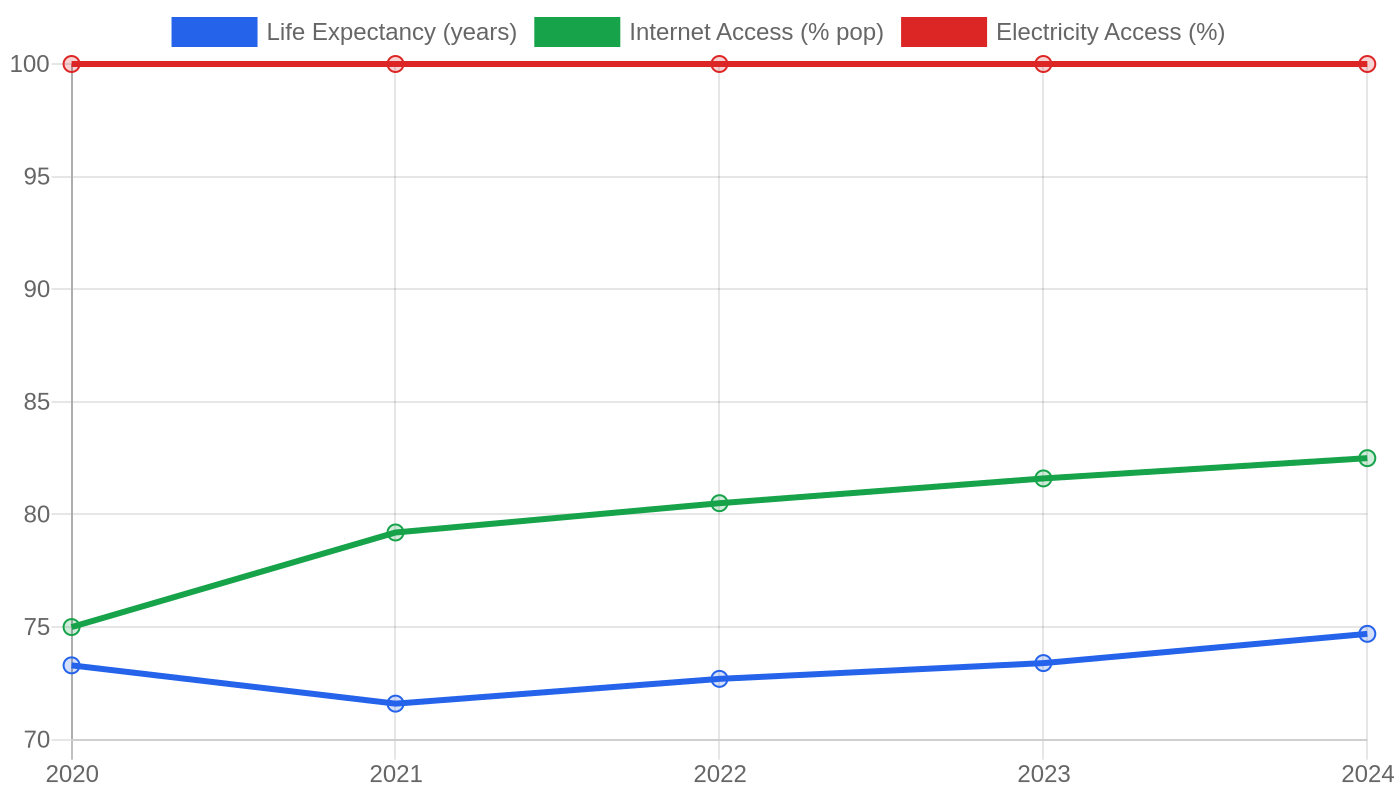
– Ukraine’s economy is operating under extreme wartime conditions, with GDP data unavailable but inflation running at 12.7%, severely eroding household purchasing power according to the World Bank.
– Unemployment stands at nearly 10%, reflecting the massive displacement and disruption caused by the ongoing conflict, though this figure likely understates the true scale of joblessness.
– The country’s GDP of $214 billion masks a deeply fractured economy, with key industrial assets destroyed or occupied, while the services sector shows surprising resilience.
– Ukraine’s GNI per capita of $5,510 places it firmly in lower-middle-income territory, a stark contrast to its GDP per capita PPP of $18,905, highlighting the vast inequality between wartime survival and pre-war potential.
– The political landscape remains stable under a semi-presidential system, but the war has fundamentally reshaped governance, with martial law and emergency powers dominating daily administration.
The War Economy — Survival, Contraction, and the Fight for Stability
Ukraine’s economic data tells a story of a nation under siege, but not broken. The World Bank reports a GDP of $214.2 billion, a figure that reflects the remnants of a pre-war economy now operating at a fraction of its capacity. Inflation is running at 12.7%, a punishing rate for households already struggling with disrupted supply chains, destroyed infrastructure, and mass displacement.
This is not the hyperinflation of the 1990s, but it is corrosive enough to erode savings and make long-term planning nearly impossible for ordinary Ukrainians.
Unemployment stands at 9.8% according to the World Bank, but this number must be read with caution. Millions of Ukrainians have fled abroad, millions more are internally displaced, and many of those still in the workforce are employed in informal or reduced-capacity roles. The true labour market is far more fragile than the headline figure suggests. The industries that once drove Ukraine’s economy — steel, agriculture, heavy machinery — have been hammered by the war.
Azovstal Iron and Steel Works, once a crown jewel of Ukrainian industry, now exists more as a symbol of resistance than a functioning plant. The Antonov aircraft company, famous for the world’s largest plane, has seen its production facilities damaged and its workforce scattered.
Yet the economy has not collapsed. Consumer services companies like ATB-Market and Amstor continue to operate, adapting to wartime logistics and shifting consumer demand. The financial sector, represented by APEKS-BANK and BG Capital, has shown remarkable stability, maintaining deposit confidence and payment systems despite the chaos.
The World Bank data suggests an economy that is surviving on resilience, international aid, and the sheer determination of its people — but survival is not recovery, and the path back to growth remains blocked by the daily reality of war.
The Cost of Living — Surviving on the Frontlines of Inflation
The World Bank’s inflation figure of 12.7% is the single most important number for understanding daily life in Ukraine. Food prices, fuel costs, and housing expenses have all risen sharply, while wages have not kept pace. For a country where the GNI per capita is just $5,510, this inflation rate represents a direct assault on living standards. Families are spending a larger share of their income on basic necessities, with less left over for anything else.
Housing presents a particularly grim picture. Entire cities — Mariupol, Bakhmut, Avdiivka — have been reduced to rubble. In Kyiv, Lviv, and other relatively safe cities, rents have surged as internally displaced people compete for limited housing stock. The concept of buying property is, for most Ukrainians, a distant dream; the war has made long-term mortgages impossible for all but the wealthiest. Utility costs have also risen, with energy infrastructure repeatedly targeted by Russian strikes.
Compared to regional averages in Eastern Europe, Ukraine’s cost of living is lower in absolute terms, but the gap is narrowing as inflation outpaces income growth. The result is a population that is increasingly impoverished, even as the economy shows signs of stubborn survival.
Investment and Business — A High-Risk, High-Stakes Arena
The list of Ukraine’s top companies reads like a roll call of pre-war ambition meeting wartime reality. Aeros, an industrial firm, represents the manufacturing sector’s struggle to retool for wartime needs. The Bogdan group, once a major automotive manufacturer, has shifted to producing military equipment. Antonov, the aerospace giant, now focuses on military transport and drone technology.
These are not normal business pivots — they are survival adaptations in an economy where the state is the primary customer and national defence is the only growth sector.
For foreign investors, Ukraine is a paradox. The risk is extreme: physical destruction, unpredictable regulatory changes, and the constant threat of escalation. Yet the potential rewards are equally enormous. Reconstruction will eventually come, and when it does, the demand for construction materials, infrastructure, and services will be staggering.
The financial sector, led by APEKS-BANK and ASKA Insurance Company, has proven resilient enough to handle wartime operations, suggesting a foundation for post-war recovery. Sectors to watch include defence technology, agricultural processing (Ukraine remains a global breadbasket despite the war), and IT services, where Ukrainian developers continue to work for international clients from bomb shelters and makeshift offices.
The business climate is not favourable by any peacetime measure, but for those with long time horizons and high risk tolerance, Ukraine offers opportunities found nowhere else.
Safety, Politics, and the Quality of Life — Democracy Under Fire
Ukraine operates under a semi-presidential system with separate legislative, executive, and judicial branches, according to the World Bank’s political landscape data. This constitutional framework remains formally in place, but the war has concentrated power in the executive branch. President Volodymyr Zelenskyy and his government operate under martial law, with elections postponed and civil liberties constrained by the demands of national survival.
The judiciary, while independent on paper, faces immense pressure from wartime exigencies.
Crime and safety indices are not available from the data provided, but the reality is clear: the greatest threat to safety in Ukraine is not crime but war. Russian missile strikes, drone attacks, and ground offensives have killed thousands of civilians and displaced millions. In areas far from the front lines, daily life continues with a semblance of normality — cafes open, children attend school in bomb shelters, and people go to work — but the psychological toll is immense.
Quality of life has deteriorated across every measurable dimension: health, education, income, and security. Yet there is a paradox: surveys consistently show that Ukrainians report higher levels of civic pride and social solidarity than before the war. The shared experience of survival has forged a national identity that is stronger than ever, even as the material conditions of life grow harder.
What’s Happening Now — Winter, Attrition, and the Economic Front
As of early 2026, Ukraine is entering its third full year of full-scale war, and the economic front is as critical as the military one. The 12.7% inflation rate reported by the World Bank is a lagging indicator; current conditions suggest that price pressures remain intense, particularly for energy and food. The winter of 2025-2026 has been brutal, with Russia intensifying strikes on Ukraine’s power grid.
Rolling blackouts have become a fact of life, forcing businesses to invest in generators and households to prepare for weeks without electricity. This is not a temporary crisis — it is the new normal.
The government continues to rely heavily on international financial support, with the European Union, the International Monetary Fund, and bilateral partners providing billions in budget support. These funds keep the state functioning, paying pensions and salaries, and financing the military. But they also create a dependency that will be difficult to unwind.
On the positive side, Ukraine’s agricultural sector has shown remarkable adaptability, finding new export routes through the Black Sea corridor despite Russian threats. The IT sector continues to generate hard currency revenue, and the defence industry is scaling up production of drones, missiles, and armoured vehicles. The economy is not growing, but it is not collapsing either — it is holding on, waiting for the moment when peace allows reconstruction to begin.
The Bottom Line
Ukraine is a country for investors and observers with long time horizons and a clear understanding of risk. The immediate economic picture is grim: high inflation, high unemployment, destroyed infrastructure, and a population under constant threat. But beneath the surface, there is a story of extraordinary resilience: a functioning banking system, a dynamic IT sector, a world-class agricultural base, and a population united by a fierce desire to rebuild.
For those willing to look past the war headlines, Ukraine represents one of the most significant reconstruction opportunities in modern history. The question is not whether Ukraine will recover, but when — and who will be there to help when that moment comes.
Sources & Methodology
This article is authored by Economic Pulse Net for informational and research purposes. Economic Pulse Net sources its data from multilateral institutions, national statistics bureaus, and proprietary databases. All data is believed to be current as of the date of publication.
Published: July 28, 2026 | Category: Research — Ukraine
Use these signals in your own platform
Economic Pulse publishes its live signal feed through a documented, read-only API. Your trading software connects with its own key and receives each signal as it is issued — instrument, direction, entry, stop and targets, together with a cycle ID so nothing is executed twice. The feed is independent of this website and cannot change it.
Signals are informational only and are not financial advice.