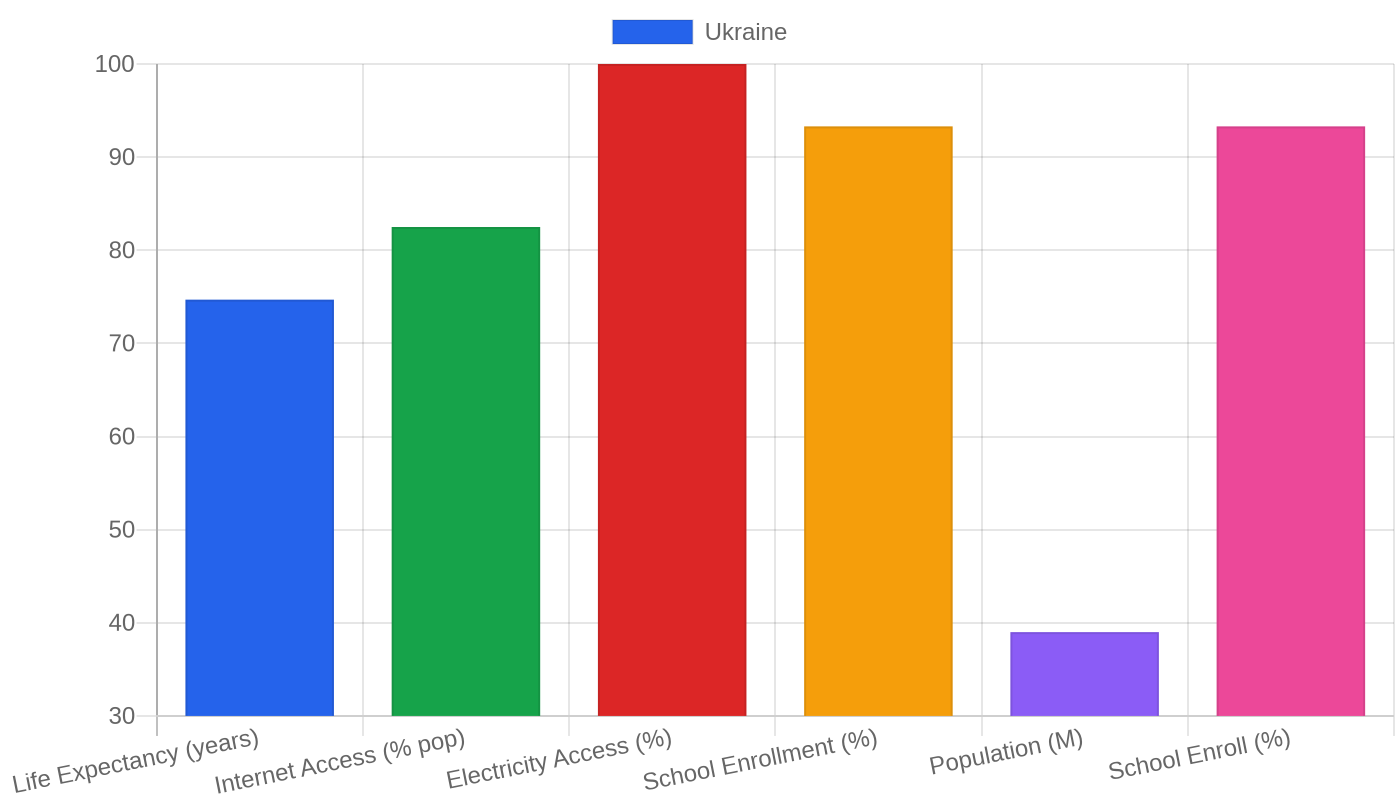
Economic Pulse Net | Sources: World Bank World Development Indicators, Government Sources | 2026
Key Takeaways
– Ukraine’s economy is showing modest but meaningful recovery, with World Bank data recording GDP growth of 1.82% in 2025 — a fragile but positive signal after years of war-induced contraction.
– Unemployment remains elevated at nearly 10%, reflecting the deep scars on the labour market from displacement and infrastructure destruction.
– The industrial backbone is still intact, with major firms like Antonov, Azovstal, and ATB-Market continuing operations despite extraordinary circumstances.
– Ukraine’s GNI per capita sits at $5,510, placing it firmly in lower-middle-income territory, with significant regional disparities between the war-affected east and the relatively calmer west.
– The political system, a semi-presidential republic with separate legislative, executive, and judicial branches, continues to function under martial law, providing a degree of institutional continuity.
The Long Climb Back — GDP, Jobs, and the Shape of Recovery
When the World Bank reported Ukraine’s 2025 GDP growth at 1.82%, the number barely registered on global radar screens. But context is everything. This is an economy that has been pummelled by full-scale war, lost swathes of industrial capacity, and seen millions of its citizens flee abroad. That it is growing at all — even modestly — is a testament to the underlying resilience of its people and businesses.
The total GDP stands at approximately $214 billion, a figure that, on a per capita purchasing power parity basis, reaches $18,905. That places Ukraine well below its European neighbours but above many lower-income economies. The gap between GDP per capita (PPP) and GNI per capita — which is just $5,510 — is stark. It suggests that a significant portion of economic output is being generated by foreign-owned capital or reinvested profits rather than flowing directly into household incomes.
For ordinary Ukrainians, the recovery has yet to translate into meaningful wage gains.
Unemployment at 9.83% tells a similarly complicated story. That rate is high by European standards but lower than many feared during the darkest days of the war. It reflects a labour market that has partially stabilised, with many workers shifting from heavy industry into services, logistics, and reconstruction-related jobs. Yet the figure almost certainly understates the true picture, as millions of working-age Ukrainians remain abroad, and many who stayed are underemployed or working informally.
The industrial landscape remains dominated by a mix of Soviet-era giants and newer private-sector champions. Aeros and Antonov in the industrials sector represent Ukraine’s enduring aerospace and engineering capabilities. Azovstal Iron and Steel Works, despite its symbolic destruction early in the war, remains listed among the top companies — a reminder that Ukraine’s steel industry, while battered, is not entirely broken.
The consumer sector is anchored by ATB-Market and Amstor, supermarket chains that have kept the domestic economy moving even as supply chains have been repeatedly disrupted. The financial sector, represented by APEKS-BANK and ASKA Insurance, continues to function, providing a crucial lifeline for businesses and households navigating extreme uncertainty.
Living Through the Crisis — Housing, Daily Costs, and the Price of Survival
Cost of living data for Ukraine is fragmented, but the broad picture is clear: this is a country where basic survival has become more expensive, even as the economy shows technical growth. The war has destroyed hundreds of thousands of homes, displaced millions, and sent rental prices soaring in relatively safer western cities like Lviv, Uzhhorod, and Chernivtsi. In Kyiv, rents have stabilised but remain well above pre-war levels, driven by the return of some businesses and international workers.
For the average Ukrainian earning a GNI per capita of $5,510, housing consumes a disproportionate share of income. Buying property is out of reach for most, with mortgage financing virtually unavailable due to war risk. Renting has become the default, but even that is a struggle in cities that have absorbed internally displaced populations. Daily expenses — food, utilities, transport — have all risen, though inflation data is not currently available from the World Bank to quantify the exact pressure.
Compared to regional peers in Eastern Europe, Ukraine’s cost of living remains lower in absolute terms, but the gap has narrowed. The war has effectively imported inflation through disrupted supply chains, higher energy costs, and the depreciation of the hryvnia. For a population that was already struggling before 2022, the squeeze is real. The resilience of the consumer goods sector — with companies like ATB-Market and Amstor still operating — suggests that domestic demand, while battered, has not collapsed.
Where the Money Is — Investment Climate and Corporate Power
For investors willing to stomach the risk, Ukraine offers a paradoxical opportunity. The country’s top companies span industrials, basic materials, financials, and consumer services — a diversified base that suggests post-war reconstruction will not be a one-sector story. Antonov, the aircraft manufacturer, remains a globally recognised brand. Bogdan group, another industrial heavyweight, has pivoted partly to defence production.
Azovstal, despite the destruction of its Mariupol plant, still holds value in its brand, land, and potential for future redevelopment.
The financial sector is surprisingly robust. APEKS-BANK and BG Capital continue to operate, providing corporate lending and investment services. ASKA Insurance remains active, a sign that the insurance market, while severely constrained, has not shut down. These institutions are critical for any future reconstruction effort — they will be the channels through which capital flows into rebuilding housing, infrastructure, and industry.
The business environment, however, remains extraordinarily difficult. War risk insurance is prohibitively expensive or unavailable. Labour shortages are acute in skilled trades. Logistics are disrupted by damaged ports, closed airspace, and the constant threat of attack. Yet the fact that these companies continue to operate — and that new ones have not simply folded — speaks to a deep well of entrepreneurial resilience.
For foreign investors, the opportunity lies in reconstruction: rebuilding roads, bridges, power grids, and housing will require billions of dollars and years of work. The companies that position themselves now, even at high risk, could reap outsized returns in the medium term.
A Nation Under Pressure — Safety, Politics, and Daily Life
Ukraine operates under a semi-presidential political system, with separate legislative, executive, and judicial branches. That structure, established in the post-Soviet constitution, has proven resilient even under martial law. The government continues to function, elections are constitutionally mandated but postponed due to the war, and civil society remains active.
The political landscape is dominated by the imperative of national survival, which has temporarily muted the intense partisan rivalries that characterised pre-war Ukrainian politics.
Crime and safety indices are not available from the data provided, but the reality on the ground is shaped overwhelmingly by the war. In frontline and recently liberated areas, the threat of shelling, mines, and drones is constant. In western and central regions, daily life has returned to a relative semblance of normality, though air raid alarms are a regular occurrence.
Violent crime rates have fluctuated, with some reports of increased domestic violence and black-market activity, but also of strong community solidarity.
Quality of life is deeply unequal. For those in secure jobs in Kyiv or Lviv, life is difficult but manageable. For the displaced, the elderly, and those in damaged cities, it is a daily struggle for basics. The Ukrainian spirit — defiant, resourceful, darkly humorous — remains the country’s most valuable intangible asset. It is what keeps businesses running, volunteers delivering aid, and soldiers fighting.
That social capital, while not measured in any World Bank statistic, is arguably Ukraine’s strongest economic advantage.
The Now — What’s Moving in Ukraine’s Economy Today
As of early 2026, Ukraine’s economy is in a delicate balancing act. The 1.82% GDP growth recorded by the World Bank for 2025 is real, but it is fragile. Reconstruction spending — funded by international partners and domestic tax revenues — has begun to trickle into infrastructure projects. Roads around Kyiv and in western regions are being repaired. Power grid restoration is ongoing, though the threat of renewed attacks on energy infrastructure remains the single biggest economic risk.
The labour market is tightening in unexpected ways. Many Ukrainians who fled abroad have not returned, creating shortages in construction, healthcare, and manufacturing. This is pushing up wages in some sectors, but it also constrains the speed of reconstruction. The government has launched programmes to encourage returns, but security concerns and better opportunities in Europe remain powerful counterweights.
On the corporate front, Ukraine’s top companies are adapting. Antonov has secured contracts for drone technology and cargo aircraft. ATB-Market has expanded its logistics network to serve areas previously cut off by fighting. The banking sector, led by APEKS-BANK, has maintained stability despite the war, with deposit insurance and digital banking keeping the financial system functioning.
The political system, meanwhile, is preparing for the eventual return to electoral politics. Discussions about post-war elections are underway, though no date has been set. The government continues to pursue European Union accession talks, a process that, while distant, provides a powerful reform incentive. For now, the immediate priority is survival — of the state, the economy, and the people.
But beneath the surface, the foundations for a longer-term recovery are being laid, brick by brick, deal by deal, day by day.
The Bottom Line
Ukraine in 2026 is not a country for the faint-hearted investor or the casual observer. It is a high-risk, high-stakes environment where economic data tells only part of the story. The 1.82% growth rate, the 9.83% unemployment, the $5,510 GNI per capita — these numbers mask a society that is fighting, working, and rebuilding under extraordinary conditions.
For those with long-term horizons, reconstruction capital to deploy, and a tolerance for volatility, Ukraine offers one of the most asymmetric opportunities in the world today. For everyone else, it remains a country to watch — not just for its resilience, but for what it reveals about the human capacity to endure and rebuild.
Sources & Methodology
This article is authored by Economic Pulse Net for informational and research purposes. Economic Pulse Net sources its data from multilateral institutions, national statistics bureaus, and proprietary databases. All data is believed to be current as of the date of publication.
Published: July 22, 2026 | Category: Research — Ukraine
Use these signals in your own platform
Economic Pulse publishes its live signal feed through a documented, read-only API. Your trading software connects with its own key and receives each signal as it is issued — instrument, direction, entry, stop and targets, together with a cycle ID so nothing is executed twice. The feed is independent of this website and cannot change it.
Signals are informational only and are not financial advice.