Economic Pulse Net | Sources: World Bank World Development Indicators, Government Sources | 2026
Key Takeaways
– Turkey operates under a presidential system that international observers describe as competitive authoritarian, with judicial capture and suppression of opposition shaping the business environment
– The economy relies on major industrial conglomerates and a growing consumer goods sector, though inflation and unemployment data gaps obscure the full picture
– Top companies span financials, industrials, and consumer goods, with giants like Akbank, Arçelik, and defence contractor Aselsan dominating the corporate landscape
– Political instability and repression of dissent create a complex risk profile for investors, even as Turkey’s strategic position and industrial base offer opportunities
– The lack of current World Bank economic data makes independent assessment difficult, but the country’s trajectory remains a critical watchpoint for emerging market observers
The Economy of Controlled Chaos
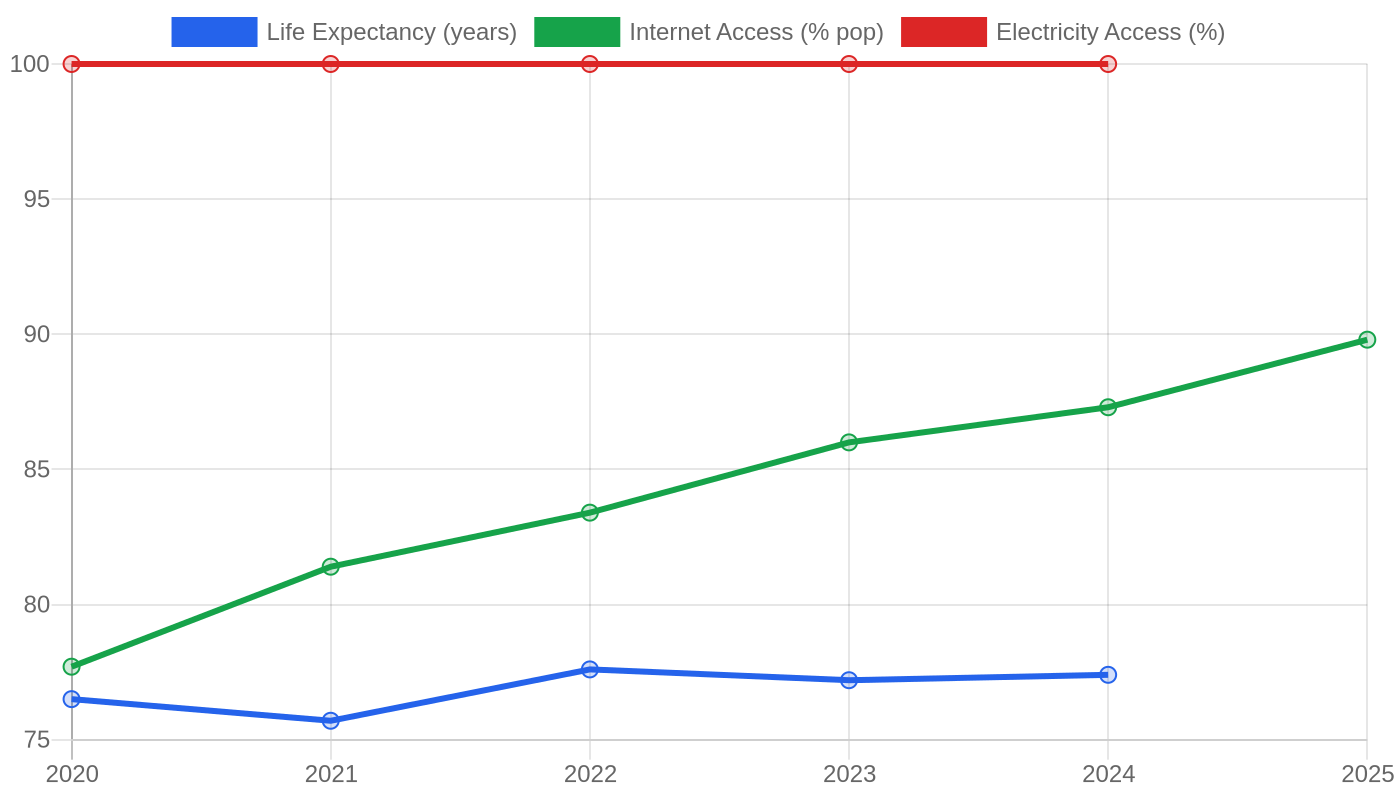
Turkey’s economic story is one of ambition colliding with structural fragility. The World Bank’s latest data set provides no GDP growth figure, no inflation rate, and no unemployment number — a silence that speaks volumes about the opacity surrounding the country’s economic management. Without these baseline indicators, analysts are forced to rely on fragmented corporate signals and political context to gauge the nation’s financial health.
What is clear from the available data is Turkey’s industrial backbone. The country’s top companies span a diverse range of sectors, from Akbank in financials to Arçelik in consumer goods, and from Aselsan in industrials to Aksa in basic materials. This industrial spread suggests an economy that has moved beyond simple manufacturing into more sophisticated value chains.
Arçelik, for instance, is a major home appliance manufacturer that competes globally, while Aselsan produces advanced defence electronics — a sector that benefits from Turkey’s assertive regional posture.
Yet the absence of core economic data from the World Bank is itself a story. It raises questions about transparency, data collection standards, and whether the government is willing to publish numbers that might paint an uncomfortable picture. In competitive authoritarian systems, economic data can become a political tool — released selectively to suit narratives, or withheld when the numbers are damaging. For investors and analysts, this data vacuum creates uncertainty that demands a premium on risk assessment.
The unemployment rate, left blank in the data set, is particularly telling. Turkey has historically struggled with youth unemployment and informal labour markets. Without official figures, one must look to corporate hiring patterns and anecdotal evidence from the country’s major industrial players.
The presence of companies like Anadolu Isuzu in commercial vehicles and Alarko Holding in industrials suggests ongoing production, but whether this translates into broad-based employment gains remains an open question.
Inflation, too, is a ghost in the data. Turkey has experienced severe currency depreciation and price pressures in recent years, but the World Bank provides no CPI figure. This gap is especially significant given that inflation erodes real wages, savings, and consumer purchasing power — all of which directly affect the performance of the consumer goods companies that dominate Turkey’s corporate landscape.
Without inflation data, it is impossible to assess whether companies like Assan and Arkem are growing in real terms or merely riding nominal price increases.
The Cost of Living in Erdoğan’s Turkey
Housing and daily expenses in Turkey reflect the broader tensions between economic ambition and political control. While the World Bank data set provides no specific cost of living figures, the structure of Turkey’s economy — dominated by large industrial conglomerates and a significant consumer goods sector — suggests a country where urban centres like Istanbul, Ankara, and Izmir command premium prices while rural areas remain more affordable.
The presence of consumer goods giants like Arçelik, Assan, and Anadolu Isuzu indicates a domestic market with substantial purchasing power, at least among the middle and upper classes. These companies produce everything from refrigerators to commercial vehicles, targeting Turkish consumers who have disposable income. Yet the cost of this consumption must be weighed against the backdrop of currency volatility and the political risks that deter foreign investment and suppress long-term economic stability.
Rent versus buy decisions in Turkey are complicated by the country’s political landscape. Property rights are generally respected, but the Erdoğan government’s judicial capture and repression of opposition create an environment where legal recourse can be unpredictable. For ordinary Turks, housing costs in major cities have risen sharply in recent years, driven by population growth, urbanisation, and inflation that official statistics may understate.
The lack of reliable CPI data makes it impossible to quantify these pressures precisely, but anecdotal evidence from corporate earnings reports and consumer spending patterns suggests a squeeze on household budgets.
Investment and Business — Playing by Unwritten Rules
Turkey’s corporate landscape offers a window into the country’s economic potential and its political constraints. The list of top companies reads like a who’s who of Turkish capitalism: Akbank in financials, Arçelik in consumer goods, Aselsan in defence, and Aksa in basic materials. These are not fly-by-night operations but established players with regional and global reach.
Akbank, for example, is one of Turkey’s largest banks, while Aselsan supplies electronic systems to the Turkish military and export customers.
The diversity of sectors — financials, basic materials, industrials, consumer goods, telecommunications — suggests an economy with multiple growth engines. Avea, the telecommunications company, represents Turkey’s digital economy, while Alarko Holding spans construction, energy, and tourism. This breadth is a strength, allowing the economy to absorb shocks in any single sector. However, it also means that political interference or policy missteps can ripple across multiple industries simultaneously.
For investors, the business climate in Turkey is defined by the tension between opportunity and risk. The country’s strategic location at the crossroads of Europe, Asia, and the Middle East offers trade advantages that few emerging markets can match. Its industrial base, particularly in defence, automotive components, and consumer goods, provides a foundation for export-led growth.
Yet the political landscape — described by sources as a competitive authoritarian system with judicial capture and repression of protest — creates a risk premium that can deter long-term capital.
The imprisonment of opposition politicians and dissidents, as noted in the political data, sends a clear signal to international investors about the rule of law. When the government can jail business rivals or political opponents on questionable grounds, the security of contracts and property rights becomes uncertain. This is not a theoretical concern; it directly affects the cost of capital and the willingness of foreign firms to establish or expand operations in Turkey.
Safety, Politics, and the Quality of Life Paradox
Turkey presents a paradox for those assessing quality of life. The country offers rich cultural heritage, diverse geography, and a relatively developed infrastructure in major cities. Yet the political landscape — defined by the 1982 constitution, Erdoğan’s judicial capture, and the repression of opposition — creates an environment where personal freedoms are constrained and political risk is ever-present.
The data set provides no crime or safety indices, leaving a gap in the quality of life assessment. However, the political context offers clues. When a government imprisons opposition politicians and suppresses protest movements, it signals a state willing to use coercive power against its citizens. This does not necessarily mean high street crime — indeed, authoritarian systems often maintain public order through heavy policing — but it does mean that political expression carries significant risk.
For ordinary Turks, daily life involves navigating this tension. The country’s major companies continue to operate, jobs exist in industrial sectors, and consumer goods are available. But the shadow of political repression falls across every aspect of society, from the media to the courts to the business environment. The constitution approved by referendum in 1982 sets out the state’s responsibility to its citizens, but the gap between constitutional ideals and political reality is vast.
What’s Happening Now — The Authoritarian Pivot
Turkey is currently living through a period of political consolidation and economic uncertainty. The Erdoğan government, having secured its grip on the judiciary and suppressed opposition movements, is now focused on managing the economic consequences of its policies. The lack of current World Bank data suggests either a data collection lag or a deliberate opacity that makes independent economic assessment difficult.
The corporate sector continues to operate, with companies like Aselsan benefiting from defence spending and Arçelik maintaining its position in consumer goods. However, the political environment creates headwinds. International investors are watching closely, weighing Turkey’s strategic importance against its governance risks.
The imprisonment of dissidents and opposition figures sends a chilling signal that extends beyond politics into the business community, where executives must calculate whether their operations could become targets of state action.
The telecommunications sector, represented by Avea, faces its own challenges in an environment where media freedom is restricted and digital surveillance is a tool of state control. For companies operating in Turkey, the line between legitimate business and political entanglement has become increasingly blurred.
This is the reality of doing business in a competitive authoritarian system: success depends not only on market factors but on navigating the whims of a government that views economic power as an extension of political control.
The Bottom Line
Turkey is a country that demands attention from anyone tracking emerging markets, geopolitical risk, or the intersection of business and authoritarian governance. Its industrial base and strategic location offer genuine economic potential, but that potential is constrained by a political system that prioritises control over transparency and repression over rule of law.
Investors and analysts should watch Turkey for what it reveals about the future of competitive authoritarianism in the global economy — a model that offers short-term stability at the cost of long-term institutional health. For those willing to accept the risks, the rewards can be substantial, but the price of miscalculation is high.
Sources & Methodology
This article is authored by Economic Pulse Net for informational and research purposes. Economic Pulse Net sources its data from multilateral institutions, national statistics bureaus, and proprietary databases. All data is believed to be current as of the date of publication.
Published: July 23, 2026 | Category: Research — Turkey
Use these signals in your own platform
Economic Pulse publishes its live signal feed through a documented, read-only API. Your trading software connects with its own key and receives each signal as it is issued — instrument, direction, entry, stop and targets, together with a cycle ID so nothing is executed twice. The feed is independent of this website and cannot change it.
Signals are informational only and are not financial advice.