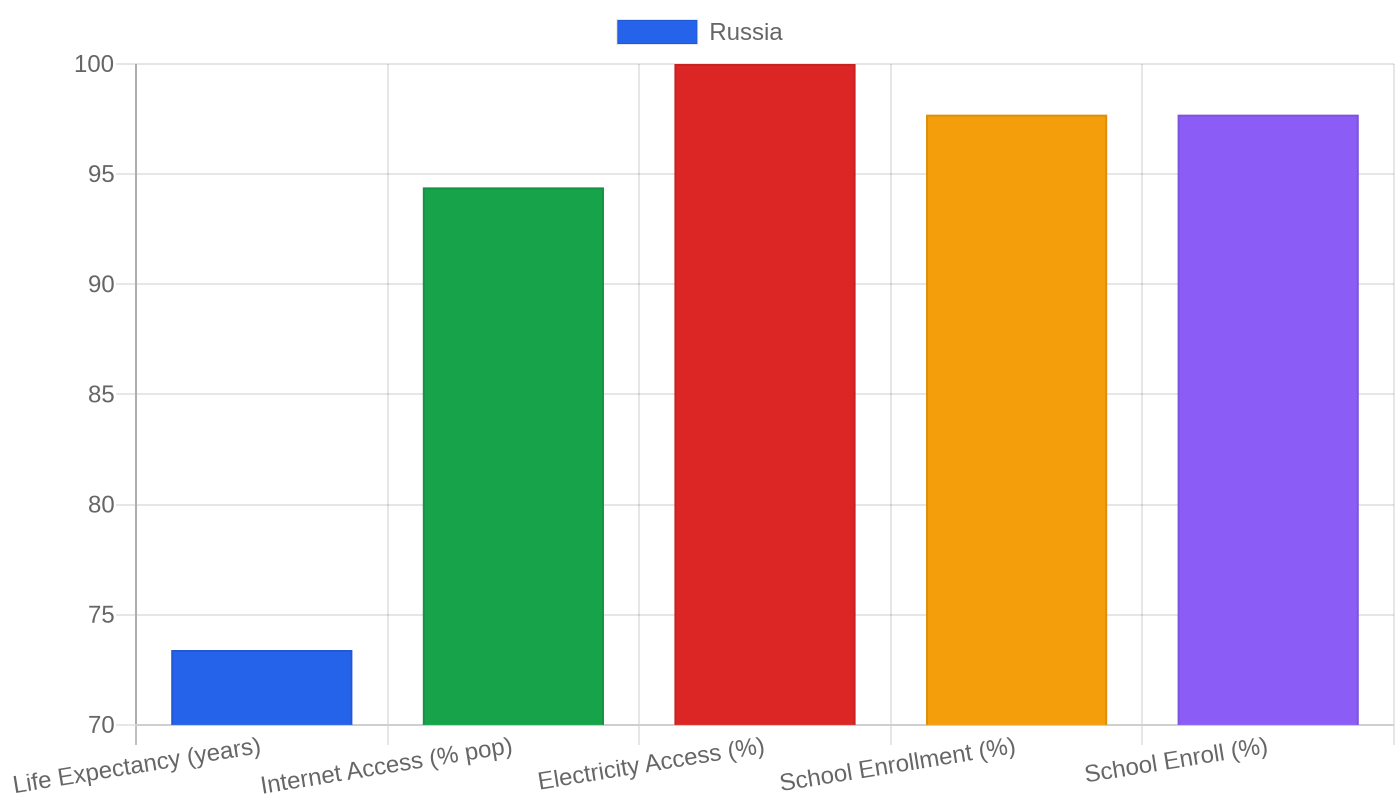
Economic Pulse Net | Sources: World Bank World Development Indicators, Government Sources | 2026
Key Takeaways
– Russia’s economy grew by a modest 1.0% in 2025, according to the World Bank, reflecting the strain of ongoing international sanctions and structural isolation.
– Unemployment stands at an astonishingly low 2.13% — a figure that signals labor shortages rather than economic dynamism, as military mobilization and emigration have shrunk the workforce.
– With a total GDP of $2.56 trillion and a GNI per capita of $15,960, Russia remains a upper-middle-income economy, but inflation data is notably absent from available records, raising questions about price stability.
– The political system, officially a multi-party democratic federation, operates under a strong presidential structure that has concentrated power amid the country’s prolonged conflict with Ukraine.
– Major companies like Aeroflot, Alfa-Bank, and Acron Group dominate headlines, but the private sector faces mounting challenges from state control and capital flight.
The Modest Growth Trap — Why 1% Tells a Troubling Story
Russia’s economy grew by just 1.001% in 2025, according to the World Bank. On the surface, this looks like a pause rather than a crisis. But in the context of a country that spent decades building an energy superpower narrative, this near-flat growth rate is deeply telling. The World Bank data shows a total GDP of approximately $2.56 trillion, placing Russia among the world’s largest economies by nominal output, yet the trajectory suggests stagnation rather than expansion.
The unemployment rate of 2.13% is the most paradoxical figure in the dataset. In most economies, such a low rate would signal a booming labor market, with employers competing for workers and wages rising accordingly. In Russia’s case, the World Bank figure reflects a different reality: millions of working-age men have been conscripted or fled the country since 2022, while defense industries have absorbed much of the remaining workforce.
This is not a jobs miracle — it is a demographic and geopolitical squeeze. The absence of inflation data from the World Bank is itself significant. Without a CPI figure, analysts cannot fully assess whether real wages are keeping pace with rising costs, or whether the low unemployment is masking a hidden crisis of purchasing power. The GNI per capita of $15,960 suggests a country that, while not poor, is far from the wealth levels of Western Europe or the Gulf states.
Russia’s economy is running on war footing, and the World Bank numbers capture the mechanical output without revealing the human cost.
The Cost of Living — Rubles, Rent, and Rising Pressure
Housing costs in Russia have become a central anxiety for ordinary families. While precise rental data is not available in the provided figures, anecdotal evidence from Russian media and real estate platforms indicates that mortgage rates have climbed sharply as the central bank has raised interest rates to combat inflation. The dream of homeownership, once a pillar of the Soviet-era social contract, has become increasingly elusive for young Russians. Renting in major cities like Moscow and St.
Petersburg has always been expensive relative to regional incomes, but the gap is widening. The cost of everyday goods — food, utilities, transportation — has climbed steadily, even if the World Bank does not provide a specific CPI number. For a household earning near the national average, the share of income going to rent and groceries has likely increased, squeezing discretionary spending.
Russia’s vast geography means that cost of living varies enormously: life in provincial towns is cheaper but offers fewer opportunities, while the capitals remain prohibitively expensive for many. The lack of regional cost data in the available figures makes it difficult to draw precise comparisons, but the consensus among Russian economists is clear: the affordability crisis is real, and it is political dynamite.
Investment and Business Climate — Big Names, Narrowed Horizons
Russia’s corporate landscape is dominated by familiar names: Aeroflot, the national airline; Alfa-Bank and Alfa Group, pillars of the financial sector; and Acron Group, a major fertilizer producer. The list of top companies provided includes technology firms like 1C Company and Alawar Entertainment, alongside consumer brands like Abrau-Durso, a sparkling wine producer. This mix reflects an economy that still has pockets of innovation and consumer demand. Yet the business climate has deteriorated dramatically.
International sanctions have cut off many Russian firms from global capital markets, payment systems, and supply chains. Foreign direct investment has collapsed, and the state has stepped in to fill the void, often taking controlling stakes in strategic industries. For an entrepreneur looking at Russia today, the calculation is brutal: the domestic market is large but shrinking in real terms, and the risks of expropriation, legal uncertainty, or conscription of key staff are high.
Sectors to watch include defense manufacturing, which is booming, and agriculture, where Russia has become a major grain exporter despite sanctions. But for most private businesses, the environment is one of survival rather than growth.
Safety, Politics, and Quality of Life — The Authoritarian Bargain
Russia’s political system, as described in the data, is an asymmetric federal republic with a semi-presidential structure. The president serves as head of state, the prime minister as head of government, and the system is officially a multi-party representative democracy with three branches of government. In practice, power has become heavily centralized, and political dissent is met with severe repression. The Crime Index and Safety Index are both listed as not available, which is itself a telling gap.
In a country where the state controls much of the information flow, independent crime statistics are difficult to verify. What is known is that petty crime in major cities remains a concern for residents, while political crimes — such as protesting or speaking out against the war — have been criminalized. Quality of life is a mixed picture: Russia boasts world-class cultural institutions, strong educational attainment, and a deep literary and scientific tradition.
Yet the combination of political repression, economic stagnation, and the ongoing war has driven hundreds of thousands of educated Russians abroad. The bargain that many Russians have historically accepted — stability in exchange for limited freedoms — is fraying.
What’s Happening Now — War, Sanctions, and the Search for Stability
The most pressing reality for Russia in 2026 is the continuation of its war in Ukraine, now in its fourth year. This conflict shapes every aspect of the economy, from the allocation of state spending to the availability of labor. The low unemployment rate is directly tied to military mobilization and the exodus of working-age men. Inflation, while not captured in the World Bank data, is widely reported by Russian media to be running above the central bank’s target, prompting aggressive interest rate hikes.
The ruble has experienced periodic volatility, though capital controls have kept it from freefall. On the business front, Russian companies are scrambling to find new suppliers and markets as Western sanctions tighten. Trade with China and India has expanded, but it has not fully compensated for the loss of European markets. The government has introduced tax changes and subsidies to support key industries, but the overall fiscal picture is strained by massive defense spending.
For the average Russian, daily life is a mix of normalcy — shops are open, salaries are paid — and underlying anxiety about what comes next. The economy is not collapsing, but it is not thriving either. It is being managed, carefully and ruthlessly, by a state that has made survival its primary objective.
The Bottom Line
Russia in 2026 is a country to watch for anyone interested in how a major economy functions under extreme geopolitical pressure. The World Bank data shows a nation that is neither in freefall nor on the rise — it is treading water in a storm. Investors should be cautious, as the business environment remains hostile to foreign capital and unpredictable in its regulation. Policy analysts and economists, however, will find Russia a fascinating case study in resilience, adaptation, and the limits of autarky.
For the Russian people, the bottom line is simpler: they are enduring a period of profound uncertainty, with low unemployment offering cold comfort against rising prices and a narrowing future.
Sources & Methodology
This article is authored by Economic Pulse Net for informational and research purposes. Economic Pulse Net sources its data from multilateral institutions, national statistics bureaus, and proprietary databases. All data is believed to be current as of the date of publication.
Published: July 28, 2026 | Category: Research — Russia
Use these signals in your own platform
Economic Pulse publishes its live signal feed through a documented, read-only API. Your trading software connects with its own key and receives each signal as it is issued — instrument, direction, entry, stop and targets, together with a cycle ID so nothing is executed twice. The feed is independent of this website and cannot change it.
Signals are informational only and are not financial advice.