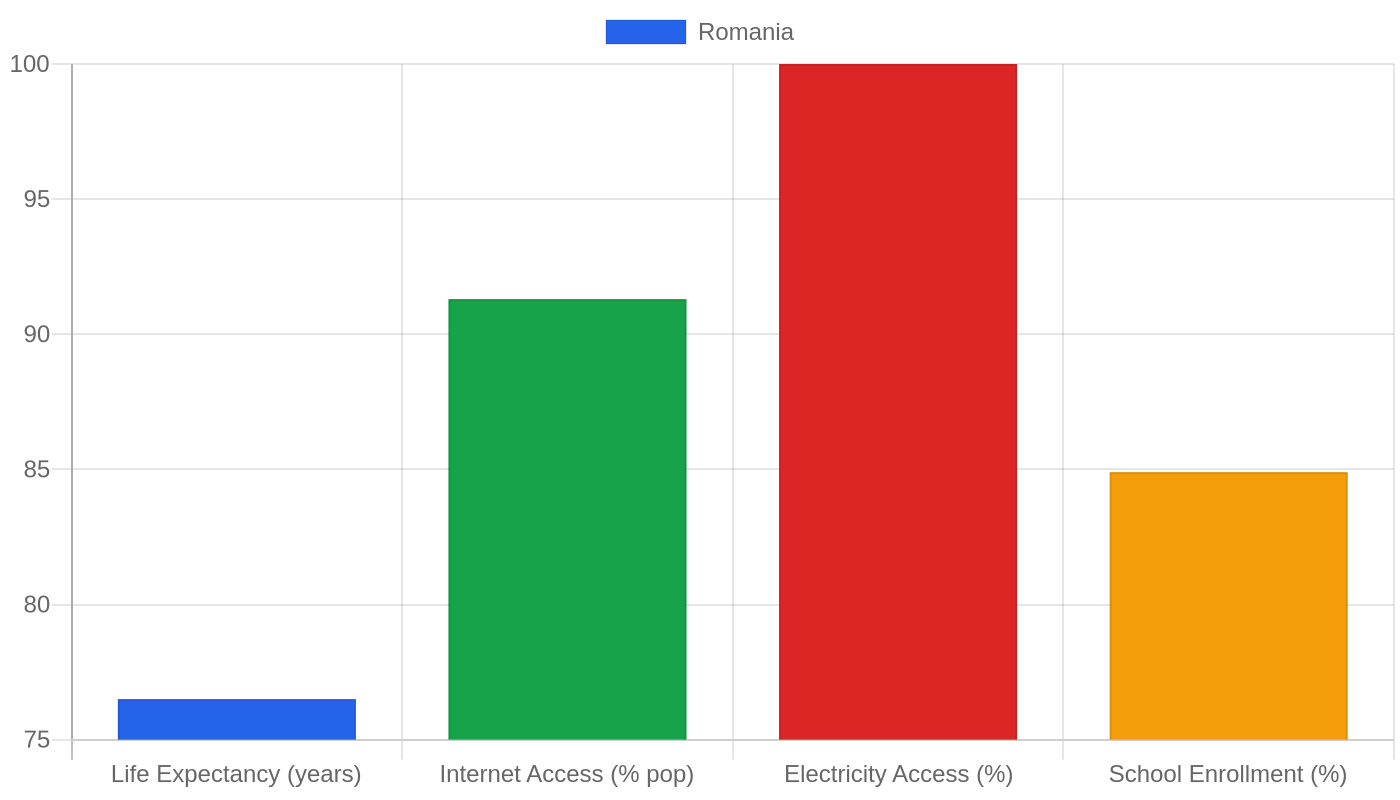
Economic Pulse Net | Sources: World Bank World Development Indicators, Government Sources | 2026
Key Takeaways
– Romania’s GDP per capita (PPP) has reached $50,895, positioning the country firmly within the upper-middle-income bracket and closing the gap with Western European peers at a pace few analysts predicted a decade ago.
– Unemployment stands at a remarkably low 5.992%, indicating a tight labor market that is increasingly driving wage growth and domestic consumption.
– The country’s economic landscape is bifurcated between traditional manufacturing strength—anchored by automotive giant Automobile Dacia—and a rapidly expanding technology sector led by cybersecurity firm Bitdefender.
– GNI per capita of $20,190 reflects significant income growth, though it also highlights persistent regional disparities between Bucharest’s booming metropolitan area and rural communities.
– Romania’s political system operates as a unitary semi-presidential representative democracy, with a governance structure that has navigated EU accession and now faces the challenges of deeper European integration.
The Macroeconomic Canvas: Growth, Labor, and Structural Change
Romania’s economic story is one of remarkable convergence, though the latest World Bank data presents a mixed picture of momentum and lingering vulnerabilities. With GDP per capita on a purchasing power parity basis reaching $50,895, Romania has effectively doubled its economic output per person over the past two decades—a transformation that has fundamentally altered the country’s position within the European Union’s eastern flank.
This figure, reported by the World Bank, places Romania ahead of several EU member states and signals that the economy has moved decisively beyond its post-communist transition phase.
The labor market tells an equally compelling story. Unemployment at 5.992% suggests an economy operating near full capacity, with employers across sectors reporting difficulty finding skilled workers. This tightness has significant implications: it drives upward pressure on wages, which in turn fuels domestic consumption—the primary engine of Romanian economic growth in recent years.
However, it also creates constraints for businesses seeking to expand, particularly in manufacturing and IT where the competition for talent has become intense.
What makes Romania’s economic profile particularly interesting is its dual-track structure. On one hand, the country maintains substantial industrial capacity, with companies like Automobile Dacia (the nation’s largest exporter) and Arctic S.A. anchoring a robust manufacturing base.
On the other, the technology sector has emerged as a genuine powerhouse, with Bitdefender achieving global recognition in cybersecurity and a thriving ecosystem of startups and IT services firms serving international clients. This diversification provides Romania with resilience that many of its regional peers lack, even as inflation remains a concern that the World Bank data suggests requires continued monitoring.
The Cost of Living Conundrum: Bucharest’s Boom and Provincial Pressures
For the Romanian middle class, the economic transformation has been tangible, but it comes with a cost-of-living reality that increasingly mirrors Western patterns. While comprehensive housing data remains limited, the anecdotal evidence from major urban centers paints a clear picture: property prices in Bucharest have surged dramatically over the past five years, driven by a combination of foreign investment, a growing professional class, and limited new supply in desirable neighborhoods.
The rent-versus-buy calculation has shifted notably, with younger professionals increasingly opting for rental arrangements as purchase prices outpace income growth.
This urban boom has created a fascinating divergence within the country. Bucharest, Cluj-Napoca, and Timișoara now boast living costs that approach those of mid-tier Western European cities, while rural areas and smaller towns remain significantly more affordable.
The GNI per capita figure of $20,190 from the World Bank masks this internal disparity—the average Romanian may earn a respectable income, but that average conceals the premium wages available in tech and finance versus the more modest earnings in agriculture and traditional manufacturing.
For the average household, daily expenses have risen noticeably in recent years. Grocery costs, energy prices, and transportation have all increased, reflecting both global inflationary pressures and Romania’s own convergence with EU price levels. The practical consequence is that while Romanians have more money than ever before, they also feel the squeeze of rising prices more acutely—a sentiment that has become a recurring theme in domestic political discourse.
Investment and Business Climate: Where Capital Meets Opportunity
Romania’s corporate landscape offers a revealing window into the country’s economic priorities and future trajectory. The presence of Banca Transilvania and Banca Comercială Română among the top companies underscores the financial sector’s centrality, with both institutions expanding aggressively across the region and modernizing their digital offerings.
Their growth reflects a banking system that has matured significantly since the turbulent 1990s, now offering sophisticated services that support both corporate investment and retail consumers.
The manufacturing sector remains the backbone of Romanian exports, with Automobile Dacia serving as the flagship. The company’s success—producing vehicles that compete effectively on price and reliability across European markets—has spawned a vast ecosystem of suppliers and logistics providers. Similarly, Arctic S.A. has established itself as a major player in home appliances, benefiting from Romania’s strategic location and competitive production costs.
Yet the most exciting investment story is undoubtedly technology. Bitdefender’s global success has put Romanian software development on the map, attracting attention from international investors and multinational corporations seeking engineering talent at competitive rates. The cybersecurity firm’s growth has catalyzed a broader tech ecosystem, with Bucharest and Cluj emerging as genuine alternatives to more expensive Western European tech hubs.
For investors, Romania offers a compelling combination: EU membership with its legal protections and market access, a highly educated workforce, and costs that remain substantially below Western benchmarks.
Governance, Safety, and the Quality of Life Equation
Romania’s political system—a unitary semi-presidential representative democratic republic—provides the framework within which this economic transformation has unfolded. The President, elected by popular vote, serves as head of state with responsibilities including representing the country internationally and serving as supreme commander of the armed forces. The Prime Minister, appointed by the President and confirmed by Parliament, oversees the executive branch and day-to-day governance.
This institutional structure has demonstrated notable stability, particularly when compared to some regional neighbors, but it has not been without challenges. Anti-corruption efforts have been a central theme of Romanian politics, with civil society playing an active and vocal role in demanding accountability. The presence of an active civil society, noted in the political landscape assessment, suggests a healthy democratic culture that can check executive power when necessary.
For citizens and expatriates alike, the quality of life equation in Romania is complex. The country offers a rich cultural heritage, beautiful natural landscapes from the Carpathian Mountains to the Black Sea coast, and a vibrant urban social scene. The low unemployment rate suggests economic security for most citizens, and the rising GDP per capita indicates improving material conditions.
However, infrastructure gaps remain—particularly in transportation and healthcare—and these continue to affect daily life, especially outside the major cities. The balance between economic opportunity and quality-of-life considerations increasingly favors Romania for those who can navigate the bureaucratic and linguistic challenges of relocation.
Romania Right Now: Navigating Geopolitical Tensions and Economic Momentum
The current moment finds Romania at a critical inflection point, balancing its impressive economic momentum against significant external pressures. The country’s strategic position on NATO’s eastern flank has elevated its geopolitical importance, with defense spending and security cooperation becoming increasingly prominent topics in policy discussions.
This security dimension intersects with economic considerations, as stability and predictability become even more valuable attributes for investors evaluating the region.
Domestically, the political calendar has brought debates over fiscal policy to the forefront, with discussions about tax reform and public spending dominating parliamentary discourse. The tension between maintaining the investment-friendly environment that has driven growth and addressing income inequality and public service deficiencies represents an ongoing challenge for the governing coalition.
The low unemployment figure suggests the economy is running hot, which gives policymakers some room to maneuver, but inflation pressures continue to test household budgets and corporate planning.
The technology sector shows no signs of slowing, with continued expansion in software development, cybersecurity, and IT services. International companies increasingly view Romania not merely as an outsourcing destination but as a genuine innovation hub, and this perception shift is driving higher-value investment. Meanwhile, traditional industries are modernizing, with automotive and manufacturing companies investing in automation and electric vehicle production capabilities.
For Romania, the immediate future appears bright, but the country must navigate complex regional dynamics and maintain its reform momentum to fully realize its considerable potential.
The Bottom Line
Romania has completed its transformation from post-communist transition economy to a dynamic European player, and the World Bank data underscores just how far the country has come. With GDP per capita approaching $51,000 on a PPP basis and unemployment below 6 percent, the macroeconomic fundamentals are genuinely impressive. Investors should watch Romania for its unique combination of EU integration, technological ambition, and competitive costs.
For businesses and individuals willing to engage with its complexities, Romania offers opportunities that few other European markets can match—though the country’s continued progress will depend on sustaining reforms and navigating an increasingly uncertain geopolitical environment.
Sources & Methodology
This article is authored by Economic Pulse Net for informational and research purposes. Economic Pulse Net sources its data from multilateral institutions, national statistics bureaus, and proprietary databases. All data is believed to be current as of the date of publication.
Published: August 01, 2026 | Category: Research — Romania
Use these signals in your own platform
Economic Pulse publishes its live signal feed through a documented, read-only API. Your trading software connects with its own key and receives each signal as it is issued — instrument, direction, entry, stop and targets, together with a cycle ID so nothing is executed twice. The feed is independent of this website and cannot change it.
Signals are informational only and are not financial advice.