Economic Pulse Net | Sources: World Bank World Development Indicators, Government Sources | 2026
Key Takeaways
* Robust Economic Expansion: Poland is projected to see significant GDP growth of approximately 3.57% in 2025, outpacing many regional peers despite global headwinds.
Tight Labor Market: With unemployment hovering near historic lows at roughly 2.98%, the country faces a competitive landscape for talent, signaling a strong consumer base but potential wage pressures.
Inflationary Pressures: Consumer price inflation is settling around 3.81%, requiring careful monetary and fiscal management to maintain purchasing power stability.
Strategic Business Hubs: The economy is supported by a diverse mix of industries, from coal mining to digital technology, anchored by major players like Allegro and Asseco.
Economic Momentum and Structural Strength
Poland’s economic trajectory in the mid-2020s presents a compelling narrative of resilience and expansion. According to World Bank data, the nation’s Gross Domestic Product (GDP) is projected to grow by 3.57% in 2025, a figure that underscores the robustness of its domestic demand and industrial output. This growth contributes to an overall GDP value exceeding $1 trillion USD, specifically calculated at $1,035,491,784,197.44, marking Poland as one of the larger economies in Central Europe.
The standard of living is reflected in the GDP per capita adjusted for Purchasing Power Parity (PPP), which stands at a healthy $54,262.40, indicating that citizens have significant real income relative to local costs. However, this prosperity is tempered by inflation; the Consumer Price Index (CPI) is recorded at 3.81%, suggesting that while prices are rising, they are doing so at a manageable rate compared to previous volatile periods.
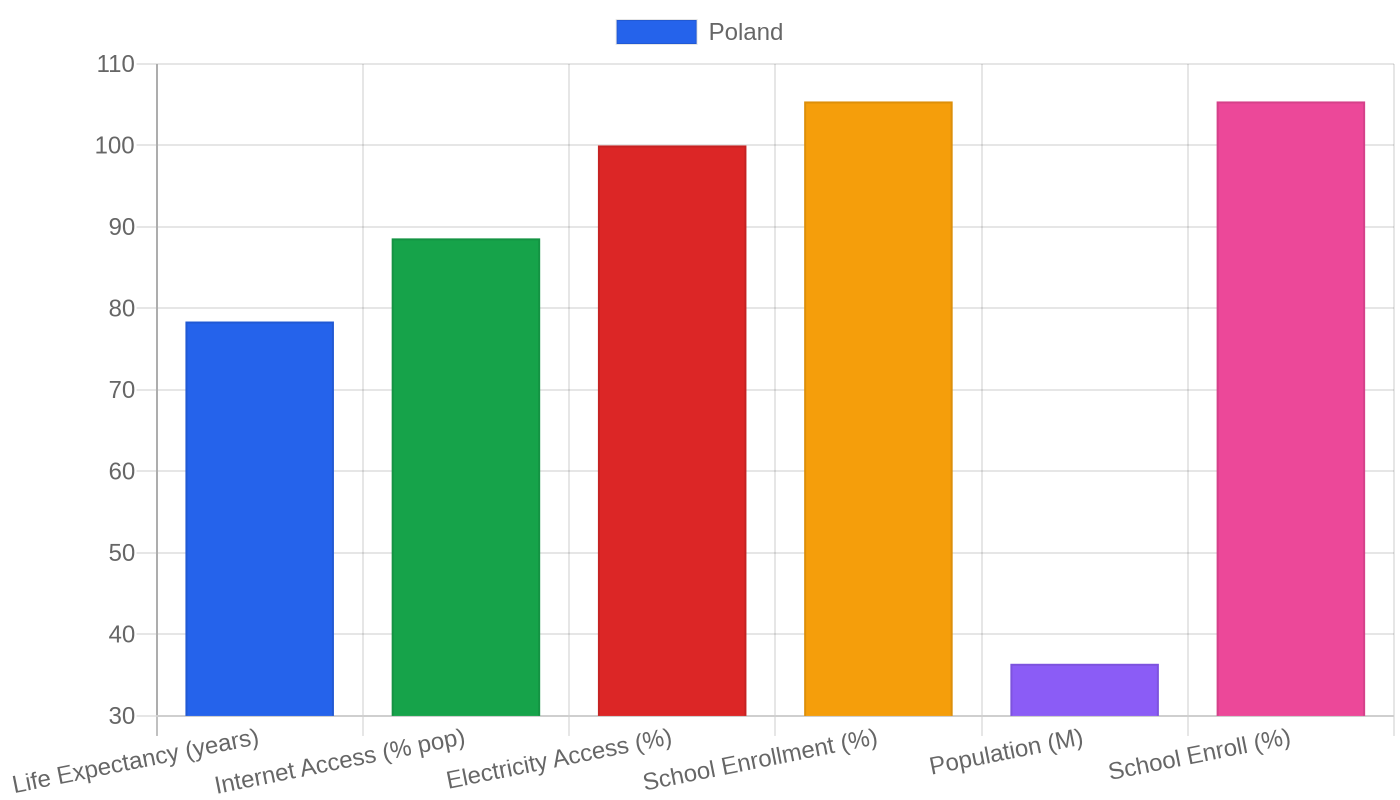
Perhaps most striking is the labor market dynamics, with unemployment sitting at a remarkably low 2.976%. This tight labor market suggests high employment levels across the population of 36.4 million people, driven by both industrial production and service sector expansion. The GNI per capita, reported at $25,520.0, provides a broader view of national income, highlighting the wealth generated within the country’s borders.
These figures collectively paint a picture of an economy that is not only growing in size but also stabilizing its macroeconomic fundamentals after years of post-pandemic adjustment.
Cost of Living and Housing Dynamics
While specific housing cost metrics are not explicitly detailed in the provided dataset, the broader economic indicators offer clear insights into the financial environment for residents and businesses. The relatively high GDP per capita (PPP) of over $54,000 suggests that the average household has substantial purchasing power, which likely supports a vibrant real estate and rental market.
With inflation at 3.81%, daily expenses for goods and services are experiencing moderate upward pressure, meaning that consumers must budget carefully to maintain their standard of living. The low unemployment rate of under 3% implies that wages are likely competitive, helping to offset some of the cost-of-living increases.
For expatriates or investors, the balance between the high nominal GDP and the moderate inflation rate indicates that Poland offers a favorable environment where income can stretch further than in many Western European nations. The absence of extreme hyperinflation or deflationary spirals points to a stable pricing mechanism, although the 3.81% CPI rise requires vigilance from policymakers to ensure affordability remains accessible to the middle class.
Consequently, while exact rent-to-income ratios are unavailable, the underlying data suggests a market where economic activity is high, and consumer spending remains a key driver of the national economy.
Investment Climate and Corporate Landscape
The business environment in Poland is characterized by a dynamic mix of traditional industries and emerging technological sectors. Major companies play a pivotal role in shaping this landscape, with entities like Allegro dominating the consumer services space as a leading e-commerce platform, while Asseco represents strength in technology and IT solutions.
In the financial sector, institutions such as Alior Bank, Bank Millennium, and Bank Ochrony Środowiska provide essential capital infrastructure, supporting both retail and corporate banking needs. Traditional industries remain vital, with Adamów Coal Mine underscoring the ongoing importance of basic materials and energy resources in the national industrial mix. Meanwhile, brands like 4F and Amica illustrate the strength of the consumer goods sector, catering to both domestic preferences and export markets.
Technology is also gaining ground, exemplified by 11 bit studios, which highlights Poland’s growing reputation as a hub for creative software development and gaming. Agora, operating in consumer services, further diversifies the corporate ecosystem. This diversity reduces systemic risk, as the economy is not overly reliant on a single industry.
Investors looking at Poland should note that the presence of these established, multi-sector leaders provides a stable foundation for new ventures and foreign direct investment, particularly in areas adjacent to existing strengths like logistics, digital services, and manufacturing.
Safety, Politics, and Quality of Life
Navigating the political and social fabric of Poland requires an understanding of its unique governance structure and current leadership. Poland operates as a unitary parliamentary republic and a representative democracy, with a president serving as the head of state and a prime minister leading the Council of Ministers as head of government.
The executive branch is formed through a rigorous process where council members are selected by the prime minister, approved by parliament, and sworn in by the president, ensuring checks and balances within the system. The current president is Karol Nawrocki, elected by popular vote for a five-year term, reflecting the democratic mandate of the nation’s highest office.
Regarding safety, specific crime and safety indices are listed as N/A in the provided data, meaning precise statistical comparisons regarding personal security cannot be made from this dataset alone. However, the stability of the political framework and the functioning of democratic institutions suggest a predictable environment for residents and businesses.
The quality of life is implicitly supported by the strong economic indicators, including high GDP per capita and low unemployment, which typically correlate with better public services and social stability. While detailed crime statistics are absent, the orderly political transition and institutional continuity provide a baseline of societal order essential for long-term planning and personal well-being.
What’s Happening Now: Policy Shifts and Leadership
The immediate political landscape is defined by the active tenure of President Karol Nawrocki and the operational dynamics of the Council of Ministers. As the head of state, Nawrocki’s role involves overseeing the constitutional framework and appointing key officials, a process that influences policy direction and international relations.
The prime minister, acting as head of government, exercises executive power alongside the Council of Ministers, whose members are vetted by parliament, ensuring legislative alignment with executive actions. This period sees the government managing the delicate balance between sustaining the 3.57% GDP growth and controlling the 3.81% inflation rate. Businesses are adapting to this environment by leveraging the strong domestic consumption driven by low unemployment.
The focus now is on maintaining this momentum while navigating any regulatory changes introduced by the current administration. With the political structure firmly in place, stakeholders are watching how the executive branch will address future economic challenges, particularly in sustaining job creation amidst a tight labor market.
The interplay between presidential authority and parliamentary approval continues to shape the pace of reform and investment incentives, making the current political cycle a critical period for assessing Poland’s long-term strategic direction.
The Bottom Line
Poland stands as a formidable economic player in Central Europe, characterized by strong growth, low unemployment, and a diversified industrial base. Investors and analysts should watch this country closely due to its robust GDP performance and the stability provided by its democratic institutions and major corporate players. The combination of high purchasing power and manageable inflation creates a favorable environment for both consumer-focused and technology-driven investments.
While specific safety metrics are unavailable, the political continuity and economic resilience suggest a reliable destination for long-term engagement. Ultimately, Poland offers a compelling case study of a modern economy balancing rapid growth with structural stability.
Sources & Methodology
This article is authored by Economic Pulse Net for informational and research purposes. Economic Pulse Net sources its data from multilateral institutions, national statistics bureaus, and proprietary databases. All data is believed to be current as of the date of publication.
Published: September 30, 2026 | Category: Research — Poland
Use these signals in your own platform
Economic Pulse publishes its live signal feed through a documented, read-only API. Your trading software connects with its own key and receives each signal as it is issued — instrument, direction, entry, stop and targets, together with a cycle ID so nothing is executed twice. The feed is independent of this website and cannot change it.
Signals are informational only and are not financial advice.