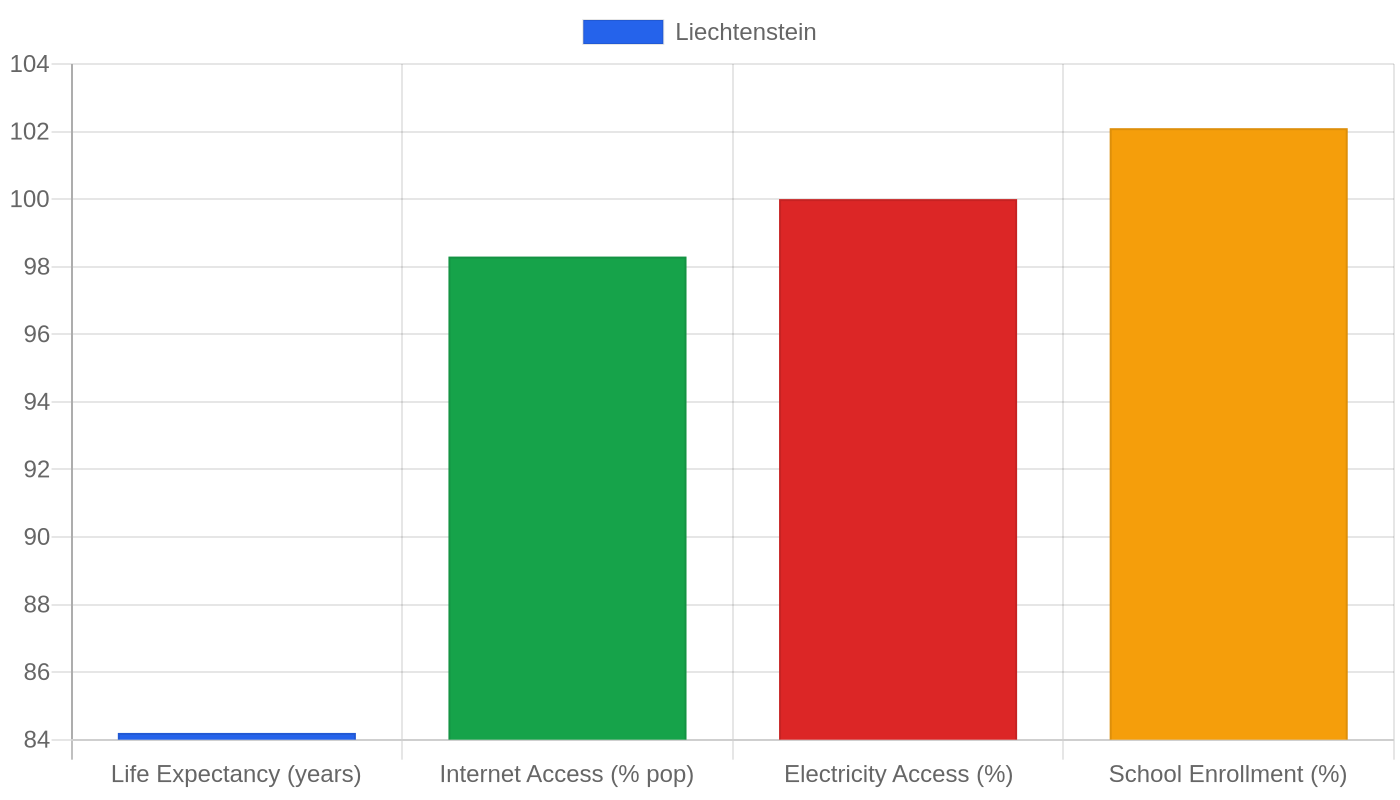
Economic Pulse Net | Sources: World Bank World Development Indicators, Government Sources | 2026
Key Takeaways
– Liechtenstein operates under a unique hybrid system that blends absolute monarchy, representative democracy, and direct democracy — the reigning prince retains extraordinary executive and legislative powers, making it one of the most politically distinctive states in Europe.
– Despite a lack of publicly available GDP, inflation, or unemployment data from the World Bank, the principality hosts a remarkable concentration of globally competitive companies, including Hilti, LGT Group, and Ivoclar Vivadent.
– The country’s industrial base is unusually strong for its size, with companies spanning consumer goods, industrials, healthcare, and financial services — a diversified portfolio for a nation of roughly 39,000 people.
– Liechtenstein’s political system allows citizens to propose and adopt laws directly, creating a governance model where the prince, parliament, and people all hold meaningful levers of power.
The Economy Without Numbers — What We Know About the Black Box
The World Bank data for Liechtenstein is conspicuously empty. No GDP growth figure. No inflation rate. No unemployment percentage. No GDP per capita. No GNI per capita. No population count. For a country that sits in the heart of Europe, sandwiched between Switzerland and Austria, this statistical silence is itself a story.
But the absence of headline numbers does not mean the economy is invisible. Liechtenstein’s industrial landscape tells a far more revealing tale. The country’s top companies read like a miniature version of a diversified European economy. Hilti, the global power tool and construction equipment giant, is headquartered here. Hilcona, a major player in convenience food, operates from the principality. Ivoclar Vivadent, a leader in dental materials and prosthetics, calls Liechtenstein home.
Intamin, the engineering firm behind some of the world’s most famous roller coasters, is another homegrown success.
The financial sector is equally robust. LGT Group, one of the largest private banking and wealth management groups in Europe, is based in Vaduz. The National Bank of Liechtenstein provides central banking functions, while the Liechtensteinische Post and Liechtenstein Bus handle essential infrastructure. This is not an economy dependent on a single industry or a narrow resource base.
It is a diversified, high-value-added economy built on precision manufacturing, healthcare technology, and financial services — all sectors that typically command premium wages and generate substantial tax revenues.
The lack of World Bank data likely reflects Liechtenstein’s unusual status. It is not a member of the European Union, though it participates in the European Economic Area. It uses the Swiss franc as its currency. Its statistical reporting may not align with the standardised formats required by international institutions. But the presence of companies like Hilti and Ivoclar Vivadent — firms with global reach and reputations for quality — suggests an economy that punches far above its weight.
The Cost of Living in a Swiss Franc Economy
Liechtenstein uses the Swiss franc, and its cost of living is closely tied to Switzerland’s famously high price levels. Housing costs in the principality are substantial, driven by limited land availability and strict building regulations in a country that measures just 160 square kilometres. Renting is common, but purchasing property requires significant capital — and the market is tight.
Daily expenses for food, transportation, and services mirror those in neighbouring Switzerland, which consistently ranks among the most expensive countries in Europe. A meal out, a coffee, or a trip on the Liechtenstein Bus network will cost roughly what it would in Zurich or Geneva.
For residents, the high cost of living is offset by high wages and the country’s low tax regime — Liechtenstein has no capital gains tax and offers a flat corporate tax rate that has attracted holding companies and financial firms.
The housing market is particularly constrained for newcomers. With limited new construction and strict zoning, finding affordable accommodation can be a challenge. Most residents live in small houses or apartments in one of the principality’s 11 municipalities, with Vaduz, the capital, being the most expensive. The cost of living, in short, is a trade-off: you pay Swiss-level prices, but you also enjoy Swiss-level infrastructure, safety, and services.
Business and Investment — Where Small Size Meets Global Reach
Liechtenstein’s business environment is defined by its corporate tax regime, its political stability, and its access to the European Economic Area. The country offers a flat corporate income tax rate of 12.5%, which is competitive within Europe. There is no capital gains tax for individuals, and withholding taxes are low. This has made Liechtenstein a favoured domicile for holding companies and family offices.
The top companies list reveals the sectors that matter most. Consumer goods firms like Hilti and Hilcona dominate, alongside industrial firms such as Intamin, Neutrik, and Liechtenstein Bus. The healthcare sector is represented by Ivoclar Vivadent, a global leader in dental technology. The financial sector is anchored by LGT Group and the National Bank of Liechtenstein. This is not a tax haven in the traditional sense — it is a real economy with real manufacturing, real engineering, and real financial services.
For investors, the key sectors to watch are precision manufacturing, dental technology, and private banking. The country’s industrial firms have global customer bases and strong reputations for quality. The financial sector benefits from the principality’s political stability and its integration with Swiss and European markets.
The business climate is business-friendly, with low bureaucracy and a highly educated workforce — though the small labour pool means companies often recruit from across the border in Switzerland and Austria.
Safety, Politics, and the Quality of Life in a Princely State
Liechtenstein’s crime and safety indices are not available from the provided data, but the country is widely regarded as one of the safest in Europe. Violent crime is rare, and the principality’s small size and tight-knit communities contribute to a strong sense of security. The quality of life is high, supported by excellent infrastructure, clean environment, and access to the Alpine landscape that surrounds the country.
The political landscape is where Liechtenstein truly stands apart. As the data notes, the country combines elements of absolute monarchy, representative democracy, and direct democracy. The reigning prince retains extensive executive and legislative powers and exercises considerable influence over the daily conduct of politics across all three branches of government. This is not a ceremonial monarchy — the prince can veto legislation, dismiss the government, and appoint judges.
At the same time, an elected parliament enacts legislation, and citizens can propose and adopt laws and constitutional amendments through direct democratic mechanisms. This hybrid system has proven remarkably stable. There have been no major political crises in recent decades, and the prince and the people have generally coexisted peacefully.
The most notable political event of recent years was a 2012 referendum in which voters rejected a proposal to limit the prince’s veto power — a clear endorsement of the existing system.
For residents, this means a high degree of political stability and predictability. The quality of life is enhanced by low crime, strong public services, and the natural beauty of the Alpine setting. Liechtenstein may be small, but it offers a standard of living that rivals its larger neighbours.
What’s Happening Now — The Principality in a Changing Europe
Liechtenstein’s current affairs are shaped by its position as a small, wealthy, non-EU state within the European Economic Area. The country is navigating the same challenges as its neighbours: inflation, energy costs, and the shifting geopolitical landscape. But it does so from a position of strength. The principality’s low debt, strong fiscal position, and diversified economy provide a buffer that many larger European countries lack.
The financial sector is under continued scrutiny from international regulators, as Liechtenstein works to maintain its reputation for transparency while preserving its competitive tax regime. The country has signed numerous tax information exchange agreements and has moved away from its historical image as a secrecy jurisdiction. The LGT Group and the National Bank of Liechtenstein are at the centre of this transition, balancing client confidentiality with regulatory compliance.
On the industrial side, companies like Hilti and Ivoclar Vivadent continue to invest in innovation and automation, maintaining their global competitive edge. The labour market remains tight, and companies are increasingly looking to attract talent from across the border. The Liechtenstein Bus network and other infrastructure investments reflect a government focused on maintaining high quality of life and connectivity.
The political system remains stable, with no major challenges to the prince’s authority. The direct democratic mechanisms continue to function, with citizens occasionally voting on local issues and constitutional amendments. For now, Liechtenstein’s unique political model appears to enjoy broad public support.
The Bottom Line
Liechtenstein is a country that defies easy categorisation. It is a monarchy where the prince still rules, a tax-competitive jurisdiction with a real industrial base, and a microstate that hosts global companies. For investors, it offers stability, low taxes, and access to European markets. For businesses, it provides a high-quality, low-bureaucracy environment. For the curious observer, it is a living experiment in how absolute monarchy, representative democracy, and direct democracy can coexist.
This is a country to watch not for its size, but for its resilience and its ability to thrive on its own terms.
Sources & Methodology
This article is authored by Economic Pulse Net for informational and research purposes. Economic Pulse Net sources its data from multilateral institutions, national statistics bureaus, and proprietary databases. All data is believed to be current as of the date of publication.
Published: July 30, 2026 | Category: Research — Liechtenstein
Use these signals in your own platform
Economic Pulse publishes its live signal feed through a documented, read-only API. Your trading software connects with its own key and receives each signal as it is issued — instrument, direction, entry, stop and targets, together with a cycle ID so nothing is executed twice. The feed is independent of this website and cannot change it.
Signals are informational only and are not financial advice.