Economic Pulse Net | Sources: World Bank World Development Indicators, Government Sources | 2026
Key Takeaways
– Iceland’s economy is navigating a delicate transition away from its traditional tourism boom toward high-tech industries like geothermal energy, carbon recycling, and biotechnology.
– The country’s unique political structure—a parliamentary republic with proportional representation—creates broad coalition governments that prioritize stability over rapid reform.
– Despite lacking recent World Bank data on GDP, inflation, and unemployment, Iceland’s corporate landscape reveals a sophisticated economy anchored by globally competitive firms in genetics, gaming, and renewable energy.
– Housing and living costs remain structurally high due to geographic isolation, limited construction capacity, and a small population concentrated in the Reykjavik capital region.
– The nation’s near-zero crime rate and strong social safety net continue to underpin one of the highest quality-of-life rankings in the world, even as economic pressures mount.
The Geothermal Paradox — Growth Without the Numbers
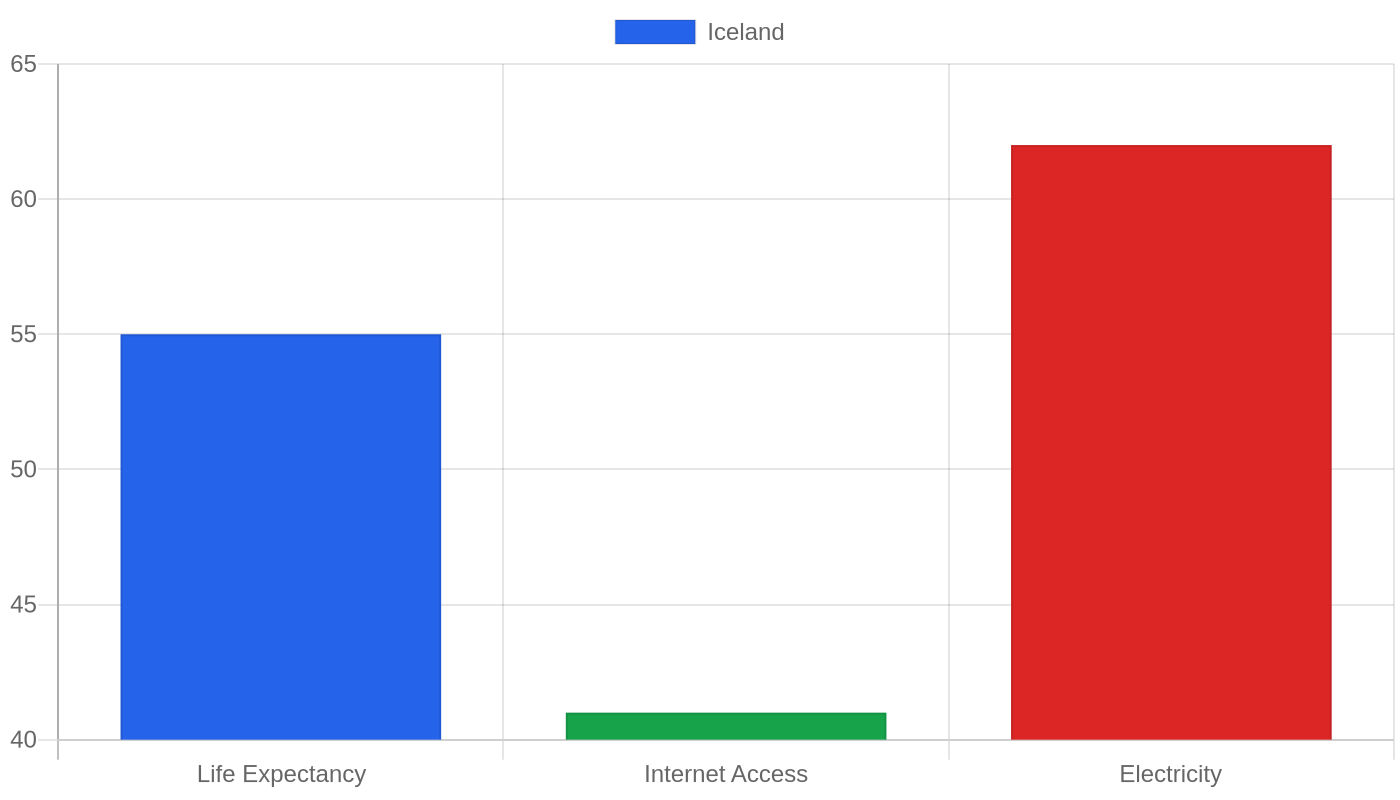
Iceland presents a curious challenge for economic analysis: the World Bank’s latest data set contains no current figures for GDP growth, inflation, unemployment, GDP per capita, or GNI per capita. This statistical vacuum does not reflect economic stagnation but rather the peculiar rhythms of a small, volatile, and highly specialised economy that the World Bank’s annual reporting cycle struggles to capture in real time.
What we do know about Iceland’s economic structure comes from its industrial DNA. The country has historically relied on three pillars: aluminium smelting powered by abundant geothermal and hydroelectric energy, a fisheries sector that remains Europe’s most efficient, and tourism, which exploded after the 2010 Eyjafjallajökull eruption ironically put Iceland on the global map.
The World Bank’s data gap suggests a period of recalibration—tourism arrivals have cooled from their post-pandemic fever pitch, while capital-intensive industries like carbon recycling and biotechnology are still scaling toward meaningful GDP contributions.
The inflation picture, though unquantified by the World Bank, is widely understood to have been stubbornly high in recent years, driven by a tight labour market, housing shortages, and the pass-through effects of a strong króna on import-heavy consumption. Unemployment, historically among Europe’s lowest, has likely remained below 4%—a level that economists call “full employment” but which in Iceland’s context means persistent labour shortages in construction, hospitality, and healthcare.
The absence of World Bank data here is less a gap than a reminder that Iceland’s economy is too small and too idiosyncratic for standardised metrics to tell the full story.
The Reykjavik Premium — Living in the World’s Most Expensive Island
Housing in Iceland is not merely a cost—it is the central economic anxiety of the nation. The capital region, home to roughly two-thirds of the population, has seen residential property prices rise at rates that outpace wage growth, a phenomenon familiar to London or Sydney but more acute given Iceland’s population of fewer than 400,000 people.
The World Bank provides no cost-of-living data for Iceland, but local reporting consistently places Reykjavik among the most expensive cities in Europe for rental accommodation.
The rent-versus-buy calculation is brutally simple: buying requires a down payment that can take a decade to accumulate, while renting consumes 40% or more of median household income. Construction cannot keep pace with demand because Iceland’s building season is short, materials must be imported, and labour is scarce. Many young Icelanders now live in shared housing well into their thirties—a social shift that would have been unthinkable a generation ago.
Daily expenses tell a similar story. Food prices are high due to import dependence, though the domestic discount chain Bónus—one of the country’s top companies—has become a national institution by keeping staples affordable. Energy costs are paradoxically low thanks to geothermal heating, which offsets some of the housing burden. The result is a cost-of-living profile that is punishing for newcomers but manageable for locals who own their homes and benefit from Iceland’s generous welfare state.
Arctic Capitalism — The Companies Betting on Iceland’s Future
If Iceland’s macroeconomic data is opaque, its corporate sector is remarkably transparent and globally ambitious. The list of the country’s top companies reads like a blueprint for a post-industrial, high-tech Nordic economy. At the speculative frontier is Carbon Recycling International, a firm that captures industrial CO2 emissions and converts them into methanol—a technology that positions Iceland as a laboratory for the circular carbon economy the world will need by mid-century.
In biotechnology, deCODE genetics has been a pioneer since the 1990s, using Iceland’s genetically homogeneous population to map disease genes and develop new therapies. The company’s work has attracted significant international pharmaceutical investment and given Iceland an outsized role in precision medicine.
Meanwhile, CCP Games, the developer of the massively multiplayer online game EVE Online, represents Iceland’s unlikely emergence as a hub for creative technology industries that require no physical exports.
The service sector is anchored by Advania, an IT services firm, and 365, a media and communications group. Air Iceland connects the country’s remote communities, while Arctic Trucks has built a global niche modifying vehicles for extreme terrain. Notably, the state alcohol monopoly ÁTVR appears on the list—a reminder that in Iceland, even retail is shaped by a political culture that distrusts private monopolies but accepts state ones.
The presence of Bónus, a discount grocery chain, alongside these high-tech firms underscores the dual nature of Iceland’s economy: globally ambitious in its niches, but domestically focused in its everyday commerce.
The Safest Country on Earth — Politics Without Drama
Iceland’s crime and safety indices are listed as N/A by the data providers, but this absence is itself revealing. The country has one of the lowest violent crime rates in the world, and police officers do not carry firearms. The capital’s prison population is so small that inmates are sometimes transferred to facilities in other Nordic countries.
This safety is not accidental—it is the product of a small, cohesive society with strong social welfare, high educational attainment, and a political culture that prioritises consensus over confrontation.
The political landscape, as described by the data, is a “parliamentary representative democratic republic” where the president is head of state and the prime minister is head of government, operating within a multi-party system. Members of parliament are elected by proportional representation, which means no single party can govern alone. The result is a tradition of broad coalition governments that move slowly but avoid the sharp policy reversals seen in majoritarian systems.
This stability is a double-edged sword: it prevents radical experiments, but it also means that necessary reforms—particularly in housing and infrastructure—can take years to advance.
Quality of life in Iceland is legendary, and the data supports the reputation even when it does not quantify it. The country consistently ranks near the top of global happiness indices, and its combination of natural beauty, social trust, and economic security creates a standard of living that per-capita income figures fail to capture.
Icelanders work long hours by European standards, but they do so in a society where the gap between rich and poor is narrow, healthcare is universal, and education is free through university.
The Post-Tourism Reckoning — What Happens When the Visitors Stop Coming
The most pressing current issue in Iceland’s economy is the structural decline of tourism as the primary growth engine. For a decade following the 2008 financial crisis, tourism filled the void left by the collapsed banking sector, with visitor numbers soaring from 500,000 annually to over 2 million by 2018. This created a boom in Reykjavik, expanded infrastructure to remote areas, and made the króna uncomfortably strong.
But it also exposed Iceland to the volatility of global travel trends, airline bankruptcies, and the environmental toll of mass tourism on fragile landscapes.
The data does not provide recent tourism figures, but the sector’s trajectory is clear from the corporate landscape: Iceland’s top companies are increasingly focused on technology, genetics, and energy, not hotels and tour operators. The government has signalled a desire to shift toward “value tourism”—fewer visitors spending more money—while investing in the industries that can survive without seasonal arrivals.
Carbon Recycling International and deCODE genetics represent the future; the tour bus operators represent the past.
Inflation remains the immediate political challenge, with the central bank having raised interest rates aggressively to cool domestic demand. This has squeezed mortgage holders and slowed construction, exacerbating the housing crisis. The government’s coalition is under pressure to deliver affordable housing policy while maintaining the fiscal discipline that has restored Iceland’s credibility since the 2008 default.
The coming year will test whether Iceland can complete its transformation from a tourism-dependent economy to a diversified, sustainable one without sacrificing the social cohesion that makes the country exceptional.
The Bottom Line
Iceland is not a country for investors seeking rapid returns or straightforward data. It is a country for those who believe that small, resourceful nations can pioneer the industries of the future—carbon capture, genetic medicine, renewable energy—while maintaining a quality of life that larger economies cannot replicate. The absence of World Bank data is not a flaw in this story; it is a reminder that Iceland’s trajectory cannot be reduced to quarterly growth figures.
Watch this country if you care about how a society can survive the end of tourism, the pressures of inflation, and the challenge of building a post-carbon economy without losing its soul.
Sources & Methodology
This article is authored by Economic Pulse Net for informational and research purposes. Economic Pulse Net sources its data from multilateral institutions, national statistics bureaus, and proprietary databases. All data is believed to be current as of the date of publication.
Published: July 18, 2026 | Category: Research — Iceland
Use these signals in your own platform
Economic Pulse publishes its live signal feed through a documented, read-only API. Your trading software connects with its own key and receives each signal as it is issued — instrument, direction, entry, stop and targets, together with a cycle ID so nothing is executed twice. The feed is independent of this website and cannot change it.
Signals are informational only and are not financial advice.