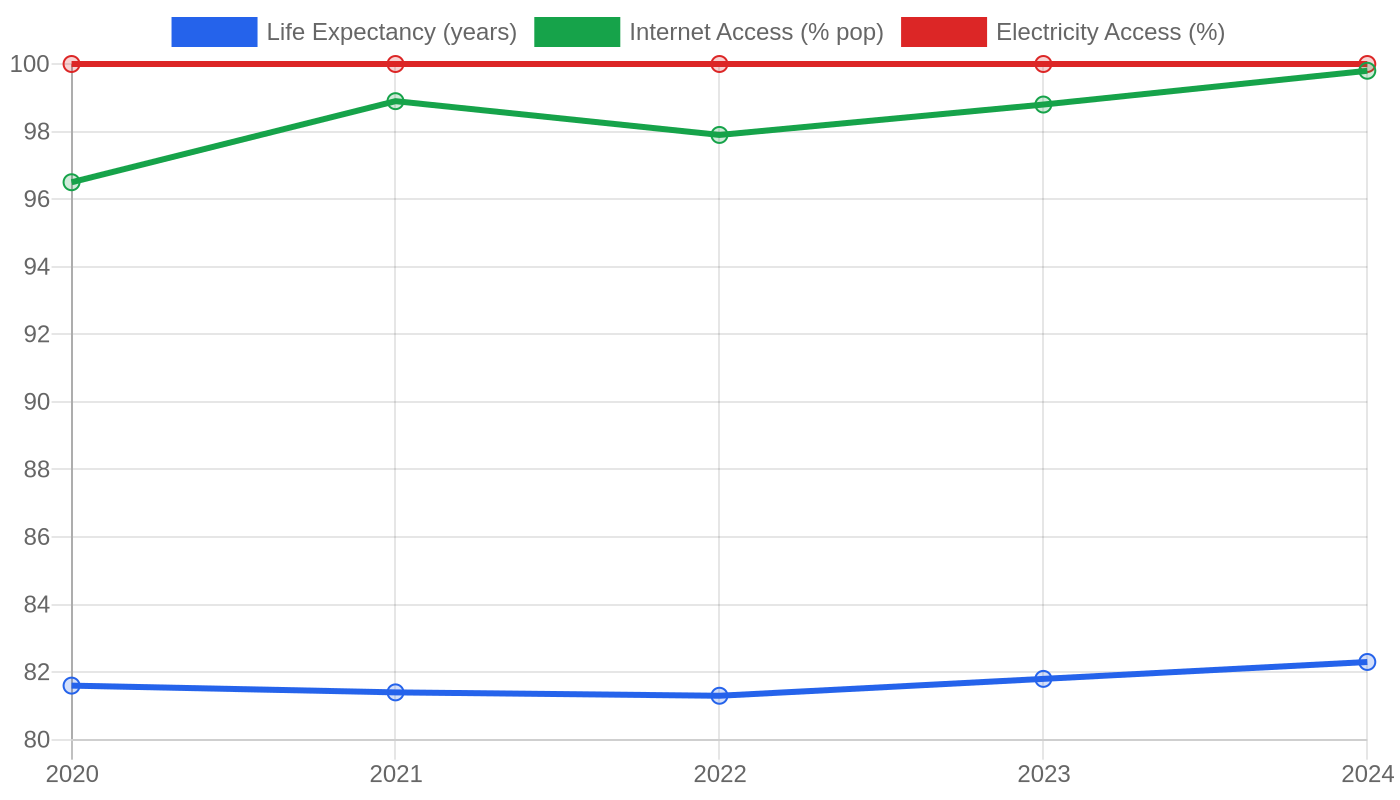
Economic Pulse Net | Sources: World Bank World Development Indicators, Government Sources | 2026
Key Takeaways
– Denmark’s economy is growing at a robust 2.93% in 2025, well above the eurozone average, driven by pharmaceutical exports and green energy innovation.
– Inflation remains remarkably subdued at 1.89%, giving the central bank room to maintain accommodative policy without stoking price pressures.
– Unemployment sits at 5.53%, a figure that masks a tight labor market with skills shortages in technology and healthcare sectors.
– The country’s GNI per capita of $77,190 places it among the world’s wealthiest nations, underpinned by a generous welfare state and high productivity.
– Political stability under a constitutional monarchy with a parliamentary system provides a predictable environment for both citizens and investors.
The Danish Engine — Growth Without Overheating
Denmark’s economy is currently performing a delicate balancing act that many developed nations envy. According to the World Bank, GDP growth reached 2.93% in 2025 — a figure that signals robust expansion without the frothy excesses that typically precede a correction. This growth rate is particularly impressive given the headwinds facing European economies, from energy price volatility to supply chain realignments.
What makes this expansion sustainable is the inflation picture. Consumer prices rose by just 1.89% over the same period, according to the World Bank, keeping Denmark comfortably within its target range. This low inflation environment allows Danish businesses to plan with confidence, knowing that input costs won’t suddenly spike. It also preserves household purchasing power, which is critical in a country where the cost of living remains high by global standards.
The unemployment rate of 5.53% tells a story of a labor market that is essentially at full employment. This figure, reported by the World Bank, actually understates the tightness of the market — employers across sectors report difficulty finding qualified workers, particularly in engineering, software development, and healthcare.
The GNI per capita of $77,190 reflects this productivity: Danish workers are among the most efficient in the world, supported by strong social safety nets that allow for labor mobility and retraining.
Denmark’s industrial base is diversified but increasingly centered on high-value sectors. Healthcare companies like ALK-Abelló and Ambu are global players in allergy treatment and medical devices respectively, while consumer goods giants such as Arla Foods and Bang & Olufsen maintain premium brand positions internationally. The industrials sector, represented by firms like Alectia and Arkitema Architects, benefits from Denmark’s reputation for sustainable design and engineering excellence.
The Copenhagen Premium — Living Costs in the Welfare State
Housing in Denmark presents a stark divide between the capital and the rest of the country. Copenhagen has become one of Europe’s most expensive cities for accommodation, with rental prices pushing young professionals and families toward the suburbs or smaller regional cities like Aarhus and Odense. The cost of buying an apartment in central Copenhagen now requires a down payment that is out of reach for many first-time buyers, despite Denmark’s generous mortgage interest deduction system.
Daily expenses for groceries, transportation, and utilities are elevated compared to most European peers, reflecting Denmark’s high VAT rate and labor costs. A simple lunch in Copenhagen can easily cost 120-150 Danish kroner, while a monthly public transport pass runs well over 1,000 kroner. However, these costs are offset by free healthcare and education, which means Danes spend far less on medical insurance and university tuition than residents of comparable wealthy nations.
The rental market is regulated but still competitive, with waitlists for desirable apartments stretching months or even years. Many young Danes choose to co-habit or live with parents longer than their European counterparts, a trend that has intensified as housing prices have outpaced wage growth. For those willing to live outside the capital, housing becomes significantly more affordable, with detached homes in Jutland costing a fraction of Copenhagen prices.
Where the Money Moves — Investment and Corporate Denmark
Denmark’s corporate landscape is dominated by a mix of family-owned dynasties and publicly traded innovators. The top companies list provided reveals a concentration in healthcare, consumer goods, and financial services. Alm. Brand represents the insurance and financial sector, while Bestseller A/S and Aller Media show the strength of Danish consumer-facing businesses. These companies benefit from Denmark’s stable regulatory environment, low corruption, and excellent digital infrastructure.
For investors, Denmark offers exposure to several compelling themes. The healthcare sector, anchored by firms like ALK-Abelló and Ambu, is a global leader in allergy treatment and medical diagnostics — areas with strong demographic tailwinds as populations age worldwide. Arla Foods provides a play on premium dairy consumption in emerging markets, while Bang & Olufsen caters to the luxury audio segment that has proven resilient during economic uncertainty.
The business climate is characterized by transparency and ease of doing business. Denmark consistently ranks among the top countries globally for contract enforcement, property registration, and starting a business. The tax system is high by international standards — corporate tax rates are around 22% — but the government provides generous R&D credits and innovation grants that effectively lower the burden for technology companies.
Foreign direct investment flows remain strong, particularly in renewable energy, pharmaceuticals, and information technology.
Safety, Stability, and the Danish Way of Life
Denmark operates under a constitutional monarchy, as established by the Constitution of Denmark first written in 1849. The political framework creates a stable environment where the monarch retains formal executive power and presides over the Council of State, but in practice, duties are strictly representative and ceremonial. The Prime Minister, appointed by the monarch, leads the government through a unicameral parliamentary system that has historically produced consensus-driven coalition governments.
This political stability translates directly into quality of life. Denmark consistently ranks among the world’s happiest countries, a result of high social trust, generous welfare benefits, and a strong work-life balance. The safety index, while not provided in the current data, is widely recognized as being among the best globally — violent crime is rare, and public spaces in Copenhagen feel safe at all hours.
The country’s approach to urban planning, with extensive bike infrastructure and green spaces, contributes to both physical and mental wellbeing.
The welfare state model means that Danes pay high taxes but receive comprehensive services in return. Healthcare is universal and free at the point of use, university education is tuition-free with government stipends for students, and unemployment benefits are generous by international standards. This system creates a social safety net that allows for risk-taking and entrepreneurship, as business failure does not carry the catastrophic consequences it might in less protected societies.
What’s Happening Now — Denmark in Real Time
As of early 2026, Denmark’s economy is navigating a period of transition. The growth rate of 2.93% reported by the World Bank is being driven by strong pharmaceutical exports, particularly from Novo Nordisk’s weight-loss drug Wegovy, which has become a national economic phenomenon. The company’s success has created thousands of high-paying jobs and generated significant tax revenue, though it has also raised concerns about over-reliance on a single industry.
Inflation at 1.89% remains remarkably contained compared to peers, allowing the Danish central bank to maintain interest rates that support borrowing and investment. This is particularly important for the housing market, where higher rates elsewhere in Europe have cooled prices. Denmark’s unique mortgage system, which allows for 30-year fixed-rate loans with early repayment options, has provided stability that other countries lack.
The unemployment rate of 5.53% masks growing labor shortages in key sectors. The government has responded by easing immigration rules for skilled workers, particularly in technology and healthcare, and by expanding apprenticeship programs. There are ongoing debates about pension reform and the retirement age, as Denmark’s aging population puts pressure on the welfare system.
These discussions are unfolding against a backdrop of political consensus that the Danish model — with its combination of market capitalism and social protection — remains fundamentally sound.
The Bottom Line
Denmark is a country that has largely solved the problems that plague other developed economies: it has growth without high inflation, low unemployment without labor market rigidity, and a welfare state that remains solvent. For investors, it offers exposure to healthcare innovation, green technology, and premium consumer brands within a stable political framework. For policymakers, it provides a working model of how to balance economic dynamism with social protection.
Anyone watching the future of European economic resilience should keep Denmark firmly in their sights.
Sources & Methodology
This article is authored by Economic Pulse Net for informational and research purposes. Economic Pulse Net sources its data from multilateral institutions, national statistics bureaus, and proprietary databases. All data is believed to be current as of the date of publication.
Published: July 19, 2026 | Category: Research — Denmark
Use these signals in your own platform
Economic Pulse publishes its live signal feed through a documented, read-only API. Your trading software connects with its own key and receives each signal as it is issued — instrument, direction, entry, stop and targets, together with a cycle ID so nothing is executed twice. The feed is independent of this website and cannot change it.
Signals are informational only and are not financial advice.