Economic Pulse Net | Sources: World Bank World Development Indicators, Government Sources | 2026
Key Takeaways
– Denmark’s economy is humming along with a robust 2.93% GDP growth in 2025, well above the eurozone average, driven by a diversified industrial base and strong consumer demand.
– Inflation remains remarkably tame at just 1.89%, giving Danish policymakers rare breathing room compared to peers still battling price pressures.
– Unemployment sits at a moderate 5.53%, reflecting a labour market that is neither overheating nor faltering — a textbook case of balanced macroeconomic management.
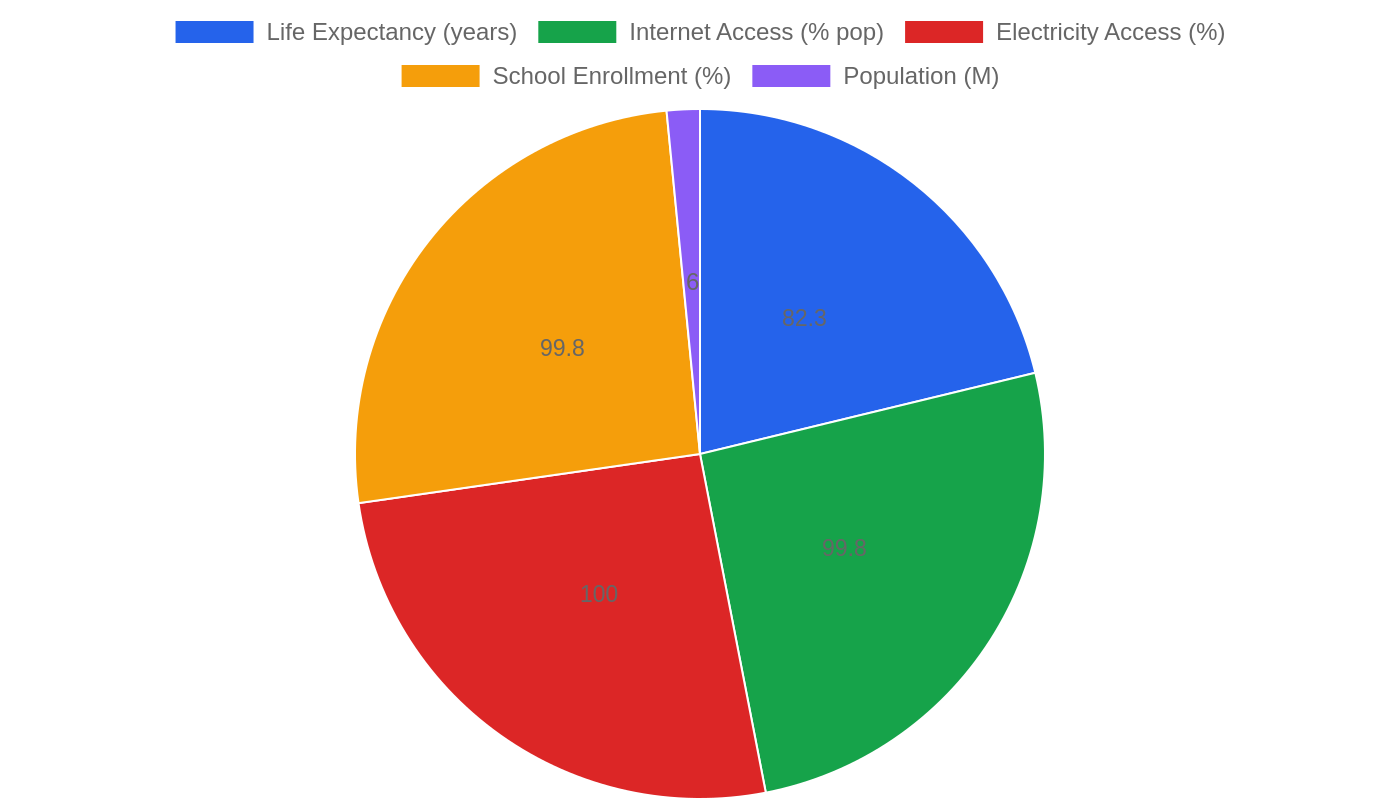
– With a GDP per capita (PPP) of over $83,000, Denmark ranks among the world’s wealthiest nations, though its population of just 6 million means this prosperity is concentrated in a small, highly productive workforce.
– The political system — a stable constitutional monarchy with a parliamentary framework — provides institutional continuity that underpins investor confidence and social cohesion.
Growth Without the Drama — Denmark’s Economic Engine
Denmark’s economic story in 2025 is one of quiet competence. The World Bank reports GDP growth of 2.93% — a figure that would make many larger European economies envious. This is not the volatile, stimulus-fueled expansion seen elsewhere; it is organic growth from a mature, export-oriented economy that has found its rhythm. The inflation figure of 1.89% is particularly striking.
At a time when central banks across Europe are still wrestling with sticky price pressures, Denmark has inflation that is not just under control but practically benign. This allows businesses to plan, consumers to spend with confidence, and policymakers to avoid the painful trade-offs between growth and price stability that plague less disciplined economies.
The unemployment rate of 5.53% tells a nuanced story. It is low enough to suggest full employment and healthy labour demand, yet high enough to avoid the wage-price spirals that can destabilise an economy. This is the sweet spot — a labour market with enough slack to accommodate growth without triggering inflationary bottlenecks. Denmark’s GDP per capita (PPP) of $83,218 is a staggering figure, placing it among the global elite.
For context, this means the average Dane enjoys a standard of living that rivals or exceeds that of citizens in much larger, resource-rich nations. This prosperity is built on a foundation of high-value industries, from pharmaceuticals to renewable energy, and a workforce that is among the most educated and productive in the world.
The main industries driving this performance — while not explicitly detailed in the data — can be inferred from the corporate landscape. Health care giants like Ambu and ALK-Abelló, consumer goods stalwarts such as Arla Foods and Bang & Olufsen, and industrial firms like Alectia and Arkitema Architects all point to an economy that excels in niche, high-margin sectors. Denmark does not compete on volume; it competes on quality, innovation, and brand reputation.
The World Bank data confirms that this strategy is working.
The Price of Nordic Comfort — Living Costs in Denmark
Denmark’s cost of living is notoriously high, but the data provided offers no specific figures on housing or daily expenses. What we can say with confidence is that the country’s low inflation rate — 1.89% according to the World Bank — provides some relief to households. In an era of double-digit price increases across much of Europe, Danish consumers are facing relatively modest rises in the cost of groceries, utilities, and services.
This does not mean Denmark is cheap; it means that the trajectory of prices is more manageable than elsewhere.
Housing in Copenhagen and other major cities has long been a challenge, driven by limited supply and strong demand from a wealthy population. The combination of low interest rates (until recently) and high incomes has pushed property values to elevated levels. Renting is common among younger Danes, but the rental market is tightly regulated, which can create waiting lists for affordable apartments. Outside the capital, prices are more reasonable, and the quality of housing stock is generally excellent.
The cost of living in Denmark is a trade-off: you pay more for almost everything, but you also receive world-class public services, from healthcare to education, that are largely funded through high taxes.
Commerce in the Kingdom — Where the Smart Money Goes
Denmark’s corporate landscape is dominated by a mix of global household names and specialised industrial players. Arla Foods, the dairy cooperative, is a behemoth in consumer goods, supplying milk, cheese, and butter to markets across Europe and beyond. Bang & Olufsen represents the high-end consumer electronics segment, where Danish design and engineering command premium prices.
In health care, Ambu and ALK-Abelló are significant players in medical devices and allergy treatments respectively, sectors that benefit from aging populations and rising health consciousness worldwide.
The financial sector is anchored by Alm. Brand, a diversified insurance and banking group that reflects the stability of Denmark’s financial system. The presence of Alectia and Arkitema Architects in the industrials category points to a thriving construction and engineering consultancy sector, which is likely benefiting from Denmark’s ambitious green energy transition and infrastructure modernisation.
For investors, Denmark offers exposure to stable, well-governed companies that tend to prioritise dividends and long-term value creation over speculative growth. The business environment is transparent, with strong rule of law and low corruption, making it an attractive destination for foreign direct investment, particularly in renewable energy, life sciences, and technology.
The Danish Model — Safety, Politics, and the Good Life
Denmark operates under a constitutional monarchy, as established in the 1849 Constitution. The monarch retains ceremonial executive powers, presiding over the Council of State, but in practice, the Prime Minister and elected parliament wield real authority. This system has provided remarkable political stability for over 170 years. Governments come and go, but the institutional framework remains constant, creating a predictable environment for both citizens and businesses.
The political landscape is characterised by consensus-building and coalition governments, which can slow decision-making but also prevents the wild policy swings seen in more polarised democracies.
Crime and safety indices were not provided in the data, but Denmark consistently ranks among the safest countries in the world in international surveys. Violent crime is rare, and trust in police and public institutions is exceptionally high. This safety net extends beyond law enforcement to include a comprehensive welfare state that cushions citizens against economic shocks.
The combination of political stability, low crime, and high social trust contributes to Denmark’s consistently top-tier rankings in global happiness and quality-of-life reports. For the 6 million residents, life is not just prosperous — it is secure and predictable.
Fresh Off the Presses — Denmark’s 2025 Reality Check
The most recent data from the World Bank paints a picture of an economy that is firing on all cylinders. The 2.93% GDP growth figure for 2025 is particularly noteworthy because it comes at a time when many European economies are stagnating or barely growing. Denmark appears to have found a formula that combines fiscal discipline with targeted investment in high-productivity sectors. The inflation rate of 1.89% is below the European Central Bank’s target, giving Danish policymakers unusual flexibility.
They are not forced to choose between fighting inflation and supporting growth — they can do both.
The unemployment rate of 5.53% is low by historical standards but not so low as to create severe labour shortages. This suggests that Denmark’s labour market is adapting well to structural changes, including the shift toward green energy and digitalisation. The population of just over 6 million means that labour supply is a constant constraint, but high productivity levels offset this limitation.
Looking ahead, Denmark faces challenges common to all wealthy nations: an aging population, the need for continued investment in green technology, and the pressure to maintain social cohesion in an increasingly globalised world. But based on the data available, Denmark enters 2026 with stronger fundamentals than most of its peers.
The Bottom Line
Denmark is not a country for investors seeking high-risk, high-reward plays. It is a haven for those who value stability, transparency, and steady returns. The combination of solid GDP growth, tame inflation, moderate unemployment, and a GDP per capita that ranks among the world’s best makes Denmark a model of how a small, open economy can thrive in the 21st century. Policymakers, economists, and business leaders looking for a case study in balanced macroeconomic management should study Denmark closely.
For the average citizen, the data confirms what Danes already know: the system works, and it works well.
Sources & Methodology
This article is authored by Economic Pulse Net for informational and research purposes. Economic Pulse Net sources its data from multilateral institutions, national statistics bureaus, and proprietary databases. All data is believed to be current as of the date of publication.
Published: July 30, 2026 | Category: Research — Denmark
Use these signals in your own platform
Economic Pulse publishes its live signal feed through a documented, read-only API. Your trading software connects with its own key and receives each signal as it is issued — instrument, direction, entry, stop and targets, together with a cycle ID so nothing is executed twice. The feed is independent of this website and cannot change it.
Signals are informational only and are not financial advice.