Economic Pulse Net | Sources: World Bank World Development Indicators, Government Sources | 2026
Key Takeaways
* The Czech economy is projected to grow by approximately 2.58% in 2025, signaling steady expansion within a stable democratic framework.
Inflation remains under control at roughly 2.46%, while unemployment sits at a remarkably low 2.825%, indicating a tight labor market.
With a GDP per capita (PPP) nearing $60,500, the nation offers one of the highest standards of living in Central Europe.
The political landscape is defined by a bicameral parliamentary system that ensures pluralist representation and checks on executive power.
Investors are drawn to a mature economy with strong industrial roots, though detailed corporate and cost-of-living specifics require deeper localized analysis.
Economic Resilience Amidst Global Shifts
The Czech Republic’s economic trajectory for 2025 presents a picture of cautious optimism and structural stability. According to World Bank data, the nation’s Gross Domestic Product (GDP) is expected to expand by 2.58046673293437%, a figure that reflects a balanced approach to growth amidst global headwinds. This growth is supported by a robust domestic foundation, evidenced by a total GDP of approximately $391 billion USD.
Perhaps more telling than aggregate size is the wealth distribution; the GDP per capita based on Purchasing Power Parity (PPP) stands at an impressive $60,487.29, suggesting that citizens enjoy a high standard of consumption relative to local prices. Furthermore, the national income metric, GNI per capita, is recorded at $32,960, reinforcing the country’s status as a high-income economy.
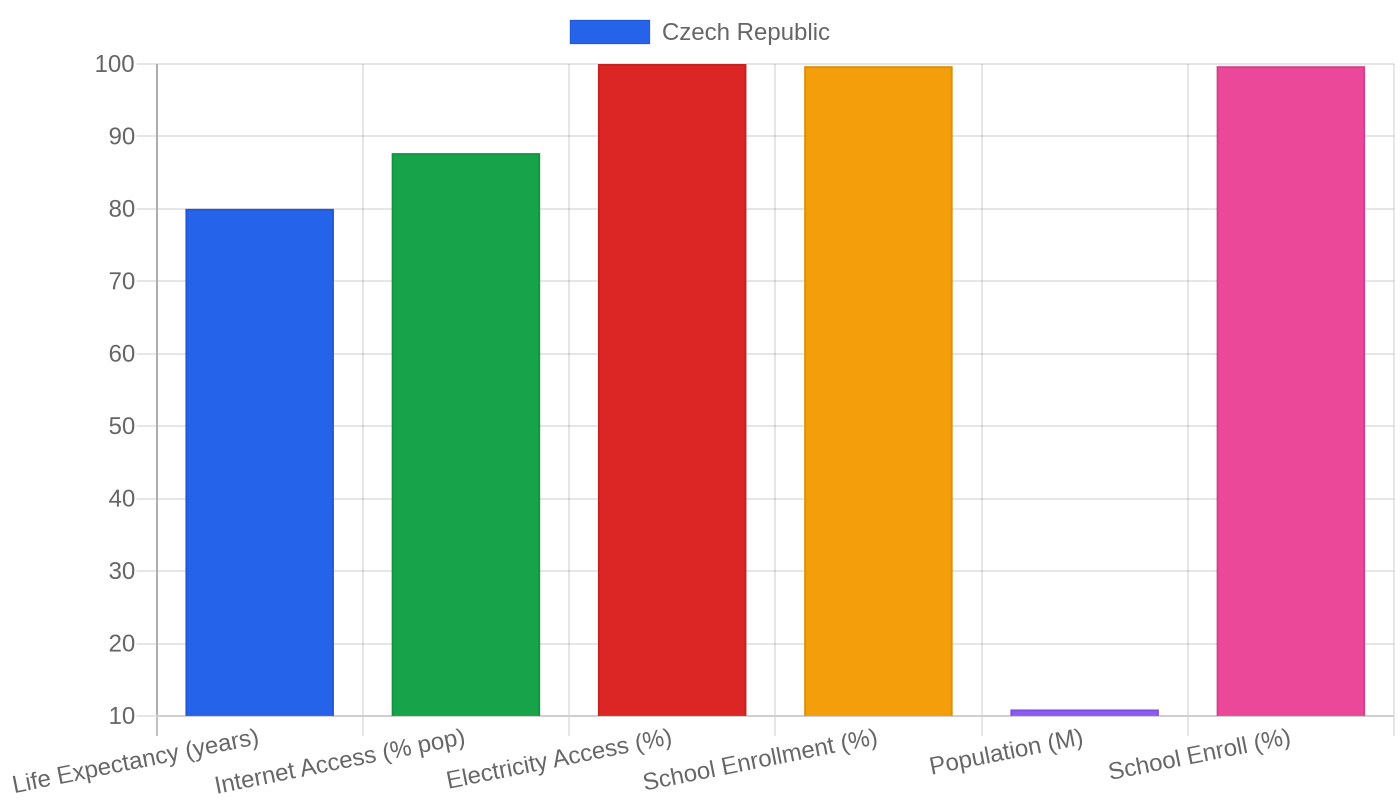
This economic output is generated by a population of just over 10.8 million people, allowing for efficient resource allocation and high productivity per worker. The interplay between moderate growth and high per-capita metrics indicates an economy that is maturing rather than exploding, prioritizing quality of life and sustainable development over rapid, volatile expansion.
Navigating the Cost of Living Landscape
For residents and expatriates alike, understanding the financial rhythm of daily life in the Czech Republic is crucial for long-term planning. While specific granular data on housing rents or consumer price baskets for individual goods is not fully detailed in the current dataset, the macroeconomic indicators provide strong clues about affordability.
With inflation measured at 2.45996367838864%, price stability is a significant advantage for households, preserving purchasing power better than in many inflation-hit regions. This controlled inflation environment suggests that essential goods and services are unlikely to experience sudden, disruptive spikes in cost. Additionally, the low unemployment rate of 2.825% implies strong wage competition, which typically helps offset rising living costs by increasing household incomes.
For those considering relocation or investment, the high PPP-adjusted GDP per capita serves as a proxy for overall accessibility to premium services, healthcare, and infrastructure, even if exact rental yields or grocery bills remain opaque in this snapshot. The general economic health suggests a cost structure that is manageable for middle-to-upper-income earners, though precise budgeting would require localized real estate and retail data.
Investment Potential and Business Climate
The business environment in the Czech Republic is anchored by its position as a manufacturing and service hub in Central Europe. While the provided data does not list specific top companies or exhaustive industry breakdowns, the macroeconomic strength points to a diverse commercial ecosystem. The low unemployment rate of 2.825% highlights a competitive labor market where businesses must offer attractive conditions to secure talent, fostering innovation and efficiency.
Companies operating in this space benefit from a stable political framework and a highly educated workforce, which are critical for high-value industries such as automotive, engineering, and information technology. The World Bank’s assessment of the country’s economic performance suggests a favorable climate for foreign direct investment, particularly in sectors that leverage the country’s central geographic location for logistics and supply chain integration.
Although specific corporate leaders are not enumerated here, the aggregate economic figures imply a mature market with established players who dominate regional trade. Investors should look toward sectors that complement the existing industrial base, keeping in mind that the high GDP per capita indicates a sophisticated consumer market ready for advanced products and services.
Safety, Politics, and Quality of Life
The social fabric of the Czech Republic is woven with threads of political stability and civic engagement. The nation operates as a pluralist multi-party parliamentary representative democracy, ensuring that no single entity holds unchecked power. The Parliament, known as *Parlament České republiky*, is bicameral, consisting of the Chamber of Deputies (*Poslanecká sněmovna*) with 200 members and the Senate (*Senát*) with 81 members.
This structure promotes thorough legislative debate and representation across the country’s 14 administrative regions. Members of the Chamber are elected every four years through proportional representation with a 5% election threshold, preventing fragmentation while ensuring minority voices can gain entry if they meet the benchmark. Regarding personal safety, available indices currently mark Crime and Safety scores as N/A, meaning comprehensive statistical comparisons cannot be made at this time.
However, the broader context of a stable democracy with strong rule of law generally correlates with lower violent crime rates compared to less developed nations. The combination of political transparency and economic prosperity contributes to a high quality of life, making it an attractive destination for families and professionals seeking security and opportunity.
Current Affairs and Policy Directions
Looking ahead, the immediate focus for policymakers and businesses is maintaining the momentum of the 2.58% growth projection while managing the delicate balance of inflation at 2.46%. Recent economic assessments suggest that the government is prioritizing fiscal discipline to keep price pressures in check without stifling the labor market, which is already near full employment at 2.825%.
As the next electoral cycles approach, political parties will likely campaign on platforms centered around sustaining this high GDP per capita ($60,487 PPP) and protecting the national income levels ($32,960 GNI). There is also growing attention on how the country will adapt its industrial policies to meet European Union green energy standards, a shift that could reshape the main industries driving the $391 billion economy.
Stakeholders are watching closely to see if the current administration will introduce reforms to further integrate the Czech labor force into digital and tech-driven sectors. The stability of the bicameral parliament provides a predictable backdrop for these policy shifts, allowing businesses to plan with greater confidence. Ultimately, the narrative of the next few years will be defined by whether the Czech Republic can leverage its human capital to maintain its edge in a competitive European market.
The Bottom Line
The Czech Republic emerges as a beacon of stability and prosperity in Central Europe, offering investors and residents a blend of high income potential and political reliability. Its strong GDP per capita and controlled inflation make it a safe haven for capital preservation and lifestyle enhancement. While some granular data points remain unavailable, the overarching economic indicators paint a clear picture of a healthy, mature economy.
For those seeking a foothold in the EU market with minimal volatility, the Czech Republic deserves serious consideration.
Sources & Methodology
This article is authored by Economic Pulse Net for informational and research purposes. Economic Pulse Net sources its data from multilateral institutions, national statistics bureaus, and proprietary databases. All data is believed to be current as of the date of publication.
Published: October 17, 2026 | Category: Research — Czech Republic
Use these signals in your own platform
Economic Pulse publishes its live signal feed through a documented, read-only API. Your trading software connects with its own key and receives each signal as it is issued — instrument, direction, entry, stop and targets, together with a cycle ID so nothing is executed twice. The feed is independent of this website and cannot change it.
Signals are informational only and are not financial advice.