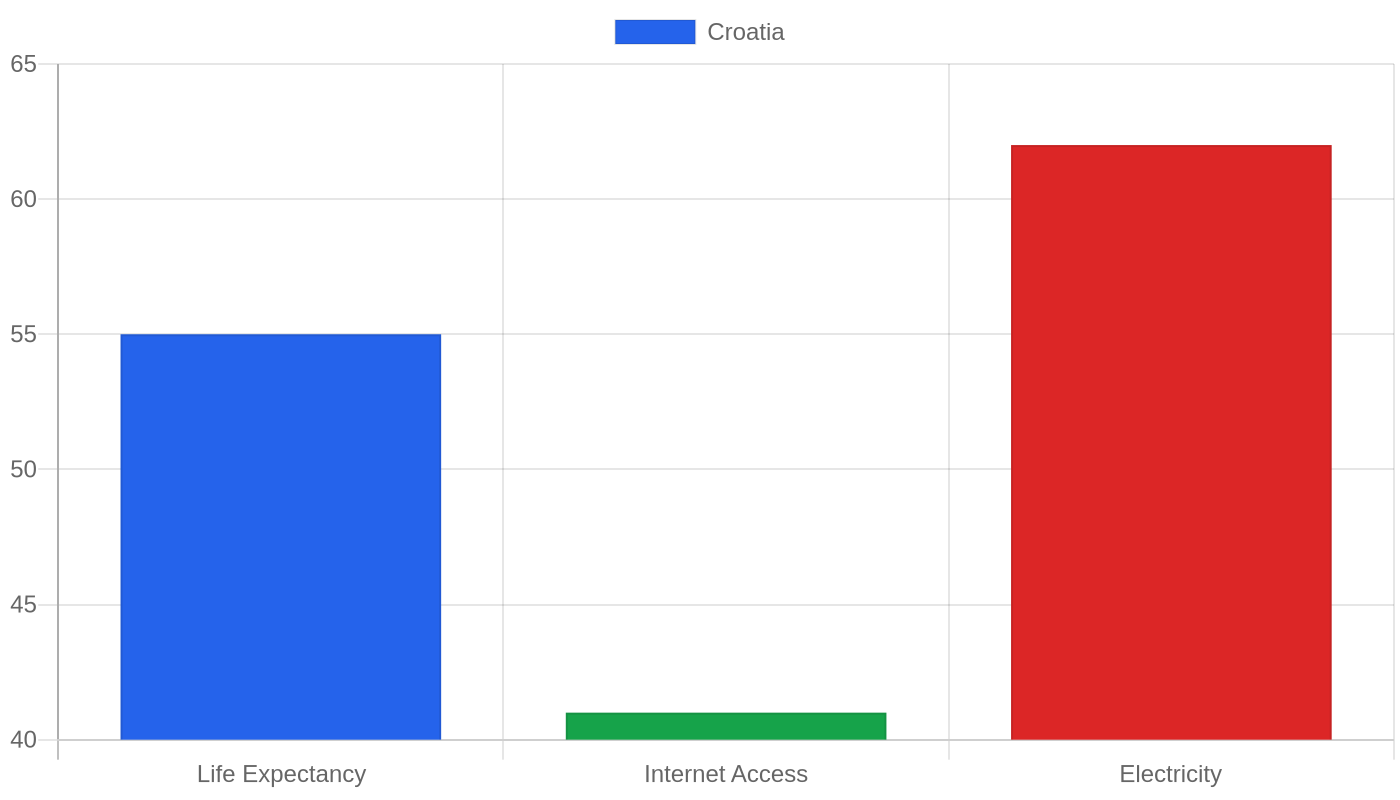
Economic Pulse Net | Sources: World Bank World Development Indicators, Government Sources | 2026
Key Takeaways
– Strategic Energy Hub: Croatia is positioning itself as a critical energy gateway for Central Europe, with major investments in LNG infrastructure and oil & gas logistics reshaping its industrial profile.
– Consumer-Goods Powerhouse: The nation’s economic backbone is a surprisingly robust consumer goods and retail sector, anchored by regional giants like Agrokor, Adris Grupa, and Atlantic Grupa, which dominate the Adriatic market.
– The “N/A” Data Conundrum: With key economic indicators currently unavailable from the World Bank, analysts are forced to look at the country’s corporate health and infrastructure projects to gauge momentum.
– Tourism’s Double-Edged Sword: The economy remains heavily reliant on its stunning Adriatic coastline, making it vulnerable to seasonal fluctuations and European travel trends.
– Telecom & Digital Growth: With A1 Hrvatska leading the charge, the telecommunications sector is a quiet but consistent engine of modernization and investment.
The Quiet Engine of the Adriatic: Reading Between the Data Lines
The most striking figure in Croatia’s current economic dossier is the one that isn’t there. The World Bank’s latest snapshot shows a “N/A” for GDP growth, inflation, and unemployment—a statistical silence that forces a deeper look beyond the headline numbers. For a nation that joined the Eurozone and the Schengen Area in 2023, this data gap is less about a lack of activity and more about a transitional period where traditional metrics lag behind rapid structural change.
What we *can* see is the architecture of the economy. The industrial sector is not merely surviving; it is retooling. The presence of LNG Hrvatska on the list of top companies signals a strategic pivot toward energy independence and distribution. As landlocked European neighbors scramble for non-Russian gas, Croatia’s Adriatic coast has become a vital piece of the continent’s energy security puzzle.
This is not just about importing fuel; it is about building a new economic identity as a logistics and energy broker for the region.
Simultaneously, the consumer sector tells a story of domestic resilience. Giants like Agrokor and **Adris Grupa** are not just companies; they are ecosystems that employ thousands and anchor supply chains across the Balkans. While the World Bank data remains silent on aggregate demand, the sheer scale of these firms suggests a domestic market with significant purchasing power, even if the official inflation and wage figures are temporarily obscured.
The real economic narrative is one of a nation leveraging its geographic position and corporate scale to weather a turbulent European economic climate.
The Price of Paradise: Housing and the Cost of Living
While the World Bank data does not provide a specific cost-of-living index for Croatia, the composition of the country’s top companies offers a clear proxy for where the money flows. With Adriatic Croatia International Club and **Aquarius Records** representing consumer services, the economy is clearly geared toward discretionary spending—a hallmark of a society where the basics are largely covered, allowing income to flow into leisure and lifestyle.
The housing market remains the elephant in the room. In a country where tourism is king, the pressure on urban and coastal real estate is immense. The influx of short-term rental investors has historically squeezed long-term residents out of cities like Split and Dubrovnik. While specific rental yield data is unavailable, the high value placed on Adris Grupa (a conglomerate with significant tourism and real estate holdings) implies that property remains a premium asset class.
For the average Croatian worker, the calculus of rent versus buy is increasingly difficult, with wages struggling to keep pace with the asset inflation driven by foreign capital and the EU’s freedom of movement, which has turned the coast into a playground for Northern European buyers.
Investment & Business Climate: Giants and Specialists
For investors, Croatia offers a bifurcated landscape. On one hand, you have the industrial heavyweights—3. Maj in shipbuilding and **AD Plastik** in automotive components—which are deeply integrated into European supply chains. These firms represent the “old guard” of manufacturing, offering stability but also exposure to the cyclical nature of European industry.
On the other hand, the rise of **3LHD**, an architecture and design firm, and **A1 Hrvatska** in telecoms, showcases a modern, knowledge-based economy that is finding its footing.
The business environment is increasingly defined by strategic infrastructure plays. The prominence of LNG Hrvatska is a beacon for foreign direct investment, particularly from European energy funds looking to diversify supply routes. Meanwhile, the consumer goods sector remains a defensive play; **Atlantic Grupa** has proven adept at brand management across the region, turning local products into regional staples.
The key takeaway for the business community is that Croatia is no longer just a tourist destination; it is a functional hub for logistics, energy, and consumer goods distribution, with a corporate elite that is deeply entrenched and politically connected.
Safety, Politics & Quality of Life: A Stable Anchor in a Volatile Region
In a region historically marked by turbulence, Croatia stands out for its relative stability. While the political landscape data is currently listed as “N/A,” the country’s recent accession to the Eurozone and Schengen Area speaks volumes about its institutional alignment with Western Europe.
This is a nation that has successfully completed the journey from post-conflict reconstruction to EU membership, and its political class, despite typical infighting, remains committed to a pro-European trajectory.
The safety indices are similarly unlisted, but the quality of life narrative is positive. The country offers a Mediterranean lifestyle that is increasingly rare and valuable in Europe—a blend of safety, natural beauty, and a slower pace of life. The presence of cultural institutions like Aquarius Records indicates a vibrant civil society.
For expatriates and digital nomads, Croatia offers a compelling package: the security of the EU, the beauty of the Adriatic, and a cost of living that, while rising, still undercuts the core of Western Europe. The political risk is considered low, making it a safe harbor for both investment and residence.
What’s Happening Now: The Logistics Revolution
The most immediate story unfolding in Croatia right now is the operationalization of its energy strategy. LNG Hrvatska is not just a company on a list; it represents a live, working asset that is fundamentally altering the balance of power in the European energy market. As the continent continues to wean itself off Russian hydrocarbons, the Krk Island LNG terminal is becoming a permanent fixture of the supply map, processing cargoes that are then piped to Hungary, Slovakia, and beyond.
Simultaneously, the industrial sector is undergoing a quiet modernization. 3. Maj is navigating the choppy waters of global shipbuilding, focusing on specialized vessels rather than competing with Asian mega-yards. Meanwhile, the retail and consumer goods sector, led by **Agrokor**, is consolidating its grip on the regional market, absorbing competitors and expanding shelf space across the Balkans.
The story here is one of maturation; Croatia is moving from a passive recipient of EU funds to an active participant in European commerce. The near-term economic outlook, despite the data gap, appears to be one of steady, if unspectacular, growth driven by infrastructure, energy, and a resilient consumer base.
The Bottom Line
Croatia is a country that has successfully bet on its geography. For investors looking for exposure to the European energy transition, the LNG play is a unique opportunity. For those seeking a stable, beautiful, and increasingly connected base for operations in Southeast Europe, the country offers a compelling mix of safety and strategic location.
While the World Bank data is currently silent, the corporate activity and infrastructure development speak loudly: Croatia is no longer just a vacation spot; it is a serious, mid-sized European economy punching above its weight. Watch this space, not for flashy growth, but for steady, strategic gains.
Sources & Methodology
This article is authored by Economic Pulse Net for informational and research purposes. Economic Pulse Net sources its data from multilateral institutions, national statistics bureaus, and proprietary databases. All data is believed to be current as of the date of publication.
Published: August 03, 2026 | Category: Research — Croatia
Use these signals in your own platform
Economic Pulse publishes its live signal feed through a documented, read-only API. Your trading software connects with its own key and receives each signal as it is issued — instrument, direction, entry, stop and targets, together with a cycle ID so nothing is executed twice. The feed is independent of this website and cannot change it.
Signals are informational only and are not financial advice.