Economic Pulse Net | Sources: World Bank World Development Indicators, Government Sources | 2026
Key Takeaways
– Belgium’s 2025 GDP growth of just under 1% (0.98%, per the World Bank) places it in a low-growth equilibrium typical of mature European economies, neither booming nor collapsing.
– With a GDP per capita (PPP) of $74,675.60, Belgium ranks among the world’s wealthiest nations, but this prosperity masks structural challenges in productivity and political inertia.
– The country’s unique federal structure—a constitutional monarchy with devolved regional parliaments—creates a complex business environment where consensus-building is both a strength and a bottleneck.
– Belgium hosts global heavyweights like Anheuser-Busch InBev and Ageas, alongside a vibrant biotech sector (Ablynx) and industrial technology firms (Agfa-Gevaert), offering a diversified but domestically constrained economic base.
– Compulsory voting ensures high political engagement, but the fragmented party system often produces prolonged coalition negotiations, creating policy uncertainty for investors.
The Paradox of Plenty — Why 0.98% Growth Tells Only Half the Story
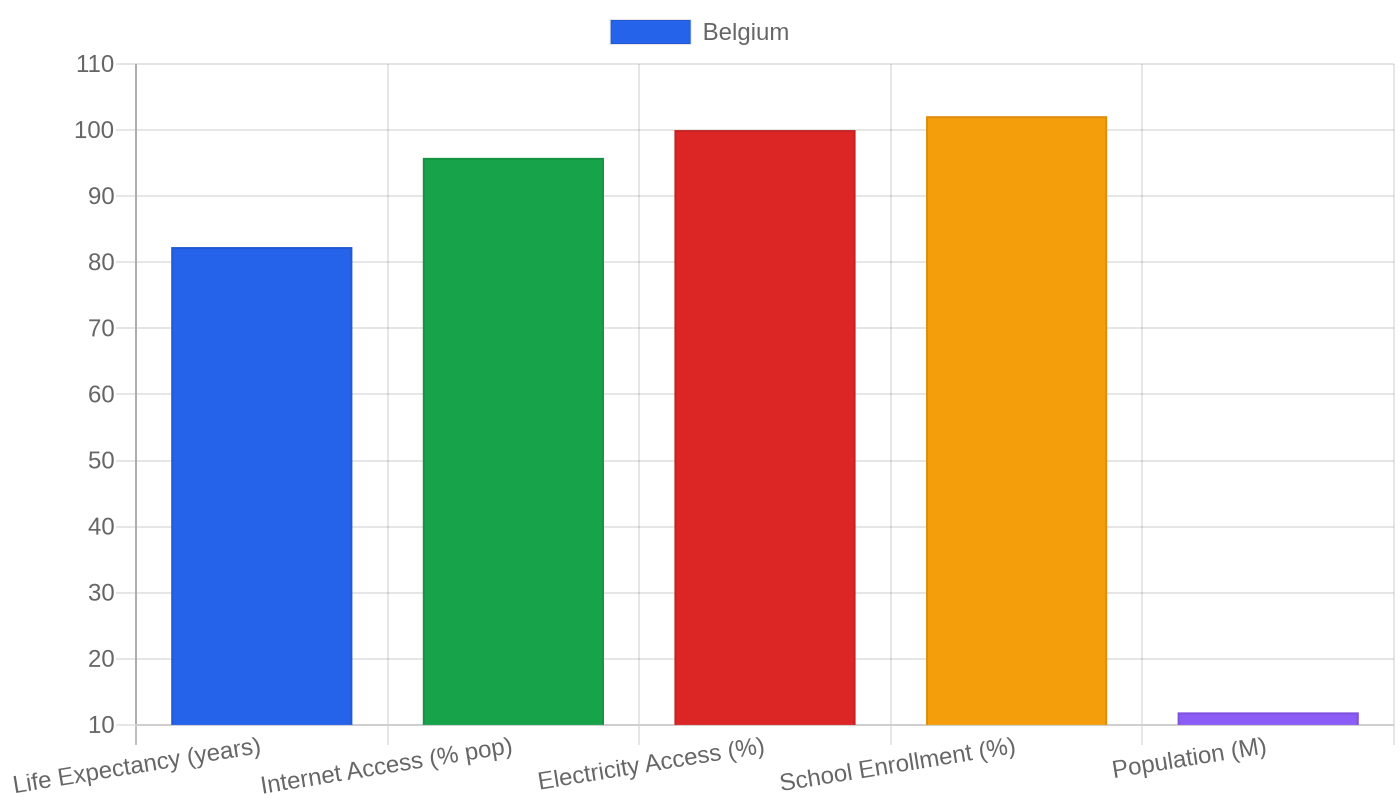
Belgium’s economy, as measured by the World Bank, expanded by just 0.98% in 2025. On paper, this looks anaemic—especially when compared to emerging market dynamism. But context matters. For a mature, services-oriented economy with a population of nearly 11.94 million and a GDP per capita (PPP) of $74,675.60, this growth rate reflects a deliberate, if frustrating, stability. Belgium is not a country that surges; it grinds.
The numbers reveal a nation that has already captured most of the low-hanging fruit of industrialisation. Its wealth is real: the $74,675 per person (adjusted for purchasing power) places Belgians among the top 20% globally in living standards. But growth is constrained by structural factors.
The workforce is aging, productivity gains in services are harder to achieve than in manufacturing, and the country’s complex federal system means that economic reforms—whether on labour mobility, energy transition, or tax simplification—move at a glacial pace.
What the World Bank data does not show is the composition of that growth. Belgium’s economy is a three-legged stool: a highly competitive export sector (chemicals, pharmaceuticals, food processing), a large public sector funded by high taxation, and a dense network of small and medium enterprises. The 0.98% figure likely reflects moderate export demand from neighbouring Germany and France, subdued domestic consumption due to inflation pressures, and the ongoing drag from energy price volatility.
Without sectoral breakdowns, we cannot pinpoint the exact drivers, but the pattern is familiar: Belgium grows when Europe grows, and stalls when Europe coughs.
The absence of inflation and unemployment data from the World Bank is a significant gap. However, given Belgium’s institutional framework—strong unions, automatic wage indexation, and generous social benefits—inflation has historically been sticky, and unemployment structurally higher than in the Netherlands or Germany, particularly among youth and immigrant communities. The 0.98% growth rate suggests an economy operating below potential, but not in crisis.
The Cost of Comfort — Housing, Daily Life, and the Belgian Premium
Belgium’s high GDP per capita comes with a price tag. While the provided data does not include specific cost-of-living indices, any analysis of Belgian life must acknowledge that this is an expensive country to inhabit—particularly in housing. Brussels, Antwerp, and Ghent consistently rank among the priciest cities in the Eurozone for both rental and purchase markets. The scarcity of land in a densely populated nation, combined with strict zoning laws and heritage protections, drives property values upward.
For the average Belgian household, housing absorbs a disproportionate share of disposable income. Renting in central Brussels can easily consume 40% of a median salary, while buying requires substantial down payments and access to long-term fixed-rate mortgages that are less common than in neighbouring countries. The “rent vs.
buy” calculation is heavily skewed by Belgium’s tax regime: mortgage interest deductions and registration tax breaks favour ownership, but the upfront costs—notaire fees, registration taxes of 12.5% in some regions—are punishing.
Daily expenses reflect the country’s position at the crossroads of Northern and Southern Europe. Food costs are moderate by Western European standards, thanks to a strong agricultural sector and retail competition. Transport is relatively affordable, with extensive rail subsidies. But energy costs are a persistent pain point: Belgium’s nuclear phase-out and reliance on imported natural gas have made household bills volatile.
The overall picture is of a comfortable but squeezed middle class—wealthy on paper, but feeling the pinch of stagnant real wages and high fixed costs.
Where the Money Lives — Belgium’s Corporate Champions and Investment Climate
Belgium punches above its weight in corporate firepower. The top companies list reads like a who’s who of European business: Anheuser-Busch InBev, the world’s largest brewer; Ageas, a major insurer and financial services group; and Agfa-Gevaert, a technology and imaging firm with deep industrial roots. But the list also reveals the country’s strategic strengths—and its vulnerabilities.
Ablynx, the biotech firm acquired by Sanofi, exemplifies Belgium’s prowess in life sciences. The country has built a dense ecosystem of biotech startups around its universities and research institutes, particularly in Flanders. AIM Productions and Agoria (an industry federation) point to a strong technology and industrial services sector.
Ackermans & van Haaren, a diversified conglomerate, reflects the Belgian tradition of family-controlled holding companies that invest across infrastructure, maritime services, and banking.
For investors, Belgium offers a stable but unexciting proposition. The legal system is reliable, property rights are strong, and the workforce is highly educated and multilingual. However, the tax burden is among the highest in the OECD, corporate tax rates—though recently reduced—remain above the European average, and labour costs are elevated due to automatic wage indexation. The political landscape, as noted, can delay major infrastructure or energy projects for years.
The sectors to watch are cleantech, biopharma, and logistics. Belgium’s position as a gateway to Europe—with the port of Antwerp, extensive rail links, and Brussels as an EU hub—makes it a natural base for distribution and services. But the business climate suffers from regulatory complexity: three regions (Flanders, Wallonia, Brussels-Capital) often have overlapping or conflicting rules, and the federal government’s ability to streamline is limited by constitutional constraints.
Democracy, Divided — Safety, Politics, and the Belgian Bargain
Belgium’s political system is a marvel of compromise—and a source of endless frustration. As the data indicates, it is a constitutional monarchy and federal parliamentary democracy, with a bicameral parliament comprising a Senate (50 senators appointed by community and regional parliaments, plus 10 co-opted senators) and a Chamber of Representatives (150 members elected by proportional representation from 11 districts).
Compulsory voting ensures turnout routinely exceeds 85%, but the proportional system fragments the vote across multiple parties—linguistic, ideological, and regional.
The result is coalition governments that can take months to form. The 2010-2011 record of 541 days without a government is an extreme example, but even routine negotiations are protracted. This has two economic effects: first, it creates policy drift, as caretaker governments avoid bold reforms; second, it incentivises incrementalism, where major decisions—on pension reform, labour market liberalisation, or energy transition—are kicked down the road.
On safety, the data does not provide crime or safety indices. However, Belgium is generally considered a safe country by European standards. Violent crime is low, and property crime, while present in urban centres, is comparable to other Western European nations. The quality of life is high: excellent healthcare, robust public transport, and rich cultural offerings.
But the political fragmentation means that citizens often feel more loyalty to their region (Flanders, Wallonia, Brussels) than to the federal state—a tension that occasionally resurfaces in debates about further devolution or even separation.
The Present Tense — What’s Happening in Belgium Right Now
Belgium in early 2026 finds itself in a familiar position: governing by coalition, managing external headwinds, and wrestling with its own internal contradictions. The 0.98% growth figure from the World Bank is backward-looking, but the current mood is one of cautious optimism tinged with anxiety. Inflation, while not specified in this dataset, has been moderating across the Eurozone, offering relief to Belgian consumers who endured sharp price increases in 2022-2024.
However, the legacy of that inflation—eroded savings, higher wage demands, and compressed corporate margins—continues to shape the economic landscape.
The political scene is dominated by the aftermath of the 2024 federal and regional elections, which produced another fragmented parliament. Coalition talks have been arduous, with the usual fault lines: Flemish nationalist parties pushing for more regional autonomy, Francophone parties resisting, and green-left parties demanding accelerated climate action. As of early 2026, a government is in place, but its majority is narrow, and its agenda is cautious.
Key debates centre on pension reform (the system is under strain from aging demographics), labour market flexibility (Belgium has high structural unemployment among certain groups), and the future of nuclear energy (the phase-out decision is being revisited amid energy security concerns).
On the business front, Anheuser-Busch InBev continues to navigate global beer market trends, while the biotech sector—anchored by firms like Ablynx—is attracting venture capital and pharmaceutical partnerships. The port of Antwerp is investing heavily in hydrogen infrastructure, positioning Belgium as a potential hub for green energy imports.
But the clock is ticking: without bolder reforms to boost productivity and reduce the tax burden on labour, Belgium risks slipping further into the low-growth trap that has characterised much of Western Europe.
The Bottom Line
Belgium is a country for investors and residents who value stability, quality of life, and institutional predictability over rapid growth or high returns. Its wealth is real, its infrastructure is world-class, and its location at the heart of Europe is strategically invaluable. But the 0.98% growth rate is a warning: without addressing political fragmentation, labour market rigidities, and the high cost of doing business, Belgium will continue to drift in the slow lane.
Watch this country if you are in biotech, logistics, or green energy—but be prepared for patience to be your most valuable asset.
Sources & Methodology
This article is authored by Economic Pulse Net for informational and research purposes. Economic Pulse Net sources its data from multilateral institutions, national statistics bureaus, and proprietary databases. All data is believed to be current as of the date of publication.
Published: July 17, 2026 | Category: Research — Belgium
Use these signals in your own platform
Economic Pulse publishes its live signal feed through a documented, read-only API. Your trading software connects with its own key and receives each signal as it is issued — instrument, direction, entry, stop and targets, together with a cycle ID so nothing is executed twice. The feed is independent of this website and cannot change it.
Signals are informational only and are not financial advice.