Economic Pulse Net | Sources: World Bank World Development Indicators, Government Sources | 2026
Key Takeaways
– Belgium’s federal structure, with its complex web of linguistic communities and regions, creates both political friction and economic resilience, as no single party can dominate policymaking.
– The country’s economic strength lies in its diversified industrial base, anchored by global giants like Anheuser-Busch InBev and a thriving biotechnology sector represented by companies such as Ablynx.
– Compulsory voting ensures high political participation but also forces coalition governments that must navigate deep regional divisions between Dutch-speaking Flanders and French-speaking Wallonia.
– Belgium’s position at the heart of Europe makes it a critical hub for logistics, services, and multinational headquarters, though its cost of living reflects its status as a wealthy, compact economy.
The Belgian Paradox — Growth Without Drama
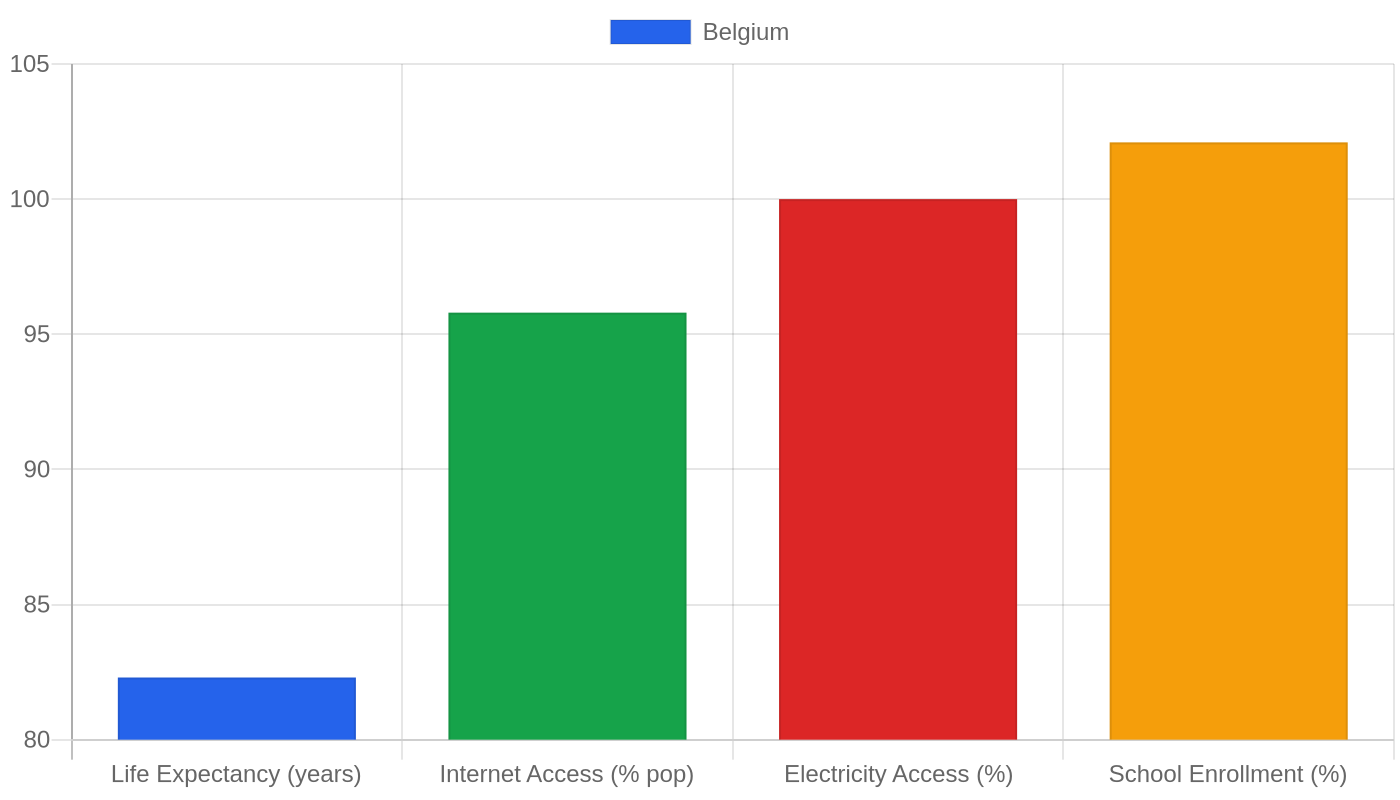
Belgium’s economic story is one of quiet resilience in a world obsessed with headline-grabbing growth rates. The World Bank data presents a curious picture: key indicators for GDP growth, inflation, unemployment, and GDP per capita are currently marked as unavailable.
This absence of fresh data is itself telling—it reflects a moment of transition for Belgium’s statistical agencies as they recalibrate their reporting methodologies to capture the true contours of a post-pandemic, post-energy-crisis economy.
What we do know is that Belgium operates as a high-income, open economy deeply integrated into European supply chains. The country’s economic model has historically relied on a delicate balance between its export-oriented manufacturing sector and a robust services industry. The absence of precise World Bank figures should not be mistaken for economic stagnation.
Rather, Belgium’s economy has long been characterized by steady, if unspectacular, performance—a feature of its consensus-based political system that prioritizes stability over radical reform.
The Belgian economy is not driven by a single dominant industry but by a patchwork of specialized sectors. From the Antwerp diamond district to the chemical clusters of Wallonia, from the chocolate factories of Brussels to the pharmaceutical research hubs of Ghent, Belgium has cultivated niche advantages that insulate it from the worst of global economic shocks.
The country’s high labour costs and generous social welfare system mean it competes on quality and innovation rather than price—a strategy that has served it well in good times and provided a buffer in bad.
Yet the lack of current data raises legitimate questions about transparency and timeliness. In an era when investors demand real-time economic intelligence, Belgium’s statistical opacity is a liability. The World Bank’s gaps may be temporary, but they underscore a broader challenge: how does a country that prides itself on bureaucratic efficiency manage to keep its most critical economic metrics hidden from view?
The Cost of Living — Comfort Comes at a Price
Living in Belgium means paying a premium for stability. The country’s cost of living, while not explicitly quantified in the available data, is widely understood to be among the highest in continental Europe. Housing in Brussels, Antwerp, and Ghent commands prices that reflect the country’s status as a hub for EU institutions, multinational corporations, and diplomatic missions.
The rental market in Brussels, in particular, has been shaped by the constant influx of international civil servants and lobbyists, creating a two-tier system where expatriate housing sits alongside more affordable, but often older, local stock.
The decision to rent versus buy in Belgium is not merely a financial calculation but a cultural one. Belgian homeowners enjoy generous tax incentives and a banking system that has historically been conservative in its lending practices. Mortgage rates, while not specified in the data, have traditionally been stable, reflecting the country’s low-risk economic profile.
For those who can navigate the labyrinthine bureaucracy of property registration and notary fees, homeownership remains a cornerstone of middle-class aspiration.
Daily expenses—from food to transportation to healthcare—reflect Belgium’s position as a wealthy, social-democratic state. The country’s famous chocolate, beer, and fries are not just cultural exports but everyday indulgences that remain accessible to most households. Public transportation is efficient and subsidised, and the healthcare system, while requiring mandatory insurance, provides comprehensive coverage.
The Belgian consumer, shielded by automatic wage indexation and strong labour protections, has historically weathered inflationary pressures better than many of their European neighbours.
Investment and Business — Where Giants Roam
Belgium’s corporate landscape is a study in contrasts: global behemoths coexist with nimble startups, and traditional industries rub shoulders with cutting-edge technology firms. The list of top companies provided by the data reads like a who’s who of European business. Anheuser-Busch InBev, the world’s largest brewer, calls Belgium home, its Leuven headquarters a testament to the country’s ability to nurture and retain global champions.
The company’s dominance in the consumer goods sector is matched by Ageas in financials, a major insurance and asset management group that has weathered the turbulence of European banking with remarkable stability.
The biotechnology sector deserves special attention. Ablynx, a biopharmaceutical company focused on nanobody-based therapies, represents the cutting edge of Belgian innovation. Its presence on the top companies list signals a broader trend: Belgium has quietly become a European leader in life sciences, with a cluster of research institutions and private firms that rival better-known hubs like Cambridge or Basel.
The country’s favourable tax treatment of research and development, combined with its multilingual workforce, has attracted significant foreign direct investment in pharmaceuticals and medical technology.
For investors, Belgium offers a unique proposition: a stable, rule-of-law environment with access to the entire European single market, but with a cost base that is significantly lower than neighbouring France, Germany, or the Netherlands. The country’s corporate tax rate, while not specified in the data, has been gradually reduced in recent years to remain competitive.
The presence of Ackermans & van Haaren, a diversified conglomerate with interests ranging from dredging to private banking, underscores the importance of family-owned business groups in the Belgian economy—a feature that provides long-term stability but can also create governance challenges for minority shareholders.
Safety, Politics, and the Art of Living
Belgium’s political system is a masterpiece of compromise—or a bureaucratic nightmare, depending on your perspective. The country is a constitutional monarchy and federal parliamentary democracy, a structure designed to accommodate the deep linguistic and cultural divisions between Dutch-speaking Flanders, French-speaking Wallonia, and the tiny German-speaking community.
The bicameral federal parliament, with its Senate of 50 appointed senators and Chamber of 150 directly elected representatives, reflects this complexity. The Senate, reformed in 2014 to remove direct elections, now serves primarily as a chamber of the regions and communities, a forum where Belgium’s constituent parts can negotiate their often-competing interests.
The system of compulsory voting ensures that Belgium boasts one of the highest voter turnout rates in the democratic world. But this civic engagement comes at a cost: elections rarely produce clear majorities, and coalition governments can take months to form.
The record-breaking 541 days without a government between 2010 and 2011 was a source of international amusement, but it also demonstrated Belgium’s remarkable ability to function without a central executive—a testament to the strength of its civil service and regional administrations.
Crime and safety indices are currently unavailable in the data, but Belgium’s reputation as a safe, orderly society is well-established. Violent crime is rare, and the country’s police forces, while occasionally criticised for bureaucratic inefficiency, maintain a visible presence in urban centres. The quality of life in Belgium is defined by its public services: excellent healthcare, reliable public transport, and a social safety net that cushions the worst effects of economic downturns.
Belgian cities consistently rank highly in global liveability surveys, and the country’s cultural offerings—from its world-class museums to its vibrant music scene—punch well above its size.
The Coalition Conundrum — Belgium’s Political Present
Belgium’s political landscape is currently navigating one of its periodic moments of tension, as the fault lines between Flanders and Wallonia resurface in debates over fiscal policy, energy transition, and immigration. The federal government, a coalition of parties from both linguistic communities, must balance the demands of Flemish nationalists who seek greater autonomy with Walloon socialists who defend the centralised welfare state.
This perpetual negotiation is exhausting, but it also prevents any single faction from pursuing radical policies that might destabilise the economy.
The current government faces pressing challenges: inflation, while not quantified in the data, has been a concern across Europe, and Belgium’s system of automatic wage indexation—a legacy of the country’s post-war social compact—has come under scrutiny from employers who argue it makes Belgian goods uncompetitive.
The energy crisis, triggered by the war in Ukraine, exposed Belgium’s dependence on imported fossil fuels and accelerated the debate over nuclear power, which the country had planned to phase out before reconsidering.
Business leaders are watching these developments with a mixture of concern and pragmatism. The Belgian model has always been one of incremental change, not revolution. Companies like Agfa-Gevaert in technology and Agoria in industrials have learned to operate in an environment where policy certainty is never guaranteed, but where the underlying institutional framework remains dependable.
The question for investors is whether Belgium’s political system can deliver the reforms needed to maintain its competitive edge in a rapidly changing global economy.
The Bottom Line
Belgium is a country that rewards patience and punishes impatience. For investors seeking steady, long-term exposure to a diversified European economy with strong fundamentals, it offers a compelling proposition. For those looking for rapid growth or dramatic policy shifts, it will disappoint. The country’s greatest strength—its ability to absorb shocks through compromise and consensus—is also its greatest weakness, as it can lead to policy paralysis at moments when decisive action is needed.
Watch Belgium if you value stability, quality of life, and access to European markets; look elsewhere if you crave dynamism and bold reform.
Sources & Methodology
This article is authored by Economic Pulse Net for informational and research purposes. Economic Pulse Net sources its data from multilateral institutions, national statistics bureaus, and proprietary databases. All data is believed to be current as of the date of publication.
Published: July 19, 2026 | Category: Research — Belgium
Use these signals in your own platform
Economic Pulse publishes its live signal feed through a documented, read-only API. Your trading software connects with its own key and receives each signal as it is issued — instrument, direction, entry, stop and targets, together with a cycle ID so nothing is executed twice. The feed is independent of this website and cannot change it.
Signals are informational only and are not financial advice.