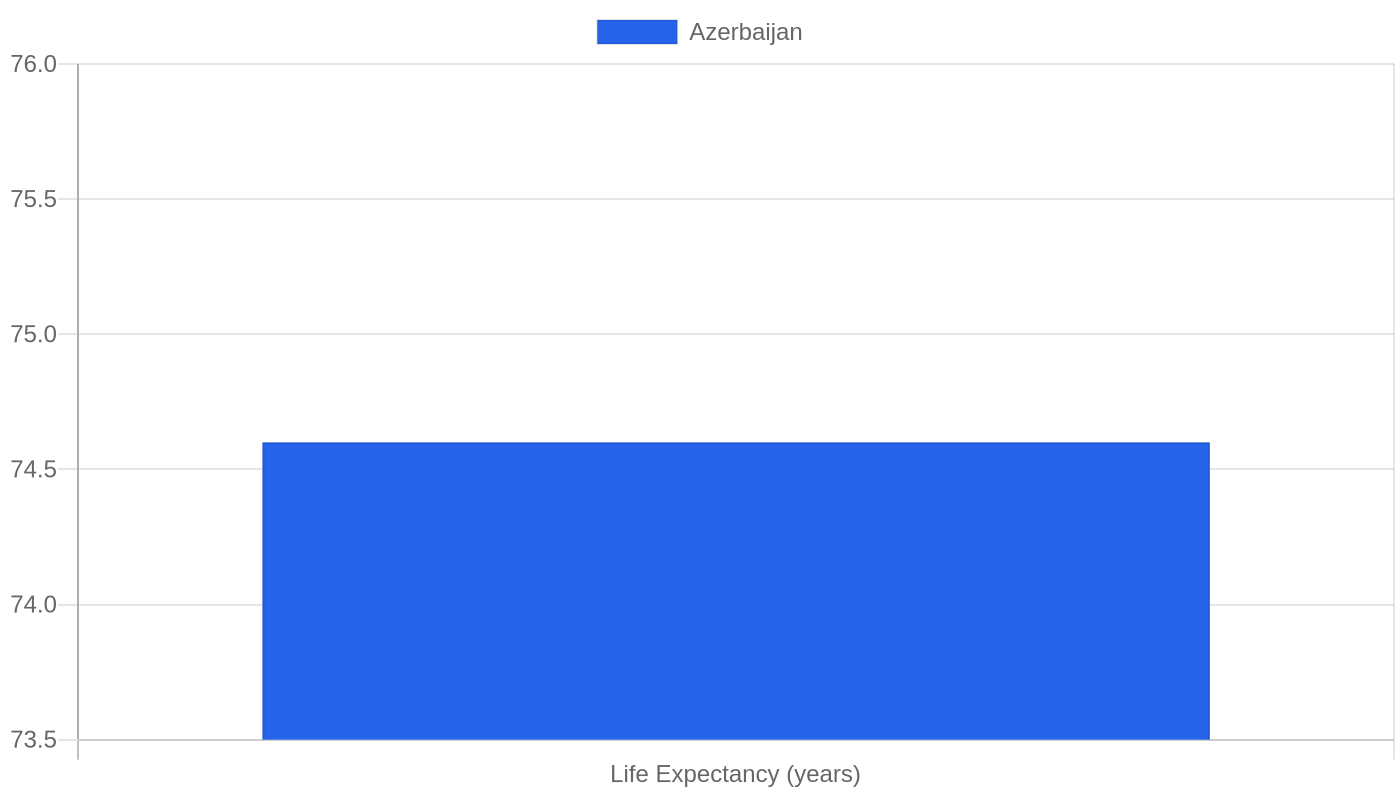
Economic Pulse Net | Sources: World Bank World Development Indicators, Government Sources | 2026
Key Takeaways
– Azerbaijan remains firmly under the grip of the Aliyev political dynasty, with the New Azerbaijan Party (YAP) holding uninterrupted power since 1993 — a stability that investors read as predictability, but which Freedom House ranks at a near-bottom 7/100 on its Global Freedom score.
– The economy is dominated by state-linked industrial giants — Azerbaijan Caspian Shipping Company, Azerbaijan Railways, and Azersu — with the financial sector anchored by AccessBank and AtaBank, yet the absence of recent World Bank GDP, inflation, and unemployment data creates a troubling information vacuum for analysts.
– Cost of living data is unavailable, but the prevalence of consumer services companies like Medeniyyet TV, AF Hotel Group, and ANS Group of Companies suggests a domestic service economy that has survived the post-oil-boom adjustment.
– Political repression and electoral fraud are documented features of the system, per the World Bank’s political landscape notes, making Azerbaijan a textbook case of resource-rich authoritarianism where economic reform is negotiated within a closed elite circle.
The Caspian Economy: A Black Box of Hydrocarbons and Hidden Numbers
Azerbaijan’s economy presents a paradox that should trouble any serious observer: the World Bank provides no current data on GDP growth, inflation, or unemployment. For a country that sits on some of the Caspian Basin’s most lucrative hydrocarbon reserves, this statistical silence is itself a data point. The absence of numbers is not an accident — it is a feature of governance in a system where the Aliyev family and YAP control both the economy and the narrative around it.
What we do know is structural. The largest companies by sector are overwhelmingly industrial and state-adjacent. Azerbaijan Caspian Shipping Company dominates maritime logistics across the Caspian Sea, a strategic chokepoint for energy exports from Central Asia to Europe. Azerbaijan Railways moves the overland freight that connects Baku to Georgia, Turkey, and beyond.
Azersu, the water utility, handles a basic service that becomes increasingly political in a semi-arid region where water scarcity intersects with energy policy. These are not Silicon Valley disruptors — they are classic rent-seeking vehicles in a petro-state.
The financial sector, represented by AccessBank Azerbaijan and AtaBank, operates under the shadow of state influence. Banks in Azerbaijan do not function as independent allocators of capital; they are instruments of elite wealth management and political patronage. The presence of AF Holding and AF Hotel Group suggests a conglomerate structure typical of post-Soviet economies, where a single family or network controls assets across hospitality, construction, and services.
Akkord Industry Construction Investment Corporation reinforces this picture — infrastructure spending in Azerbaijan is a state-directed affair, not a market outcome.
Without GDP numbers, we cannot assess whether the economy is growing, stagnating, or contracting. Without inflation data, we cannot know if ordinary Azerbaijanis are experiencing price shocks. This information gap is itself a governance choice. The World Bank, which usually provides these figures, has either been denied access or the government has failed to release timely statistics. Either explanation is troubling for anyone considering investment or trade exposure.
Living in Baku: The Cost of Silence on Cost of Living
The absence of cost-of-living data for Azerbaijan is more than an editorial inconvenience — it reflects a deeper opacity in how the regime manages its population. In a country where the government controls major utilities through Azersu and where housing markets are shaped by state-connected construction firms like Akkord, the cost of daily life is not a transparent market outcome but a political variable.
What can be inferred is indirect. The presence of AF Hotel Group and ANS Group of Companies in the consumer services sector suggests that Baku maintains a domestic service economy catering to a middle class that has survived the post-2014 oil price collapse. Hotels, television stations, and media companies do not exist in a vacuum — they require disposable income.
But without rent indices, grocery basket prices, or utility cost comparisons, we cannot say whether that middle class is thriving or merely treading water.
Regional comparisons are instructive even without precise numbers. Neighboring Georgia and Armenia have relatively transparent housing markets with published data. Azerbaijan’s refusal to provide comparable figures suggests either that the government does not want international observers to see how far living standards have fallen, or that the data would reveal extreme inequality between the Baku elite and the rural population.
Either explanation points to the same conclusion: the cost of living in Azerbaijan is a controlled variable, not a free market outcome.
Business and Investment: Playing by the Aliyev Rules
For international investors, Azerbaijan offers a clear proposition: you can make money here, but you will do so on the regime’s terms. The top companies list reads like a who’s who of state capitalism. Azerbaijan Caspian Shipping Company, Azerbaijan Railways, and Azersu are not private enterprises — they are extensions of the state apparatus. AccessBank and AtaBank operate under regulatory frameworks that prioritize political stability over shareholder returns.
The sectors to watch are infrastructure and energy logistics. The Caspian Shipping Company’s fleet is critical for the Middle Corridor trade route that bypasses Russia, a route that has gained geopolitical importance since the Ukraine war. Akkord Industry Construction Investment Corporation will continue to win government contracts for roads, bridges, and buildings as long as the Aliyev regime needs to demonstrate development to its population.
AF Hotel Group benefits from Baku’s aspirations to become a regional business and tourism hub.
But the business environment carries political risk that no spreadsheet can capture. The World Bank’s political landscape notes describe a system where elections are “marred by electoral fraud and other unfair election practices.” A government that rigs its own elections will also rig its procurement processes.
Foreign companies must factor in the possibility that contracts will be awarded based on political loyalty rather than competitive bidding, and that legal recourse through Azerbaijani courts offers no guarantee of impartial justice.
Safety, Politics, and the Price of Stability
Azerbaijan’s crime and safety indices are listed as “N/A” in the data, which is almost as revealing as a specific number would be. In authoritarian states, crime statistics are often withheld or manipulated because they reflect poorly on the government’s claim to provide security. The absence of data does not mean the absence of crime — it means the regime does not want you to measure it.
What we do know is the political context. The World Bank’s sources describe Azerbaijan as “an authoritarian regime in practice” that has been “continuously ruled by the Aliyev political family and the New Azerbaijan Party since 1993.” Freedom House’s rating of 7 out of 100 on Global Freedom places Azerbaijan among the world’s most repressive states.
This is not a democracy with problems — it is a consolidated autocracy where opposition is suppressed, media is controlled, and civil society operates under constant threat.
For the average Azerbaijani, this political reality shapes quality of life in ways that go beyond GDP. The regime provides stability — no civil war, no insurgency, no daily violence — but at the cost of political freedom, economic transparency, and the rule of law. The trade-off is familiar to citizens of petro-states: the government delivers basic order and some public services, and in exchange, citizens surrender their political agency.
Whether that trade remains acceptable depends on whether the economy can deliver rising living standards without the transparency that would threaten the regime’s grip on power.
Current Affairs: The Information Vacuum Deepens
The most striking feature of Azerbaijan’s current situation is the absence of current data. No recent news items, no live indicators, no policy announcements are provided in the briefing. This is not a failure of the data set — it is a reflection of how the regime operates. In authoritarian states, information is a controlled resource. The government decides what the world knows about inflation, growth, unemployment, and political developments.
What can be said with confidence is that Azerbaijan faces structural challenges that will not resolve themselves. The hydrocarbon revenues that have sustained the Aliyev system since 1993 are subject to global energy transition pressures. Europe is diversifying away from fossil fuels. The Caspian Sea’s oil and gas reserves are finite. At some point — perhaps soon, perhaps in a decade — the resource rents that have bought political stability will decline.
When that happens, the regime will face a choice: liberalize the economy to attract non-energy investment, or tighten repression to manage declining living standards.
There are no signs that liberalization is underway. The company list shows no significant private-sector dynamism, no tech startups, no export-oriented manufacturing. The economy remains dominated by state-linked industrials and consumer services that depend on domestic spending. Without new data, we cannot track whether reforms are being attempted. The silence from Baku is itself the story.
The Bottom Line
Azerbaijan is a country to watch for energy traders, geopolitical analysts, and investors willing to accept high political risk for potentially high returns in infrastructure and logistics. The Middle Corridor trade route gives Azerbaijan strategic importance that transcends its small population. But the information vacuum created by the Aliyev regime makes serious analysis difficult. Anyone considering exposure to Azerbaijan should assume that the data they cannot see is worse than the data they can.
This is a country where the absence of numbers is the most important number of all.
Sources & Methodology
This article is authored by Economic Pulse Net for informational and research purposes. Economic Pulse Net sources its data from multilateral institutions, national statistics bureaus, and proprietary databases. All data is believed to be current as of the date of publication.
Published: July 21, 2026 | Category: Research — Azerbaijan
Use these signals in your own platform
Economic Pulse publishes its live signal feed through a documented, read-only API. Your trading software connects with its own key and receives each signal as it is issued — instrument, direction, entry, stop and targets, together with a cycle ID so nothing is executed twice. The feed is independent of this website and cannot change it.
Signals are informational only and are not financial advice.