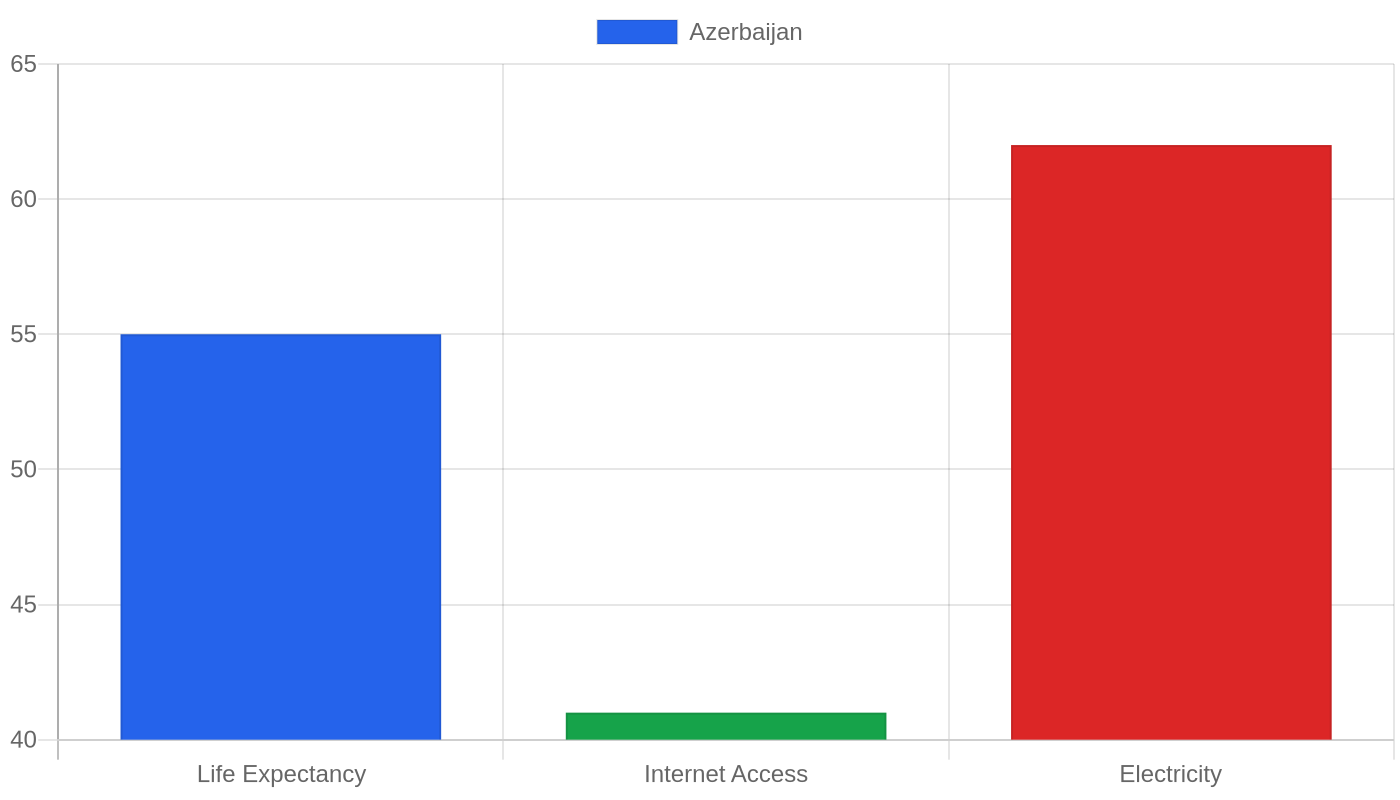
Economic Pulse Net | Sources: World Bank World Development Indicators, Government Sources | 2026
Key Takeaways
– Azerbaijan remains one of the world’s most authoritarian states, with the Aliyev family dynasty and the New Azerbaijan Party maintaining uninterrupted rule since 1993, creating a stable but politically rigid environment for investors.
– The economy is dominated by state-linked industrial giants—shipping, railways, utilities, and construction—while the financial sector shows signs of private banking activity through institutions like AccessBank and AtaBank.
– The country’s cost of living and consumer price data remain opaque, making it difficult to assess real household purchasing power without official inflation or GDP figures.
– Crime and safety indices are unavailable, but the political landscape—rated “not free” by Freedom House with a 7/100 global freedom score—suggests tight state control extends beyond politics into daily life.
– Azerbaijan’s economic future hinges on whether its state-led industrial base can transition beyond hydrocarbon dependence, a question that remains unanswered in the current data.
The Numbers Gap — What the World Bank Doesn’t Tell Us
The World Bank’s latest data on Azerbaijan presents a curious paradox: a country with a functioning economy, active stock exchange, and major industrial enterprises, yet no reported figures for GDP growth, inflation, unemployment, GDP per capita, or GNI per capita. This statistical black hole is itself a story.
For a nation that sits on significant Caspian energy reserves and has invested heavily in transport infrastructure, the absence of basic macroeconomic indicators raises questions about transparency and data governance.
What we do know is that Azerbaijan’s industrial backbone is unmistakably state-connected. The Azerbaijan Caspian Shipping Company and Azerbaijan Railways dominate the industrials sector, while Azersu Open Joint Stock Company controls water utilities. These are not nimble private enterprises; they are legacy Soviet-era behemoths that have been repurposed under the Aliyev system.
The construction sector, represented by Akkord Industry Construction Investment Corporation, suggests ongoing infrastructure spending—likely tied to the country’s strategic position along the Middle Corridor trade route linking China to Europe.
The financial sector offers a slightly different picture. AccessBank Azerbaijan and AtaBank represent a private banking presence, though their operations exist within a political system that Freedom House ranks at 7 out of 100 on global freedom. In such environments, banking often serves as an extension of state industrial policy rather than genuine market intermediation.
The presence of AF Holding—a conglomerate—and AF Hotel Group indicates some diversification into consumer services, but the overall picture remains one of state-directed capitalism.
Living in Baku — The Hidden Cost of Caspian Life
Without official cost of living data from the World Bank, we must read between the lines of what the corporate landscape reveals. The presence of Medeniyyet TV and ANS Group of Companies in the consumer services sector suggests a domestic media and entertainment market exists, though its independence is questionable given the political environment.
AF Hotel Group’s operations point to a tourism and hospitality sector that likely caters to business travelers and regional visitors rather than mass international tourism.
Housing costs in Baku, the capital, are typically higher than in regional neighbors, driven by oil wealth and construction booms. The presence of Akkord Industry Construction Investment Corporation among the top companies indicates that construction remains a major economic driver. However, without rental or purchase price data, we can only infer that housing affordability is likely stratified—affordable for those connected to the state apparatus, challenging for ordinary workers.
The gap between Baku’s gleaming new developments and the regions is probably substantial, mirroring the wealth concentration typical of petro-states.
Daily expenses for food, transportation, and utilities likely reflect the subsidized pricing common in energy-rich authoritarian states. Azersu’s control over water utilities suggests basic services remain under state management, which can keep costs low but efficiency questionable. The absence of inflation data makes it impossible to track whether these subsidies are eroding or whether household purchasing power is under pressure.
Investment Climate — State-Linked Giants and the Private Fringe
For investors looking at Azerbaijan, the top companies list tells a clear story: the commanding heights of the economy are occupied by state-linked or state-owned enterprises. Azerbaijan Caspian Shipping Company and Azerbaijan Railways are strategic assets likely shielded from foreign competition.
AccessBank and AtaBank offer some financial sector exposure, but operate under the watchful eye of a regime that Freedom House categorizes as “not free” and has ruled continuously since 1993 through the Aliyev political family.
The sectors to watch are infrastructure and logistics. Azerbaijan’s position on the Caspian Sea makes it a natural hub for east-west trade, and the government has invested in port facilities and railway connections. The Azerbaijan Caspian Shipping Company could benefit from increased trade volumes if the Middle Corridor develops as anticipated.
However, investors must weigh this potential against the political risk of operating in a country where elections are marred by fraud and the government is described by multiple sources as authoritarian.
The business environment is characterized by what economists call “crony capitalism”—where success depends more on political connections than market competition. AF Holding and AF Hotel Group likely benefit from their ties to the ruling family.
For foreign investors, the calculation is straightforward: Azerbaijan offers access to Caspian energy and trade routes, but the price is operating within a system where rule of law is weak and political stability comes at the cost of genuine democratic accountability.
Safety, Politics, and Daily Life — The Authoritarian Bargain
Azerbaijan’s crime and safety indices are unreported, but the political context provides a strong proxy. Freedom House’s assessment—a 7 out of 100 on global freedom—places Azerbaijan firmly in the “not free” category. The government holds regular elections, but these are marred by electoral fraud and unfair practices, according to multiple sources cited in the data.
This is not a country where citizens can openly criticize the government or where independent media operates without constraints.
The presence of Medeniyyet TV and ANS Group of Companies in the consumer services sector suggests some media activity, but in a country ranked 7/100 for freedom, these outlets likely operate within narrow boundaries. The Aliyev family has ruled since 1993, and the New Azerbaijan Party has never lost power. This longevity creates predictability—a key factor for investors—but also suppresses the kind of organic economic and social development that emerges from open societies.
Safety in the conventional sense—street crime, personal security—may be relatively high due to the pervasive state security apparatus. However, this comes at the cost of political freedom. The “authoritarian bargain” in Azerbaijan, as in similar states, trades personal security and economic stability for political rights. Whether this bargain holds depends on whether the economy can deliver rising living standards without the transparency that democratic systems provide.
What’s Happening Now — The Post-Oil Pivot
Azerbaijan is currently navigating a delicate transition. With global energy markets shifting toward renewables and European buyers diversifying away from Caspian gas, the pressure to diversify is real. The government’s focus on infrastructure—railways, shipping, construction—suggests a strategy to position Azerbaijan as a transport hub rather than just an energy exporter.
The Middle Corridor initiative, which aims to connect China to Europe via Central Asia and the Caucasus, could be Azerbaijan’s economic lifeline in a decarbonizing world.
The dominance of state-owned enterprises in the top companies list indicates that this transition will be state-led, not market-driven. Akkord’s construction activities and Azersu’s utility operations suggest ongoing domestic investment, but the lack of GDP or inflation data makes it impossible to assess whether this investment is translating into broad-based economic growth.
The financial sector, represented by AccessBank and AtaBank, may be positioning to finance small and medium enterprises, but without credit data, this remains speculation.
Politically, the regime shows no signs of liberalizing. The Aliyev family’s grip remains absolute, and the New Azerbaijan Party faces no credible opposition. For the average Azerbaijani, the immediate economic reality is opaque—without inflation or employment figures, we cannot know whether living standards are improving or deteriorating. This information vacuum is itself a political tool, allowing the government to control the narrative about economic performance.
The Bottom Line
Azerbaijan is a country for investors with high risk tolerance and a strategic focus on infrastructure and energy transit. The authoritarian stability offers predictability, but the lack of transparency—reflected in missing World Bank data—means investors are operating partially blind. For those interested in the Middle Corridor or Caspian energy logistics, Azerbaijan offers opportunities that few other countries can match.
But the political cost is real: doing business here means accepting a system where the Aliyev family’s interests come first, and where economic data is treated as a state secret rather than a public good. Watch Azerbaijan if you believe in the future of the Middle Corridor; avoid it if you require transparency and rule of law.
Sources & Methodology
This article is authored by Economic Pulse Net for informational and research purposes. Economic Pulse Net sources its data from multilateral institutions, national statistics bureaus, and proprietary databases. All data is believed to be current as of the date of publication.
Published: July 30, 2026 | Category: Research — Azerbaijan
Use these signals in your own platform
Economic Pulse publishes its live signal feed through a documented, read-only API. Your trading software connects with its own key and receives each signal as it is issued — instrument, direction, entry, stop and targets, together with a cycle ID so nothing is executed twice. The feed is independent of this website and cannot change it.
Signals are informational only and are not financial advice.