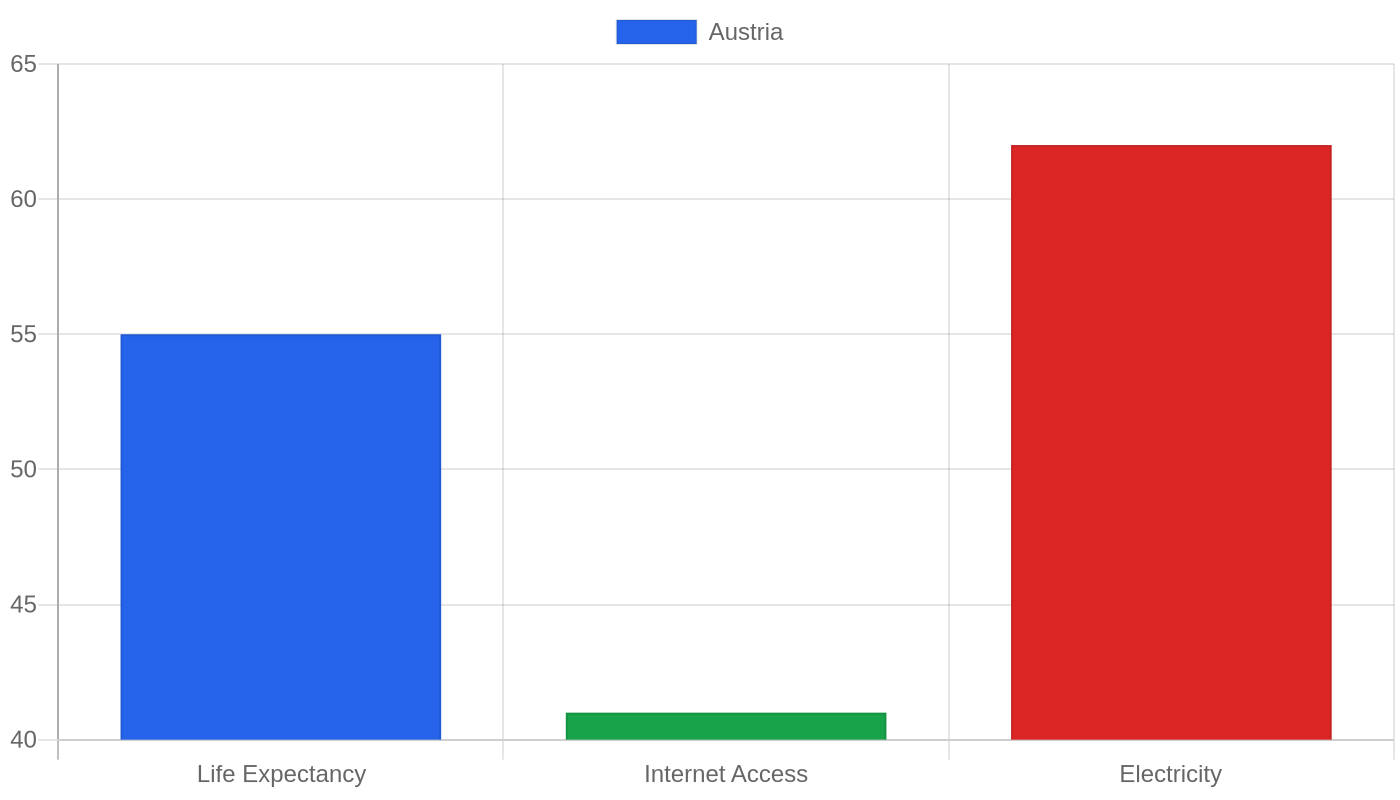
Economic Pulse Net | Sources: World Bank World Development Indicators, Government Sources | 2026
Key Takeaways
– Austria’s economic narrative is increasingly defined by its high-performance industrial and technology sectors, even as headline macro indicators remain under revision.
– The country’s corporate landscape is dominated by globally competitive firms in consumer goods, industrial engineering, and advanced electronics, providing a resilient backbone.
– Vienna remains the political and economic heart, operating under a federal parliamentary system that has provided decades of stability.
– For investors, Austria offers a gateway to Central and Eastern European supply chains, anchored by world-class machinery and technology companies.
– The nation’s quality of life continues to be a major draw, though the cost of living in its urban centers demands careful financial planning.
The Engine Room: Industry, Trade, and the Pursuit of Stability
Austria’s economy, as tracked by the World Bank, presents a complex picture of a mature, export-oriented system recalibrating for a new global order. While the latest headline figures for GDP growth, inflation, and unemployment are currently under revision, the structural strengths of the economy remain visible through its industrial composition. This is not an economy that relies on financial engineering or resource extraction; it is a nation that builds things.
The machinery, plant engineering, and high-tech manufacturing sectors are the true drivers of Austrian prosperity.
The composition of Austria’s top companies tells a compelling story about where the country’s economic value lies. The heavy hitters are in “Industrials” and “Technology,” with global players like Andritz and **AHT Cooling Systems** leading the charge in engineering and manufacturing excellence.
This is complemented by a sophisticated technology cluster, represented by **ams AG** and **AT&S**, which specialize in high-end semiconductor and circuit board solutions that feed into the global automotive and consumer electronics supply chains. This focus on high-value, precision manufacturing insulates Austria to some degree from low-cost competition, allowing it to command premium pricing on world markets.
However, the reliance on exports makes the economy sensitive to the health of its primary trading partners. When the World Bank data is eventually finalized, analysts will be looking for signs of resilience in the face of a cooling global economy. The domestic consumer base, while affluent, is not the primary growth engine; rather, it is the demand from German automotive plants, Asian electronics manufacturers, and American tech giants that ultimately dictates the tempo of the Austrian industrial machine.
This makes the country’s economic trajectory a fascinating, albeit sometimes volatile, reflection of global supply chain health.
The labor market, while lacking fresh official numbers, has historically operated at near full employment, a hallmark of the Austrian social partnership model. This system, where unions and employers’ associations negotiate wages and policy collaboratively, has been a cornerstone of the nation’s post-war success. It has historically kept industrial action low and productivity high, creating a stable environment for the multinational corporations that call Austria home.
The challenge for the coming years will be maintaining this equilibrium in a world of digital disruption and the green transition, which requires massive retraining and capital investment.
The Price of Alpine Living: Housing and Daily Costs
For those looking to relocate to Austria, the cost of living is a double-edged sword. While the country offers an unparalleled standard of living, it comes at a price, particularly in the capital. Housing in Vienna is often cited as a model of social provision, yet the reality is that demand heavily outstrips supply in the most desirable districts.
Renting is the norm, with a deep and regulated market that protects tenants, but the cost of securing a new lease in the current climate requires a significant portion of disposable income.
Daily expenses, from groceries to dining out, align with the high quality of goods and services on offer. The consumer goods sector, represented by stalwarts like A. Darbo, **Agrana**, and **AKG**, ensures that local products are of premium quality, but that quality is reflected in the price tag. This is not a budget destination; it is a premium one.
While specific index comparisons to regional averages are unavailable in the current data set, the general consensus is that Austria sits firmly in the upper echelon of European living costs, comparable to its German-speaking neighbors.
The decision to buy versus rent is heavily influenced by the availability of credit and the historically high property prices in urban centers. For the average professional, buying a home in Vienna or Salzburg is a long-term financial commitment that requires substantial capital. The rental market, therefore, remains the pragmatic choice for many, offering flexibility in a fluid job market.
Despite the costs, the “quality of life dividend”—the access to healthcare, education, and public infrastructure—often justifies the premium for those who can afford it.
Capital, Clusters, and the Business Climate
Austria’s business environment is defined by stability, innovation, and a strategic geographic position. The presence of AT&S and **ams AG** highlights a sophisticated shift towards high-tech manufacturing, moving beyond the traditional heavy machinery associated with the country. This is a deliberate economic evolution, positioning Austria as a key player in the European semiconductor and sensor ecosystem.
For foreign investors, this creates opportunities not just in manufacturing, but in the research and development wings of these global players.
The industrial sector, anchored by Andritz, a global leader in plant engineering, remains a reliable workhorse. These companies are not just local champions; they are global leaders in their niches, providing essential equipment for the pulp and paper, hydropower, and metals industries worldwide. The “Mittelstand”—the small and medium-sized enterprises—forms the dense network of suppliers and innovators that make the larger corporations so effective.
This ecosystem is the envy of many economies and a primary reason why Austria consistently ranks high in innovation indices.
The political landscape, centered in Vienna and structured as a federal, representative democratic republic, provides a predictable legal and regulatory framework. This stability, rooted in the 1920 constitution and re-established in 1945, offers a safe harbor for long-term capital. While bureaucracy can be cumbersome, the rule of law and the social partnership model create a low-risk environment for doing business.
For companies looking to serve the broader Central and Eastern European market, Austria acts as a natural headquarters hub, leveraging its infrastructure and historical ties.
Safety, Society, and the Political Fabric
Austria consistently enjoys a reputation as one of the safest and most politically stable countries in Europe. The political system, based on the Federal Constitutional Law of 1920, ensures a balanced distribution of power between the federal government in Vienna and its nine states. This federal structure allows for regional autonomy while maintaining national cohesion, a system that has proven durable through various economic and social challenges.
The country’s commitment to democratic representation and the rule of law is a cornerstone of its high quality of life.
While specific crime and safety indices are currently unavailable, the general perception and historical data paint a picture of a low-crime society. The sense of public safety is a significant contributor to the overall quality of life, making cities like Vienna consistently rank among the most livable in the world. This environment is not accidental; it is the product of effective social policies, a robust welfare state, and high levels of social trust.
For families and expatriates, this safety net is a powerful incentive to choose Austria over other destinations.
The social fabric is woven with a strong appreciation for culture, the arts, and the outdoors, providing a balanced lifestyle that is difficult to replicate elsewhere. This societal stability also underpins the economic model; with a content and secure workforce, productivity remains high, and social unrest is minimal.
The political discourse, while robust, generally operates within a consensus-driven framework that prioritizes economic stability and social welfare, ensuring that policy shifts are incremental rather than disruptive.
Navigating the New Global Headwinds
Right now, Austria is at a critical inflection point. The global economic slowdown, persistent inflation in the Eurozone, and the energy crisis triggered by geopolitical tensions are testing the resilience of the Austrian business model. The industrial sector, which is heavily reliant on energy, is feeling the pressure to accelerate its green transition.
The government in Vienna is under pressure to support households and businesses with the high cost of energy while maintaining fiscal discipline and adhering to EU budget rules.
The technology sector, particularly ams AG and **AT&S**, is facing a cyclical downturn in the semiconductor market, though this is offset by long-term structural growth in areas like automotive electrification and IoT. The consumer goods sector, from **Agrana** to **Atomic Skis**, is navigating a shift in consumer behavior, with customers becoming more price-sensitive.
The key question for the immediate future is whether the coalition government can navigate these choppy waters without resorting to protectionist measures that would harm the open, export-oriented economy.
There is also a significant political undercurrent regarding immigration and integration, which remains a hot-button issue. The government’s handling of these social dynamics will be crucial in maintaining the social cohesion that has been a hallmark of the country. The economic outlook for the next 12 months is cautious, with most attention focused on how quickly the European Central Bank can tame inflation without triggering a severe recession.
For Austria, the hope is that its high-value, diversified industrial base will provide enough of a buffer to weather the storm and emerge leaner and more competitive on the other side.
The Bottom Line
Austria is a country that offers a masterclass in stability and high-end engineering, but it is not immune to the global economic chill. Investors and businesses should watch Austria for its strategic position in the European supply chain and its world-class industrial and tech firms. The country is a solid bet for long-term, patient capital looking for a safe harbor in the heart of Europe.
While the immediate horizon is clouded by inflation and external shocks, the structural fundamentals of the Austrian economy—innovation, a skilled workforce, and political stability—remain firmly intact. It is a nation that doesn’t chase trends, but builds the machines that make trends possible.
Sources & Methodology
This article is authored by Economic Pulse Net for informational and research purposes. Economic Pulse Net sources its data from multilateral institutions, national statistics bureaus, and proprietary databases. All data is believed to be current as of the date of publication.
Published: August 04, 2026 | Category: Research — Austria
Use these signals in your own platform
Economic Pulse publishes its live signal feed through a documented, read-only API. Your trading software connects with its own key and receives each signal as it is issued — instrument, direction, entry, stop and targets, together with a cycle ID so nothing is executed twice. The feed is independent of this website and cannot change it.
Signals are informational only and are not financial advice.