Economic Pulse Net | Sources: World Bank World Development Indicators, Government Sources | 2026
Key Takeaways
– Austria’s economic narrative is increasingly defined by its high-value industrial and technology sectors, with globally competitive firms like Andritz and ams AG leading the charge.
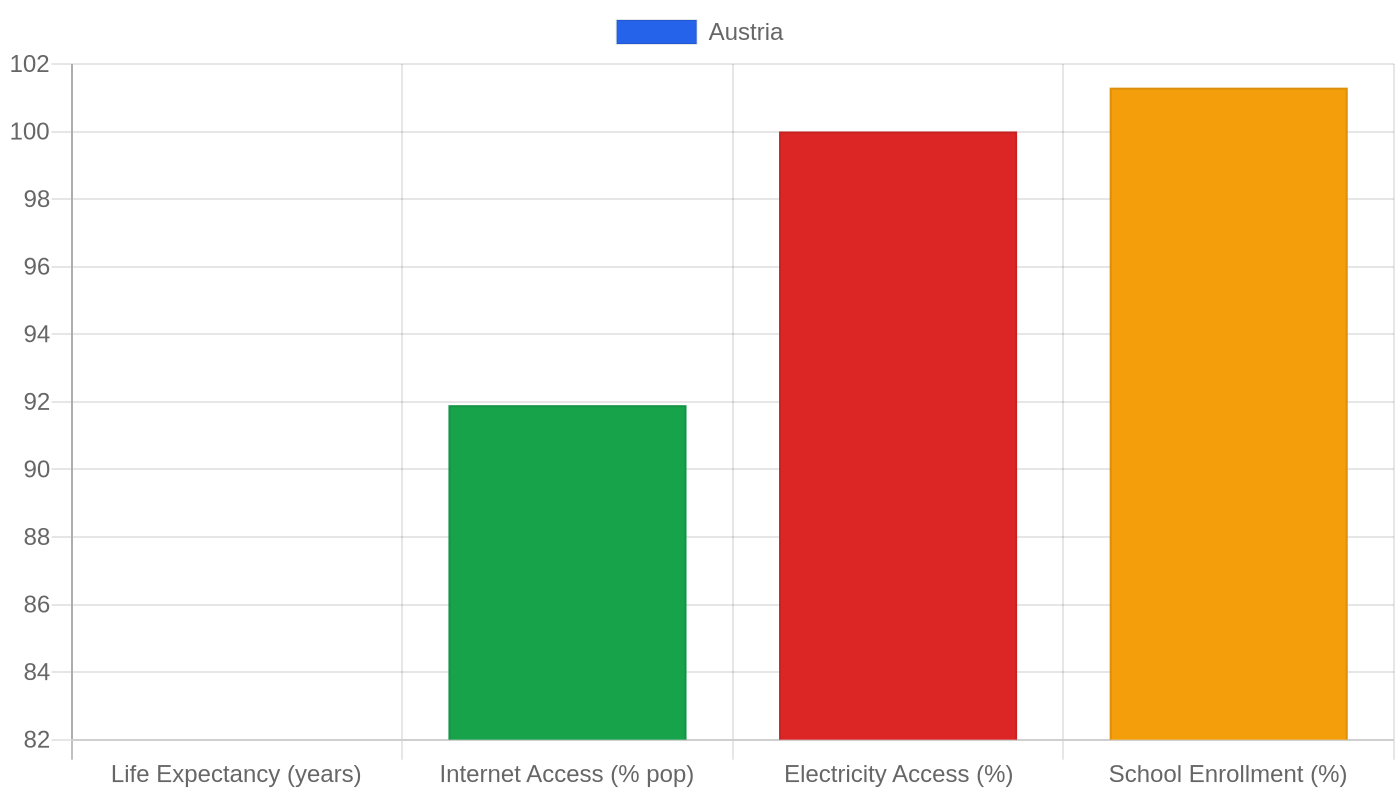
– The country’s economic data landscape is currently undergoing a reporting transition, with key World Bank indicators pending, making forward-looking analysis of its corporate sector essential.
– Austrian consumer goods and manufacturing companies—from Agrana’s food processing to Atomic Skis’ sporting goods—demonstrate the economy’s deep diversification beyond traditional Alpine tourism.
– The political system, anchored in Vienna and structured as a federal representative democracy, provides a stable backdrop for business operations and investment.
– Austria’s quality of life proposition remains strong, with the nation’s political stability and industrial sophistication positioning it as a key gateway for Central European commerce.
The Alpine Economic Engine: Manufacturing, Technology, and Strategic Position
Austria’s economic structure tells a compelling story of a nation that has successfully transitioned from its historical role as a post-war reconstruction economy into a sophisticated, export-oriented industrial power. The World Bank’s latest data release shows GDP growth, inflation, and unemployment figures pending, which itself signals a period of recalibration for the country’s statistical agencies.
However, the composition of Austria’s top companies reveals the true nature of its economic might. The presence of Andritz in the industrials sector is particularly significant—this is a global leader in plant engineering and equipment manufacturing, serving industries from pulp and paper to hydropower generation.
The technology sector’s prominence, represented by ams AG and AT&S, underscores Austria’s strategic bet on high-value semiconductor and circuit board manufacturing. AT&S, in particular, has positioned itself as a critical supplier to the global electronics industry, manufacturing the advanced printed circuit boards that power everything from smartphones to automotive electronics.
This technological depth provides Austria with a competitive moat that less industrialized European economies cannot easily replicate.
The consumer goods sector, featuring companies like A. Darbo, Agrana, and AKG, demonstrates the resilience of Austria’s traditional food and beverage processing industries. Agrana’s role as a major processor of fruit, starch, and sugar products connects Austria’s agricultural heritage with modern food technology.
Meanwhile, the presence of niche manufacturers like Ammerer Bed Company and Atomic Skis highlights how Austrian companies have carved out premium positions in specialized markets—from luxury bedding to high-performance winter sports equipment.
What makes Austria’s economic model particularly interesting is its ability to maintain high-value manufacturing within a relatively small domestic market. The country’s GDP per capita figures, while pending in the current World Bank data, have historically placed it among the wealthiest nations in the European Union. This wealth generation is not accidental but rather the result of deliberate industrial policy and a skilled workforce that supports sophisticated engineering and production capabilities.
Housing and Living Costs: The Vienna Premium
Vienna’s status as Austria’s capital and most populous city—indeed, one of the great imperial cities of Europe—shapes the country’s cost of living dynamics considerably. The city’s architectural grandeur, from the Ringstrasse boulevards to the Habsburg-era palaces, exists alongside a modern urban economy that commands premium real estate prices.
While specific cost of living data is pending, the structural factors are clear: Vienna consistently ranks among Europe’s most livable cities, and that desirability translates into housing demand that outpaces supply in the city’s historic districts.
The broader Austrian housing market reflects the country’s federal structure, with significant variation between Vienna and the other eight states. The Alpine regions, particularly Tyrol and Salzburg, face their own housing pressures driven by tourism-related development and the finite availability of buildable land in mountainous terrain.
This geographic constraint creates a natural ceiling on housing supply in the country’s most scenic areas, pushing prices upward in communities that might otherwise be affordable.
Renting remains the dominant tenure choice in Vienna, where a substantial portion of the housing stock is municipally owned or subject to rent regulation. This social housing tradition, dating back to the “Red Vienna” era of the 1920s, provides a buffer against the extreme housing cost inflation seen in some other European capitals.
For those considering homeownership, Austrian mortgage markets are well-developed, but the combination of high construction standards and limited land availability means that property acquisition requires significant capital.
Daily expenses in Austria reflect the country’s position as a high-income economy. Grocery costs, dining, and services all carry the premium associated with a wealthy nation that maintains high labor standards and quality expectations. The consumer goods companies that dominate Austria’s corporate landscape—Agrana, A. Darbo, and others—also benefit from domestic consumers who prioritize quality and are willing to pay for premium food products.
Investment Climate and Corporate Champions
Austria’s investment environment is characterized by remarkable stability and a corporate sector that punches well above its weight internationally. The list of top companies reads like a masterclass in niche dominance: AHT Cooling Systems has carved out a leadership position in commercial refrigeration, while ATP represents the construction and engineering capabilities that have built Austria’s modern infrastructure.
These companies, while not household names globally, are critical players in their respective industrial niches.
The industrial sector’s strength is particularly noteworthy in the context of Austria’s export orientation. Andritz’s global reach in hydropower and industrial plant construction positions Austrian engineering as a key component of global infrastructure development. This is not merely a matter of historical legacy—these companies continue to innovate and expand, investing in research and development to maintain their competitive edges.
For foreign investors, Austria offers a gateway to Central and Eastern European markets while providing the institutional stability of a Western European democracy. The country’s transport infrastructure, banking sector, and legal system all operate at high European standards. The presence of AT&S and ams AG in the technology sector signals that Austria is not content to rest on its industrial laurels but is actively cultivating the next generation of high-technology industries.
The business climate benefits from Austria’s social partnership model, where employers, unions, and government have historically collaborated to maintain industrial peace and competitiveness. This consensus-based approach to economic governance has helped Austria navigate economic transitions with less social disruption than some of its European neighbors.
For companies considering Austrian operations, the availability of a highly skilled workforce, particularly in engineering and technical fields, remains a significant draw.
Political Stability and Quality of Life
Austria’s political system, established through the Federal Constitutional Law of 1920 and re-enacted in 1945, represents one of Europe’s enduring democratic institutions. The Parliament in Vienna serves as the seat of a federal, representative democratic republic that has successfully balanced central governance with the autonomy of its nine states. This federal structure allows for policy experimentation and regional adaptation while maintaining national coherence.
The Second Republic, as contemporary Austria is known, has developed a political culture characterized by consensus and stability. While specific crime and safety indices are pending, Austria’s reputation as a safe, orderly society is well-established. The country’s low crime rates, efficient public administration, and high levels of social trust contribute to an environment where both citizens and businesses can operate with confidence.
Quality of life in Austria extends beyond mere safety statistics. The country’s cultural offerings—from Vienna’s opera houses and museums to the Alpine regions’ outdoor recreational opportunities—create a standard of living that money alone cannot measure. The balance between urban sophistication and natural beauty is perhaps Austria’s greatest asset, offering residents access to world-class culture and pristine wilderness within hours of each other.
The political landscape’s stability has direct economic implications. Austria’s consistent governance and predictable policy environment reduce the risk premium associated with investment, making the country an attractive destination for long-term capital commitments. The federal structure also means that regional governments can tailor economic development strategies to local strengths, whether that means supporting ski tourism in the Tyrol or technology clusters in Styria.
Current Affairs: Austria’s Industrial Core Faces the Future
Austria’s corporate landscape is currently navigating a period of significant transformation as global supply chains reconfigure and technological change accelerates. The technology companies in Austria’s top tier—ams AG and AT&S—are at the forefront of this shift, responding to global demand for semiconductors and advanced electronic components.
These companies’ fortunes are increasingly tied to the automotive industry’s electrification and the proliferation of smart devices, both of which require the sophisticated components Austrian firms produce.
The consumer goods sector is similarly adapting, with companies like Agrana responding to changing consumer preferences toward sustainable and plant-based products. A. Darbo’s premium fruit products and Atomic Skis’ high-performance equipment represent different ends of the consumer spectrum, but both demonstrate Austrian companies’ ability to command premium prices through quality and brand heritage.
The industrial sector, anchored by Andritz and supported by companies like AHT Cooling Systems and ATP, continues to benefit from global infrastructure investment trends. As nations worldwide invest in renewable energy, water treatment, and modern manufacturing facilities, Austrian engineering firms are well-positioned to capture a share of these capital expenditures.
The country’s reputation for precision engineering and reliability gives its companies a competitive advantage in markets where quality and longevity are valued over lowest-cost production.
Austria’s political establishment in Vienna is concurrently focused on maintaining the country’s competitive position through investments in education, research, and digital infrastructure. The federal government’s commitment to these priorities, while not without fiscal constraints, reflects an understanding that Austria’s future prosperity depends on its ability to remain at the technological frontier.
The country’s small domestic market makes export success essential, and maintaining the innovative capacity that supports premium positioning in global markets is an ongoing policy priority.
The Bottom Line
Austria represents a compelling case study in how a mid-sized European nation can maintain economic prosperity through industrial excellence, political stability, and strategic positioning. For investors and business leaders, the country offers access to world-class engineering capabilities, a stable political environment, and a gateway to Central European markets.
The current data reporting transition should not obscure the fundamental strengths of the Austrian economy—its technological sophistication, its quality-focused consumer goods, and its reliable industrial base. As global supply chains continue to evolve and technology reshapes industries, Austria’s companies are well-positioned to thrive, making the country worthy of close attention from anyone tracking European economic dynamics.
Sources & Methodology
This article is authored by Economic Pulse Net for informational and research purposes. Economic Pulse Net sources its data from multilateral institutions, national statistics bureaus, and proprietary databases. All data is believed to be current as of the date of publication.
Published: August 06, 2026 | Category: Research — Austria
Use these signals in your own platform
Economic Pulse publishes its live signal feed through a documented, read-only API. Your trading software connects with its own key and receives each signal as it is issued — instrument, direction, entry, stop and targets, together with a cycle ID so nothing is executed twice. The feed is independent of this website and cannot change it.
Signals are informational only and are not financial advice.