Economic Pulse Net | Sources: World Bank World Development Indicators, Government Sources | 2026
Key Takeaways
– Austria boasts one of the highest GDP per capita figures in Europe at nearly $77,000 (PPP), according to the World Bank, placing it firmly among the continent’s wealthiest nations.
– The country’s economic engine is driven by a sophisticated blend of industrial giants like Andritz and technology innovators such as ams AG and AT&S, rather than tourism alone.
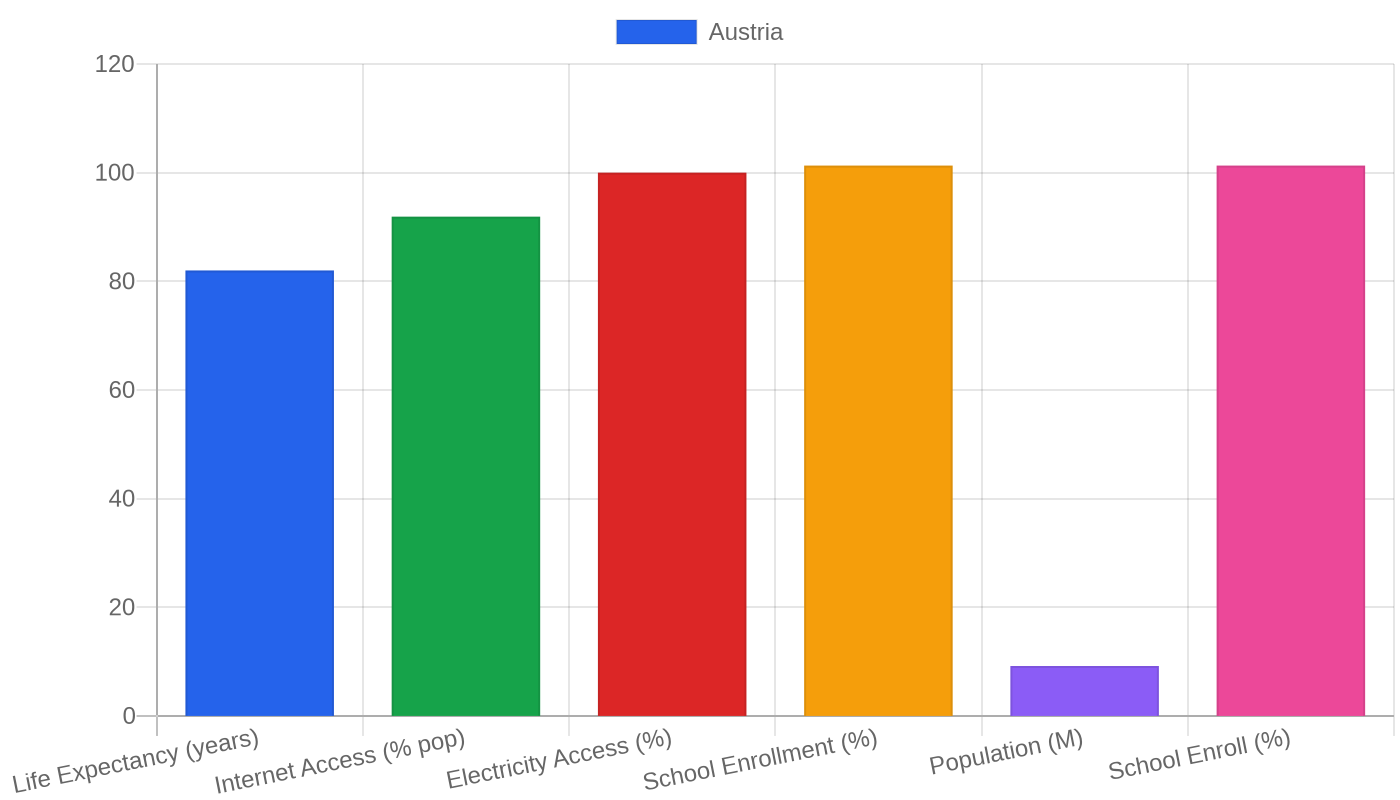
– With a population of just over 9.2 million, Austria faces the familiar Western European challenges of maintaining its high-wage, high-productivity model in an era of global economic uncertainty.
– The political landscape remains anchored in the stability of the Second Republic’s federal system, though the absence of recent growth and inflation data from the World Bank leaves analysts watching closely for emerging trends.
– Austria’s cost of living and quality of life dynamics are shaped by its position as a small, landlocked economy with strong ties to German and Central European supply chains.
The Alpine Economic Engine — More Than Mozart and Mountains
Austria’s economy, as measured by the World Bank, presents a picture of quiet strength. With a GDP of approximately $579 billion and a GDP per capita (PPP) of $76,778, the country sits comfortably among the world’s most affluent societies. These numbers tell a story that goes far beyond the postcard images of Vienna’s coffee houses or Salzburg’s festival halls.
They reflect a deeply integrated European economy that has successfully transitioned from the remnants of the Austro-Hungarian Empire into a modern, export-oriented powerhouse.
The absence of a specific GDP growth figure from the World Bank data does not diminish the broader narrative. Austria’s wealth is not new; it is structural. The country has long benefited from its geographic position at the heart of Europe, serving as a gateway between East and West. Its high per capita income signals that productivity levels remain robust, even as the broader Eurozone grapples with slower expansion.
The lack of inflation and unemployment data in this dataset is notable, but the per capita figure alone suggests an economy that has historically managed to distribute its prosperity relatively evenly.
The main industries driving this performance are diverse. Consumer goods companies like A. Darbo, Agrana, and AKG represent a strong domestic market and export capability in food processing and household products. But the real edge comes from the industrial and technology sectors. Andritz, a global leader in plant engineering and equipment for hydropower, pulp and paper, and steelmaking, exemplifies Austria’s high-end manufacturing prowess.
Meanwhile, ams AG and AT&S are significant players in the semiconductor and printed circuit board industries, sectors that have become strategically critical worldwide. This is not an economy resting on its laurels; it is one that competes at the technological frontier.
The Price of Alpine Living — Housing and Daily Costs in the Republic
Living in Austria carries a price tag that matches its high GDP per capita. While the data provided does not include specific cost of living indices or housing figures, the economic context allows for informed inference. Vienna regularly ranks among the world’s most liveable cities, but that status comes with correspondingly high housing costs, particularly in the capital.
The rental market in Vienna is moderated by a strong social housing sector — nearly a quarter of all housing is municipally owned — but private market rents in desirable districts remain steep.
For those looking to buy, property prices in urban centers have followed the broader European trend of steady appreciation. The gap between renting and buying is a live debate among Austrian households, much as it is across the continent. Daily expenses for food, transportation, and utilities reflect the country’s high labour costs and stringent quality standards.
Compared to regional averages, Austria tends to be more expensive than its Central European neighbours like Czechia or Hungary, but comparable to Germany and Switzerland. The strength of the Austrian economy means that wages have historically kept pace with these costs, though the recent inflationary period across Europe has tested that equilibrium.
Where Capital Meets Innovation — Austria’s Business Landscape
Austria’s corporate landscape, as revealed by the list of top companies, is a study in contrasts and complementarity. The presence of iconic consumer brands like Atomic Skis — a name synonymous with winter sports — sits alongside industrial behemoths and technology innovators. This mix is the country’s competitive advantage. AHT Cooling Systems and Andritz serve global industrial markets, while ams AG and AT&S compete in the high-stakes world of microelectronics and advanced manufacturing.
The business environment in Austria is characterised by stability, a highly skilled workforce, and strong infrastructure. The country’s federal structure, with nine states, means that business conditions can vary slightly by region, but the overall regulatory framework is consistent and transparent.
For investors, the key sectors to watch are those where Austria already holds a strong position: environmental technology (given Andritz’s hydropower expertise), automotive components, and specialized manufacturing. The technology sector, particularly semiconductors, is poised for growth as European Union initiatives push for greater chip sovereignty.
However, the absence of recent GDP growth data from the World Bank should give investors pause — it suggests a need for more current information before making major commitments.
Stability in the Shadow of History — Politics, Safety, and Daily Life
Austria’s political system is a model of post-war stability. As the World Bank data indicates, the country operates as a federal, representative democratic republic under the Federal Constitutional Law of 1920, amended in 1929 and re-enacted in 1945. This Second Republic framework has provided continuity through decades of change. The parliament sits in Vienna, and the nine states enjoy significant autonomy, particularly in areas like education and housing.
The data does not provide a crime index or safety index, but Austria’s reputation speaks clearly. It is consistently ranked among the safest countries in the world. Violent crime is low, and the major cities are generally secure, even at night. This safety is a significant component of the country’s quality of life, which routinely scores high on international happiness and well-being surveys. The political landscape, while stable, is not without its tensions.
The rise of right-wing populism in recent years has injected a new dynamic into Austrian politics, challenging the traditional dominance of the centre-right People’s Party and the centre-left Social Democrats. The federal system, however, provides multiple layers of governance that can absorb and manage such political shifts without destabilising the nation.
The View from Vienna — What’s Happening Now
This is the moment when Austria’s narrative becomes most immediate. While the World Bank data provides a snapshot of the country’s economic heft, the present reality is shaped by forces that no single dataset can fully capture. Europe’s energy transition, ongoing supply chain realignments, and the persistent challenge of inflation are all playing out in real time across the Austrian economy.
The technology sector, represented by companies like ams AG and AT&S, is navigating a global semiconductor market that has seen both shortages and oversupply in recent years. These firms are critical to Austria’s future positioning. Meanwhile, the industrial giants like Andritz are benefiting from the global push toward renewable energy and decarbonisation, particularly in hydropower and industrial efficiency. The consumer goods sector, including names like Agrana and A.
Darbo, faces the classic pressures of a high-cost economy: maintaining competitiveness while adhering to strict European quality and environmental standards.
Politically, the country is grappling with the aftermath of the COVID-19 pandemic and the economic dislocations caused by Russia’s war in Ukraine, which has particular resonance for Austria given its historical energy dependence on Russian gas. The government’s response to these challenges — including efforts to diversify energy sources and manage inflation — will shape the economic outlook for the remainder of the decade.
The absence of current inflation data from the World Bank is a gap, but anecdotal and regional evidence suggests Austrian consumers, like their European neighbours, have been feeling the pinch.
The Bottom Line
Austria remains a compelling story of sustained prosperity in a turbulent world. Its high GDP per capita, diversified industrial base, and political stability make it a safe bet for long-term investors and a desirable destination for skilled workers. The country’s ability to navigate the energy transition and maintain its technological edge will determine whether it can sustain its Alpine standard of living.
For anyone watching European economies — from policymakers to business strategists to prospective migrants — Austria is a case study in how a small, wealthy nation can punch above its weight, provided it continues to adapt.
Sources & Methodology
This article is authored by Economic Pulse Net for informational and research purposes. Economic Pulse Net sources its data from multilateral institutions, national statistics bureaus, and proprietary databases. All data is believed to be current as of the date of publication.
Published: July 22, 2026 | Category: Research — Austria
Use these signals in your own platform
Economic Pulse publishes its live signal feed through a documented, read-only API. Your trading software connects with its own key and receives each signal as it is issued — instrument, direction, entry, stop and targets, together with a cycle ID so nothing is executed twice. The feed is independent of this website and cannot change it.
Signals are informational only and are not financial advice.