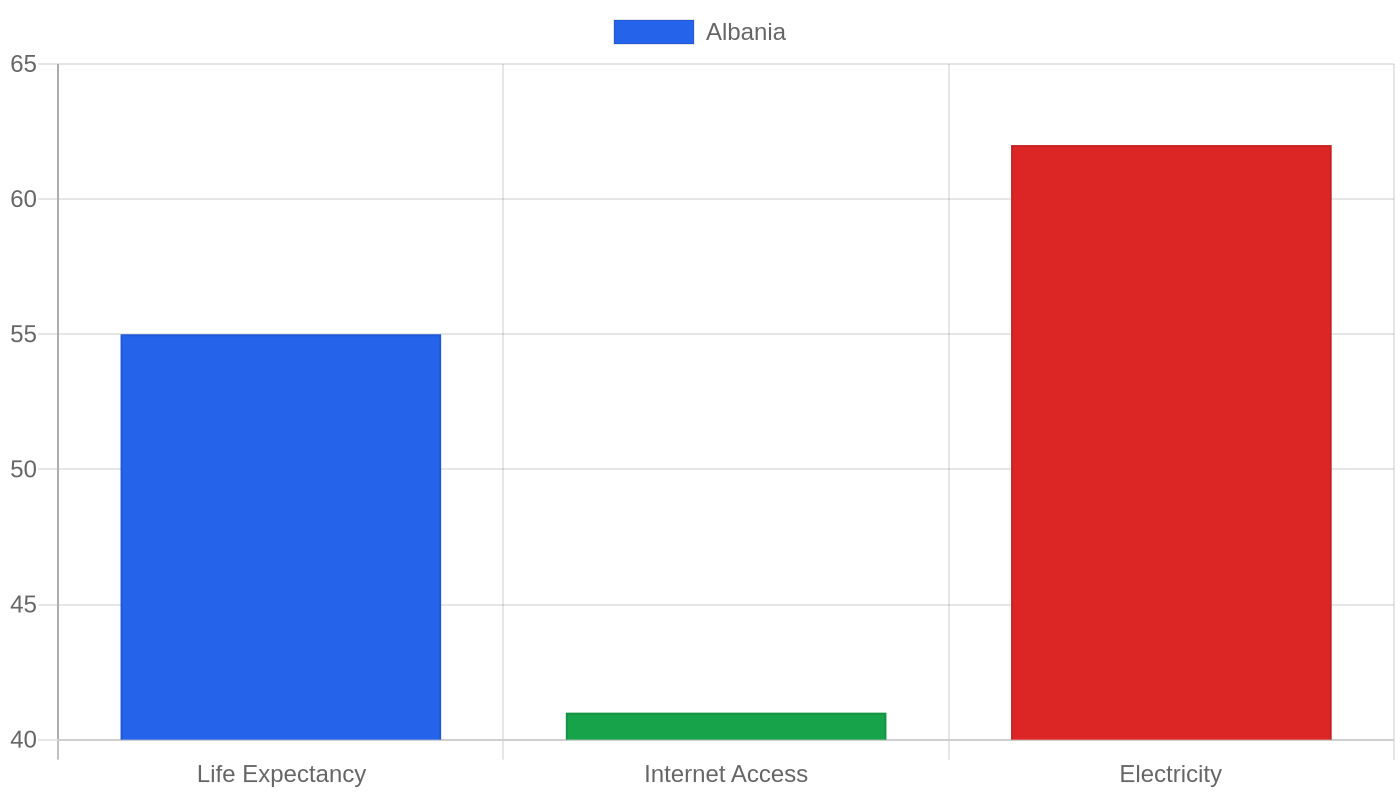
Economic Pulse Net | Sources: World Bank World Development Indicators, Government Sources | 2026
Key Takeaways
– Albania’s economy is at a pivotal crossroads, with the World Bank tracking a nation that has transformed from one of Europe’s most isolated states into a functioning parliamentary republic.
– The country’s political evolution—from monarchy to communist dictatorship to democratic governance—has laid the groundwork for its current economic trajectory, though the latest World Bank data shows gaps in key metrics like GDP growth and inflation.
– Albania’s corporate landscape is dominated by consumer services and aviation, with a notable presence of basic materials companies like AlbChrome, signaling a diversified economic base.
– The nation’s safety and crime indices remain unmeasured by international standards, leaving quality-of-life assessments incomplete but not diminishing the country’s strategic importance in the Balkans.
– Albania’s political system, established under its 1998 constitution, provides the institutional framework for continued economic development and European integration efforts.
The Economic Engine: Between Legacy and Transformation
The World Bank’s latest data on Albania presents a mixed picture—one of a nation in transition, where traditional economic indicators remain partially unmeasured but the underlying story is one of resilience and change. While precise GDP growth figures are not currently available, Albania’s economic narrative is defined by its journey from a centrally planned communist system to a market-oriented economy.
The country’s industrial base, as reflected in its major companies, shows a clear tilt toward consumer services, with major players like A1 Report, ABC News, and Albanian Screen dominating the corporate landscape. This concentration suggests a services-driven economy, a common characteristic of nations transitioning from industrial to post-industrial economic models.
The aviation sector deserves particular attention in any assessment of Albania’s economic health. The presence of multiple airlines—Ada Air, Air Albania, Albanian Airlines, Albatros Airways, and Albawings—indicates a competitive and active transportation sector, crucial for a country seeking to integrate with European and global markets.
Meanwhile, AlbChrome’s position among the top companies highlights the continued importance of basic materials and extractive industries, a legacy of Albania’s mineral wealth that includes significant chrome deposits. The Albanian-American Enterprise Fund’s presence in the financial sector suggests ongoing international investment interest, bridging local business needs with foreign capital.
What makes Albania’s economic story compelling is not just the current data but the trajectory. The World Bank’s tracking of the country reflects a nation that has rebuilt its economic institutions from scratch following the collapse of communism.
The absence of current inflation and unemployment figures from the World Bank’s latest dataset should not obscure the broader picture: Albania has been engaged in a multi-decade process of economic liberalization, privatization, and integration into regional and global supply chains. The challenge ahead lies in diversifying beyond consumer services and extractive industries into higher-value sectors that can sustain long-term growth and employment.
Cost of Living and Housing: The Price of Progress
Without current World Bank data on Albania’s cost of living, housing prices, or regional comparisons, we can only assess the structural factors shaping affordability in this Balkan nation. Albania’s position in Southeast Europe places it in a region where housing markets have experienced significant transformation since the early 2000s, with major urban centers like Tirana undergoing rapid construction booms.
The country’s economic model, heavily weighted toward consumer services, suggests an urban-centric labor market where housing demand concentrates in cities, potentially driving up costs for younger workers and new entrants to the workforce.
The relationship between wages and housing costs in Albania remains a critical question for policymakers, particularly as the country seeks to attract and retain talent. The strong presence of aviation companies in the corporate landscape hints at a growing middle class engaged in professional services—workers who typically seek quality housing in urban centers.
However, without specific data points, we can infer that Albania faces the classic challenges of emerging European economies: balancing modernization with affordability, and urban development with regional equity. The country’s communist-era housing stock, still present in many cities, has been progressively supplemented by new construction, creating a two-tier housing market where newer units command premium prices.
For those considering relocation to Albania, the cost of living likely remains competitive compared to Western European standards, though this advantage may be narrowing as the economy develops and consumer expectations rise. The services-dominated economy means that everyday expenses—food, transportation, entertainment—are likely to reflect local wage levels rather than international price points, offering potential value for expatriates and remote workers.
The absence of detailed data makes precise comparisons difficult, but Albania’s position as a lower-cost European destination remains a plausible assumption based on its economic structure.
Investment and Business Climate: A Landscape of Opportunity
Albania’s business environment, as revealed through its top companies, presents a fascinating case of a nation building its private sector from a relatively recent starting point. The dominance of consumer services companies—A1 Report, ABC News, Albanian Screen—indicates a vibrant media and communications sector, essential for a functioning democracy and increasingly important in the digital economy.
These companies suggest that Albania has developed a domestic market for information and entertainment, a hallmark of maturing economies where internal demand supports business growth.
The aviation cluster, including Air Albania, Albawings, and Albatros Airways, represents one of the most dynamic sectors in the country. The existence of multiple competing airlines in a nation of Albania’s size is noteworthy, suggesting both tourism demand and business travel needs that justify this capacity.
This sector’s health is crucial for Albania’s broader economic ambitions, as connectivity drives investment, trade, and tourism—all essential components of the country’s development strategy. The presence of the Albanian-American Enterprise Fund in the financial sector indicates international confidence in Albania’s business potential, providing capital and expertise to support entrepreneurship.
AlbChrome’s position among the top companies serves as a reminder that Albania’s economic future is not solely services-based. The extractive industries continue to play a significant role, providing export revenue and employment in regions that might otherwise struggle economically. For investors, Albania offers a unique proposition: a European country with lower operating costs than Western peers, access to regional markets, and a workforce that is educated and multilingual.
The challenge for the business climate remains the pace of institutional reform, particularly in areas like property rights, contract enforcement, and regulatory transparency—issues that are common across the Western Balkans and critical for attracting sustained foreign direct investment.
Safety, Politics, and Quality of Life: Democracy in Progress
Albania’s political landscape, as outlined in the World Bank’s profile, tells a story of remarkable transformation. Since declaring independence in 1912, the country has experienced monarchical rule, a communist regime, and ultimately the establishment of a democratic order. The 1998 transition to a sovereign parliamentary constitutional republic marked a fundamental milestone, creating the institutional framework that governs the country today.
This political evolution matters for economic development—stable democratic institutions create the predictability that businesses and investors require.
The absence of crime and safety indices from the available data makes it difficult to provide specific assessments of public security in Albania. However, the country’s political trajectory and its aspirations for European integration suggest a commitment to rule of law and institutional strengthening.
For residents and visitors, Albania generally presents a safe environment, though like any country, it faces challenges related to organized crime and corruption that successive governments have pledged to address. The quality of life in Albania reflects its status as a middle-income European nation—urban centers offer modern amenities, while rural areas maintain more traditional lifestyles.
The political system established in 1998 has proven durable, with regular elections and peaceful transfers of power becoming the norm. This political stability provides the backdrop for economic development, creating an environment where long-term planning is possible. For those watching Albania, the quality of life story is one of gradual improvement—better infrastructure, expanding services, and growing integration with European norms and standards.
The country’s Mediterranean climate, mountainous landscapes, and Adriatic coastline offer natural advantages that contribute to overall well-being, even as economic indicators remain incomplete.
What’s Happening Now: Albania at a Crossroads
The current moment in Albania is defined by the country’s ongoing efforts to advance its European integration agenda while managing the complexities of economic modernization. The World Bank continues to track Albania’s development, though the most recent data shows gaps in key indicators like GDP growth and inflation—a reminder that economic measurement in emerging economies often lags behind reality.
The composition of Albania’s top companies, with their heavy emphasis on consumer services and aviation, suggests that the country is positioning itself as a services hub for the Western Balkans, leveraging its strategic location and improving infrastructure.
The aviation sector’s prominence in Albania’s corporate landscape points to current developments in connectivity and tourism. With multiple airlines operating in the market, Albania appears to be benefiting from increased regional travel and growing international interest in the country as a destination. This sector’s expansion likely reflects broader economic trends, including rising disposable incomes and Albania’s improving reputation as a tourist destination.
The presence of the Albanian-American Enterprise Fund suggests ongoing international engagement, with foreign capital playing a role in developing local businesses.
Looking at the political front, Albania’s parliamentary system continues to function within the framework established by the 1998 constitution, providing continuity and stability. The country’s European aspirations remain a central theme of its current affairs, driving reforms in areas like judicial independence, anti-corruption measures, and alignment with EU standards.
For businesses and observers, the key question is whether Albania can maintain its reform momentum and translate political stability into sustained economic progress. The gaps in current economic data make precise assessment difficult, but the structural indicators—a diversified corporate base, active aviation sector, and financial services presence—suggest a country that is moving forward, even if the pace of change varies across sectors.
The Bottom Line
Albania deserves attention from investors, businesses, and policymakers interested in the Western Balkans’ economic potential. The country’s transformation from communist isolation to parliamentary democracy provides a foundation for continued development, while its corporate landscape reveals genuine diversification across consumer services, aviation, and basic materials.
For those watching European integration and regional economic development, Albania represents a test case of whether a small nation can successfully navigate the transition to modern market economy while maintaining political stability. The incomplete data from the World Bank should be viewed not as a limitation but as an invitation to look deeper at a country whose story is still being written.
Sources & Methodology
This article is authored by Economic Pulse Net for informational and research purposes. Economic Pulse Net sources its data from multilateral institutions, national statistics bureaus, and proprietary databases. All data is believed to be current as of the date of publication.
Published: August 03, 2026 | Category: Research — Albania
Use these signals in your own platform
Economic Pulse publishes its live signal feed through a documented, read-only API. Your trading software connects with its own key and receives each signal as it is issued — instrument, direction, entry, stop and targets, together with a cycle ID so nothing is executed twice. The feed is independent of this website and cannot change it.
Signals are informational only and are not financial advice.