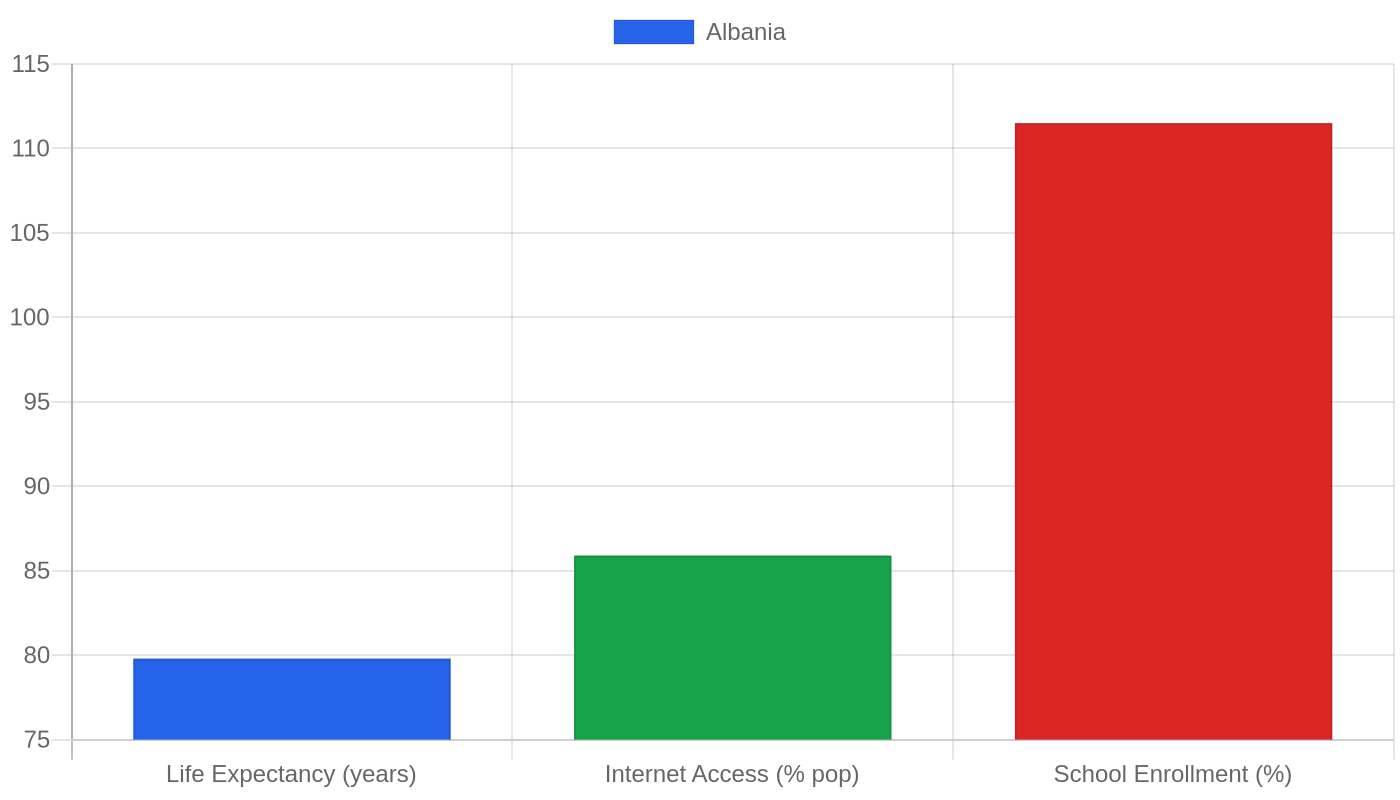
Economic Pulse Net | Sources: World Bank World Development Indicators, Government Sources | 2026
Key Takeaways
– Albania has completed a remarkable political arc since 1912, moving from monarchy to communist rule and finally to a sovereign parliamentary constitutional republic in 1998, establishing a stable democratic framework that underpins its modern economic ambitions.
– The country’s economic narrative is still being written, with the World Bank tracking key indicators that will define Albania’s next phase of development as it seeks deeper integration with European markets.
– Albania’s corporate landscape is dominated by consumer services and aviation companies, signaling a shift toward a service-oriented economy with growing regional connectivity.
– The political system operates under a constitution that serves as the principal governing document, providing institutional stability that investors and citizens alike can rely upon.
– As a nation in transition, Albania represents a compelling case study of how historical transformation can lay the groundwork for future economic opportunity.
From Isolation to Integration — Reading Albania’s Economic Signals
Albania’s economic journey is inseparable from its political evolution. The World Bank’s monitoring of the country reflects a nation that has undergone one of Europe’s most dramatic transformations — from one of the continent’s most isolated states to a country actively seeking its place in the regional and global economy.
While the latest GDP growth figures remain in flux, the structural story is clear: Albania has spent the past three decades building the institutional foundations necessary for sustainable development.
The composition of Albania’s top companies tells a revealing story about where the economy is heading. Consumer services dominate the corporate landscape, with A1 Report, ABC News, Albanian Screen, and other media and service enterprises leading the private sector. This concentration suggests that Albania’s domestic market is increasingly driven by consumption, information services, and internal demand rather than traditional heavy industry.
The presence of multiple airlines — including Air Albania, Albanian Airlines, Albatros Airways, and Albawings — indicates a strategic focus on connectivity, both for tourism and for maintaining ties with the Albanian diaspora across Europe.
The financial sector shows early signs of maturation with the Albanian-American Enterprise Fund operating in the financials space, while AlbChrome represents the basic materials sector, suggesting that extractive industries still play a role in the economy. This mix of aviation, media, finance, and materials points to an economy in transition — not yet fully industrialized, but no longer solely dependent on agriculture or raw material extraction.
The challenge for Albania’s policymakers will be converting this diverse corporate base into sustained, inclusive growth that benefits the broader population.
The Cost of Living Question — What Albanians Pay for Progress
Cost of living data for Albania remains a work in progress, but the broader picture of a country in economic transition suggests a nation where affordability is a central concern for ordinary citizens. As Albania continues its convergence with European standards, the gap between domestic wages and the cost of imported goods represents a significant challenge for households navigating the transition period.
Housing dynamics in Albania reflect the broader economic transformation. The capital, Tirana, has experienced visible construction booms in recent years, with new residential and commercial developments reshaping the urban landscape. For most Albanian families, homeownership remains the preferred and dominant housing model, a legacy of the post-communist privatization era when properties were transferred to occupants.
However, younger Albanians increasingly face a different reality, with rental markets growing in cities as internal migration and return migration from abroad create new housing demand.
Daily expenses in Albania have historically been lower than Western European averages, but the gap has been narrowing as the economy integrates with regional markets. Food, utilities, and transportation costs consume a significant share of household budgets, particularly for lower-income families. The affordability question is not just about prices but about the relationship between productivity, wages, and the cost of living — a balance that Albania must strike as it pursues its European aspirations.
Where Capital Meets Opportunity — Albania’s Investment Landscape
For investors willing to look beyond the headlines, Albania presents a market at an interesting inflection point. The corporate registry reveals a private sector that is domestically rooted but increasingly outward-looking. The aviation sector’s prominence is particularly notable — with five carriers operating under the Albanian flag — reflecting both the tourism potential and the importance of diaspora connections to the economy.
The Albanian-American Enterprise Fund’s presence in the financial sector signals that international capital has found opportunities in Albania’s developing financial markets. This institution, focused on private sector development, suggests there is room for growth in banking, insurance, and investment services as the country’s economy matures. For foreign investors, Albania offers proximity to European markets, a young population, and a strategic position in the Western Balkans.
The business environment, while improving, still carries the marks of a country in transition. Regulatory frameworks have been modernized as part of the EU accession process, but bureaucratic inefficiencies and infrastructure gaps remain challenges. Sectors to watch include tourism, where Albania’s Adriatic and Ionian coastlines offer significant untapped potential, and energy, where the country’s hydroelectric capacity provides a foundation for renewable energy development.
The key question for investors is whether Albania can convert its structural advantages into a more predictable and transparent business climate.
Stability and Transformation — Albania’s Political and Social Fabric
Albania’s political transformation since 1912 represents one of the Balkans’ most complete journeys toward democratic governance. The transition in 1998 to a sovereign parliamentary constitutional republic marked the culmination of this process, establishing a framework where executive power is accountable to parliament and the constitution serves as the supreme law of the land. This institutional settlement has provided the stability necessary for economic development.
The governance structure that emerged from the 1998 constitution created a system designed to prevent the concentration of power that characterized earlier periods of Albanian history. The constitution establishes the separation of powers, protects fundamental rights, and provides mechanisms for peaceful political succession. For a country that experienced both monarchy and communist dictatorship, these constitutional guarantees represent a hard-won achievement.
Quality of life in Albania reflects both progress and persistent challenges. The country has made significant strides in reducing poverty and improving access to services since the difficult years of the 1990s, but emigration has been a persistent phenomenon, with many young Albanians seeking opportunities abroad. The social fabric remains strong, with family networks providing support systems that compensate for gaps in public services.
As Albania continues its European integration journey, the quality of life question will increasingly hinge on whether the country can create opportunities that encourage its talented young people to build their futures at home.
The Road Ahead — Albania’s Current Moment
Albania stands at a pivotal moment in its development trajectory. The political consensus around European integration provides a clear strategic direction, even as the technical work of aligning with EU standards continues across every sector of governance and the economy. This reform agenda touches everything from judicial independence to environmental standards, creating both challenges and opportunities for businesses operating in the country.
The composition of Albania’s leading companies offers insights into current dynamics. The strength of the aviation sector suggests that connectivity and mobility remain priorities, both for tourism development and for maintaining links with the Albanian diaspora. The media companies among the top firms indicate a vibrant public discourse, essential for democratic accountability and informed citizenship.
The presence of extractive industry in the form of AlbChrome reminds us that traditional sectors still contribute to export earnings and employment.
As Albania navigates its path forward, the interplay between domestic reform and regional dynamics will shape its prospects. The country’s stability, its constitutional order, and its diverse corporate base provide foundations for future growth. The coming years will test whether Albania can translate its political achievements into the economic convergence that its citizens expect and deserve.
The Bottom Line
Albania is a country that has already achieved the hardest part of its modern transformation — the establishment of a stable, constitutional democratic order after decades of authoritarian rule. For investors, the country offers early-mover advantages in sectors ranging from tourism and aviation to financial services. For observers of political economy, Albania provides a compelling case study of how institutional development and economic growth interact.
The nation’s story is far from complete, but the foundations for the next chapter are firmly in place.
Sources & Methodology
This article is authored by Economic Pulse Net for informational and research purposes. Economic Pulse Net sources its data from multilateral institutions, national statistics bureaus, and proprietary databases. All data is believed to be current as of the date of publication.
Published: August 01, 2026 | Category: Research — Albania
Use these signals in your own platform
Economic Pulse publishes its live signal feed through a documented, read-only API. Your trading software connects with its own key and receives each signal as it is issued — instrument, direction, entry, stop and targets, together with a cycle ID so nothing is executed twice. The feed is independent of this website and cannot change it.
Signals are informational only and are not financial advice.