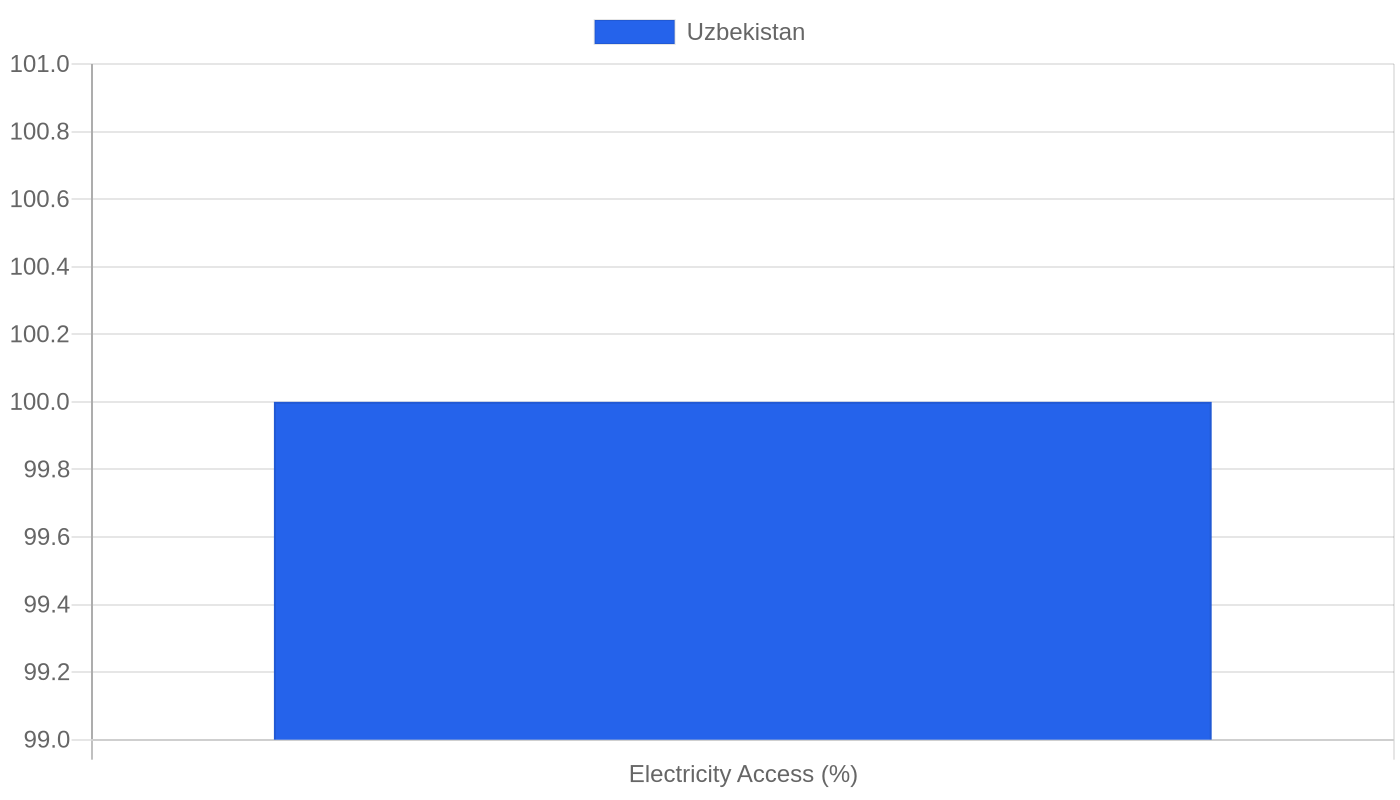
Economic Pulse Net | Sources: World Bank World Development Indicators, Government Sources | 2026
For three decades, Uzbekistan has been the enigmatic heart of Central Asia — a nation rich in history, gold, and natural gas, yet often overlooked by global investors who preferred its more market-friendly neighbours. That perception is shifting. As the government in Tashkent pushes forward with cautious economic liberalisation, a wave of modernisation is washing over a country that has long been defined by its cotton fields and Soviet-era industrial giants.
The numbers may be sparse, but the direction of travel is unmistakable: Uzbekistan is opening for business, and the world is beginning to take notice.
Key Takeaways
– Strategic Pivot: Uzbekistan is actively courting foreign investment, moving away from decades of state-dominated economic isolationism.
– Industrial Heavyweights: The economy remains anchored by state-linked behemoths in mining, automotive manufacturing, and heavy industry, providing a stable but challenging base for reform.
– Consumer Potential: With a young, urbanising population, the domestic consumer goods market—led by companies like Artel Electronics—represents a significant growth frontier.
– Political Continuity: The political landscape, while evolving since independence in 1991, remains a centralised system where the pace of change is carefully managed from the top.
– Infrastructure Focus: Significant government attention is being directed at modernising transport, logistics, and industrial capacity to position the country as a regional hub.
The Economic Engine: Heavy Industry and the Long Road to Diversification
According to the World Bank, the most recent headline figures for Uzbekistan’s GDP growth, inflation, and employment remain unpublished, leaving analysts to piece together the picture from the country’s industrial output and trade flows. What is clear is that the economy is still fundamentally powered by its basic materials and manufacturing sectors.
The Navoi Mining and Metallurgical Company, a state-controlled behemoth, remains a cornerstone of the economy, extracting and processing the gold and uranium that have long been the country’s most reliable export earners. Alongside it, the automotive sector, represented by GM Uzbekistan and MAN Auto-Uzbekistan, anchors a manufacturing base that supplies both domestic demand and regional markets.
This reliance on heavy industry is a double-edged sword. On one hand, it provides a floor of employment and export revenue that has shielded Uzbekistan from the kind of economic shocks seen in more open economies. On the other, it creates a structural inertia. The dominance of state-linked industrial conglomerates makes it difficult for small and medium-sized enterprises to emerge, which is a critical component for sustainable job creation.
The lack of current CPI data from the World Bank makes it difficult to gauge the pressure on household budgets, but the broader narrative is one of an economy in transition—moving from a Soviet-era model of central planning towards a more market-oriented system, albeit at a deliberate pace.
The Cost of Living: A Tale of Two Cities
For the average citizen, the cost of living in Uzbekistan is a study in contrasts. While the country’s GDP per capita on a purchasing power parity basis is not currently listed by the World Bank, observers note that the daily reality for many Uzbeks remains defined by a mix of subsistence agriculture in rural areas and a cash-based, service-oriented economy in urban centres like Tashkent. Housing, in particular, is a significant pressure point.
The rental market in Tashkent has seen steady demand from a growing class of white-collar workers and expatriates, pushing prices in the capital well above the national average. For most locals, however, buying a home remains a generational project, often funded through family savings and informal loans rather than accessible mortgage markets.
The cost of everyday goods is similarly stratified. Imported electronics and Western-branded goods carry a significant premium, making them aspirational purchases for the middle class. In contrast, locally produced foodstuffs and public transport remain affordable, reflecting a government policy that has historically prioritised price stability on staples over broader wage growth.
This creates a unique economic environment where the gap between those plugged into the new, globalised economy and those dependent on traditional state salaries can be stark. The presence of major consumer goods companies like Artel Electronics, which produces affordable appliances for the local market, is a testament to the growing consumer base, but also highlights the fact that disposable income is still limited for the majority of the population.
Business and Investment: Heavyweights and Hidden Opportunities
The corporate landscape in Uzbekistan is dominated by a mix of privatised giants and state-owned enterprises that are slowly being reshaped. The top companies list provided by the data—from Avialeasing in the aviation sector to the Tashkent Aviation Production Association and O’zelectroapparat-Electroshield in heavy industry—paints a picture of an economy still heavily weighted towards industrial production.
These firms are the legacy of the Soviet era, and their modernisation is central to the government’s economic strategy. For foreign investors, the primary opportunities lie not in displacing these giants but in supplying them, providing the technology, logistics, and services that these industrial behemoths lack.
The financial sector, anchored by the Central Bank of Uzbekistan, is undergoing a period of cautious reform. The banking system is slowly modernising, moving away from its role as a state funding mechanism towards a more commercial model. This is a critical enabler for the broader economy; without a functioning credit market, the SME sector will continue to struggle. For those willing to navigate the bureaucracy, the rewards can be significant.
The government has signalled its intent to attract foreign direct investment, particularly in energy, agriculture, and tourism, and the presence of companies like O′zbekiston Pochtasi in the logistics space suggests a push to modernise the country’s infrastructure. The business climate is improving, but it remains a place where patience, local partnerships, and a deep understanding of the political landscape are essential for success.
Safety, Politics, and the Quality of Life
The political landscape in Uzbekistan is defined by a legacy of strong centralised leadership. As the data outlines, the country’s modern history began with the election of Islam Karimov as its first President in December 1991, following independence from the Soviet Union. The subsequent establishment of the Oliy Majlis, first as a unicameral body and later as a bicameral parliament with a 150-member Legislative Chamber and a 100-member Senate, created the institutional framework for governance.
While the specifics of the current political climate are not detailed in the data, the historical context indicates a system where stability and gradual, state-directed change are prioritised over rapid liberalisation.
In terms of safety and quality of life, the absence of a specific crime index from the World Bank makes it difficult to provide a comparative statistical analysis. However, anecdotally, Uzbekistan is often described as a relatively safe country, with low levels of petty crime compared to many global cities. The quality of life is heavily influenced by the economic factors previously mentioned—access to affordable housing, healthcare, and education.
The government’s focus on industrial development is, in part, a social policy aimed at maintaining employment and social stability. For the population, life in Uzbekistan is a blend of deep cultural tradition and a slow, deliberate embrace of modernity, with the state continuing to play a dominant role in shaping the social and economic environment.
What’s Happening Now: The Slow Dance of Reform
The most current narrative coming out of Tashkent is one of cautious, top-down reform. While the World Bank has not released the latest quarterly growth or inflation figures, the policy signals from the government are clear. There is a concerted push to modernise the economy’s industrial base, with a focus on import substitution and expanding export capacity beyond traditional commodities.
The automotive and electronics sectors are being nurtured as national champions, with the government likely using its influence to encourage localisation and technology transfer. The ongoing efforts to reform the financial sector, led by the Central Bank, are also a key indicator of the direction of travel.
The business community is watching these developments with a mix of optimism and pragmatism. The recent news cycle, as reflected in the company data, shows a flurry of activity in the industrial and logistics sectors, suggesting that state investment is flowing into these areas. However, the pace of change is often frustratingly slow for international observers accustomed to faster-moving economies.
The government appears committed to reform, but it is a commitment tempered by a desire to avoid the social dislocation that rapid liberalisation can bring. The real test for Uzbekistan will be whether it can translate its industrial strength and strategic location into sustainable, broad-based growth that lifts the living standards of its entire population, not just the corporate elite.
The Bottom Line
Uzbekistan is a country on the cusp of significant change, but it is a change that will come on its own terms. For investors and businesses with a long-term perspective, the potential is immense—a strategically located nation with a strong industrial base, a young population, and a government that is finally signalling its intention to engage with the global economy. However, it is not a market for the faint-hearted. The path is still fraught with bureaucratic hurdles, and the state remains a dominant force.
Those who succeed will be those who recognise that doing business in Uzbekistan requires patience, local knowledge, and a genuine commitment to partnering with the country’s established industrial powers. This is a nation to watch—not for overnight returns, but for the steady, compounding rewards of being an early mover in one of the world’s last great frontier markets.
Sources & Methodology
This article is authored by Economic Pulse Net for informational and research purposes. Economic Pulse Net sources its data from multilateral institutions, national statistics bureaus, and proprietary databases. All data is believed to be current as of the date of publication.
Published: August 06, 2026 | Category: Research — Uzbekistan
Use these signals in your own platform
Economic Pulse publishes its live signal feed through a documented, read-only API. Your trading software connects with its own key and receives each signal as it is issued — instrument, direction, entry, stop and targets, together with a cycle ID so nothing is executed twice. The feed is independent of this website and cannot change it.
Signals are informational only and are not financial advice.