Economic Pulse Net | Sources: World Bank World Development Indicators, Government Sources | 2026
Key Takeaways
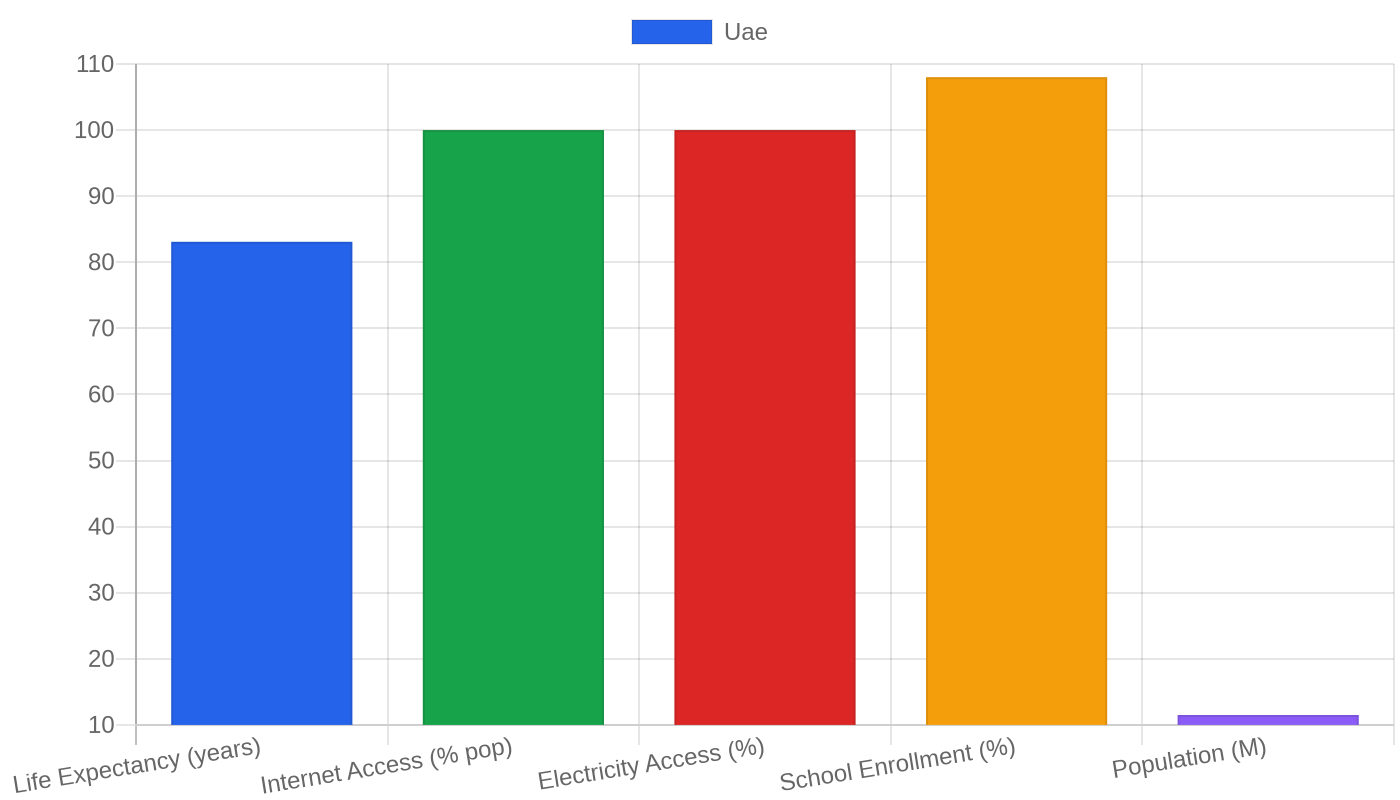
– The UAE’s economy grew by nearly 4% in 2024, according to the World Bank, reaching a GDP of over $552 billion — a sign of resilience in a volatile global environment.
– With a GDP per capita (PPP) of nearly $80,000, the UAE ranks among the world’s wealthiest nations, though this masks significant variation between its seven emirates.
– The country is a unique hybrid: a federal semi-presidential state under a semi-constitutional monarchy, where seven hereditary sheikhdoms pool resources but retain significant local control.
– The UAE’s population of 11.5 million is overwhelmingly expatriate, a demographic reality that shapes everything from labor markets to housing demand.
– No official inflation or unemployment data is available from the World Bank for 2024, but the country’s economic trajectory suggests continued expansion driven by diversification efforts.
The $552 Billion Engine — Growth, Wealth, and the Diversification Gamble
The numbers from the World Bank tell a story of a small nation punching far above its weight. The UAE’s GDP reached $552.3 billion in 2024, with growth clocking in at a respectable 3.99%. For context, that rate of expansion would be the envy of most mature economies, though it represents a moderation from the post-pandemic boom years. The real headline, however, is the wealth per capita.
At $79,343 on a purchasing power parity basis, the UAE’s citizens and long-term residents enjoy a standard of living that rivals Switzerland or Norway. The GNI per capita of $51,550 further underscores this affluence — though this figure, like all averages, obscures the vast gulf between the Emirati elite and the millions of migrant workers who build and serve the nation.
The World Bank data does not break down the UAE’s main industries, but any observer of the Gulf knows the story: oil and gas remain the backbone, though the government has aggressively pushed into tourism, aviation, real estate, and financial services. Dubai’s transformation into a global hub for trade and logistics, Abu Dhabi’s role as an energy powerhouse, and the rise of free zones have all contributed to the 3.99% growth figure.
The question is whether this diversification is deep enough to sustain growth when global oil demand eventually peaks. The 2024 GDP numbers suggest the answer is cautiously optimistic — the economy is growing, but it remains tethered to hydrocarbon revenues that flow from the seven emirates to the federal government.
The Seven Sheikhdoms — Housing, Rent, and the Cost of the Good Life
The UAE’s cost of living is legendary for its extremes. While the World Bank data does not provide specific housing or inflation figures, any report on the Emirates must acknowledge the bifurcated reality. In Dubai and Abu Dhabi, luxury apartments in towers like the Burj Khalifa or on Saadiyat Island command rents that rival Manhattan or London — often exceeding $50,000 annually for a one-bedroom.
Yet the vast majority of the population, particularly the low-income migrant workers who make up nearly 90% of residents, live in cramped shared accommodations in areas like Dubai’s Satwa or Abu Dhabi’s Mussafah, where a bed in a shared room can cost as little as $150 per month.
The absence of official inflation data from the World Bank is notable, but anecdotal evidence from regional surveys suggests that housing costs have risen sharply since 2022, driven by an influx of wealthy expatriates and Russian capital fleeing sanctions.
The rent-versus-buy calculation is heavily skewed toward renting for most expatriates, who cannot own freehold property outside designated zones. For Emirati nationals, however, the government provides generous housing subsidies and land grants, creating a two-tier market that is both a social safety net and a source of tension.
The cost of daily essentials — food, utilities, transportation — is broadly in line with other Gulf states, though the UAE’s lack of a broad-based income tax makes it a magnet for high-earning professionals who can stomach the rent.
Free Zones, Family Firms, and the Business of the Future
The UAE’s business climate is defined by its free zones — designated areas where foreign investors can enjoy 100% ownership, tax exemptions, and simplified customs procedures. While the World Bank data does not list specific top companies, the landscape is dominated by state-linked giants like Emirates airline, Abu Dhabi National Oil Company (ADNOC), and DP World, alongside a growing cohort of tech startups and logistics firms.
The sectors to watch are renewable energy, where the UAE has invested heavily in solar projects like Noor Abu Dhabi, and artificial intelligence, where the government has established a dedicated ministry and launched initiatives like the Mohamed bin Zayed University of Artificial Intelligence.
The political structure — a federation of seven hereditary sheikhdoms — creates a unique business environment. Each emirate has its own economic development authority, leading to competition for foreign investment. Dubai offers a more laissez-faire approach, while Abu Dhabi leans on its vast hydrocarbon wealth to underwrite long-term industrial projects. For investors, the key is understanding which emirate’s rules apply.
The federal government sets monetary policy and defense, but the real action happens at the local level, where sheikhs can fast-track approvals or grant exclusive licenses. This patchwork system is both a strength — offering flexibility — and a weakness, as businesses must navigate seven different regulatory regimes.
The Sheikhs, the Police, and the Social Contract
The UAE’s political landscape, as described in the provided data, is a “federal semi-presidential state under a semi-constitutional monarchy” — a mouthful that reflects a complex reality. The Federal Supreme Council, made up of the seven ruling sheikhs, is the highest authority, and a percentage of each emirate’s revenues is allocated to the federal budget.
This arrangement has proven remarkably stable, with Abu Dhabi’s Al Nahyan family and Dubai’s Al Maktoum family dominating decision-making. There are no elections for the top leadership, and political parties are banned. The trade-off is clear: the population accepts limited political freedoms in exchange for safety, stability, and a generous welfare state for citizens.
The World Bank provides no crime or safety indices for the UAE, but the country is widely regarded as one of the safest in the world. Street crime is rare, and the police presence is heavy and technologically advanced, with AI-powered surveillance systems in major cities. For expatriates, this safety is a major draw, though it comes with strict laws on speech, assembly, and personal behavior.
The quality of life for high-income residents is exceptional — world-class healthcare, infrastructure, and leisure options. For low-income migrant workers, however, the experience is often one of exploitation and limited legal recourse, a tension that the government has attempted to address with labor law reforms in recent years.
The Post-Oil Pivot — What’s Happening Now in the Emirates
The UAE in 2025 is in the midst of a generational transformation. The government has accelerated its push to attract foreign talent, introducing a “golden visa” system that grants long-term residency to investors, scientists, and exceptional students. The recent news cycle has been dominated by the UAE’s role as a mediator in regional conflicts, its investment in African infrastructure, and its ambitious space program, which recently sent a probe to the asteroid belt.
On the economic front, the non-oil sector is growing faster than the hydrocarbon sector, a trend that the World Bank’s 3.99% GDP growth figure partially reflects. The government has also implemented a 9% corporate tax on profits above a certain threshold, a major policy shift designed to align with global tax standards while still maintaining the UAE’s competitive edge.
The population of 11.5 million continues to grow, driven by an influx of skilled professionals from South Asia, Europe, and Africa. This demographic pressure is reshaping housing markets and straining infrastructure in Dubai and Abu Dhabi. Meanwhile, the federal government is grappling with how to distribute revenues more equitably among the seven emirates, particularly as oil revenues — which flow disproportionately to Abu Dhabi — become a smaller share of the total economy.
The coming years will test whether the UAE’s unique federal model can adapt to a post-oil future, or whether the centrifugal forces of local autonomy will pull the seven sheikhdoms in different directions.
The Bottom Line
The UAE is a country of superlatives and contradictions — a place where $80,000 per capita wealth coexists with a migrant labor force that earns a fraction of that, where seven sheikhdoms operate as a single nation while fiercely guarding their local powers. For investors, it offers a stable, low-tax environment with world-class infrastructure and a government that is serious about diversification.
For policymakers, it is a case study in how to manage a resource-rich economy through a transition that most petrostates will eventually face. Watch the UAE if you want to understand the future of the Gulf — or if you’re looking for a place where the numbers tell only part of the story.
Sources & Methodology
This article is authored by Economic Pulse Net for informational and research purposes. Economic Pulse Net sources its data from multilateral institutions, national statistics bureaus, and proprietary databases. All data is believed to be current as of the date of publication.
Published: July 16, 2026 | Category: Research — UAE
Use these signals in your own platform
Economic Pulse publishes its live signal feed through a documented, read-only API. Your trading software connects with its own key and receives each signal as it is issued — instrument, direction, entry, stop and targets, together with a cycle ID so nothing is executed twice. The feed is independent of this website and cannot change it.
Signals are informational only and are not financial advice.