Economic Pulse Net | Sources: World Bank World Development Indicators, Government Sources | 2026
Key Takeaways
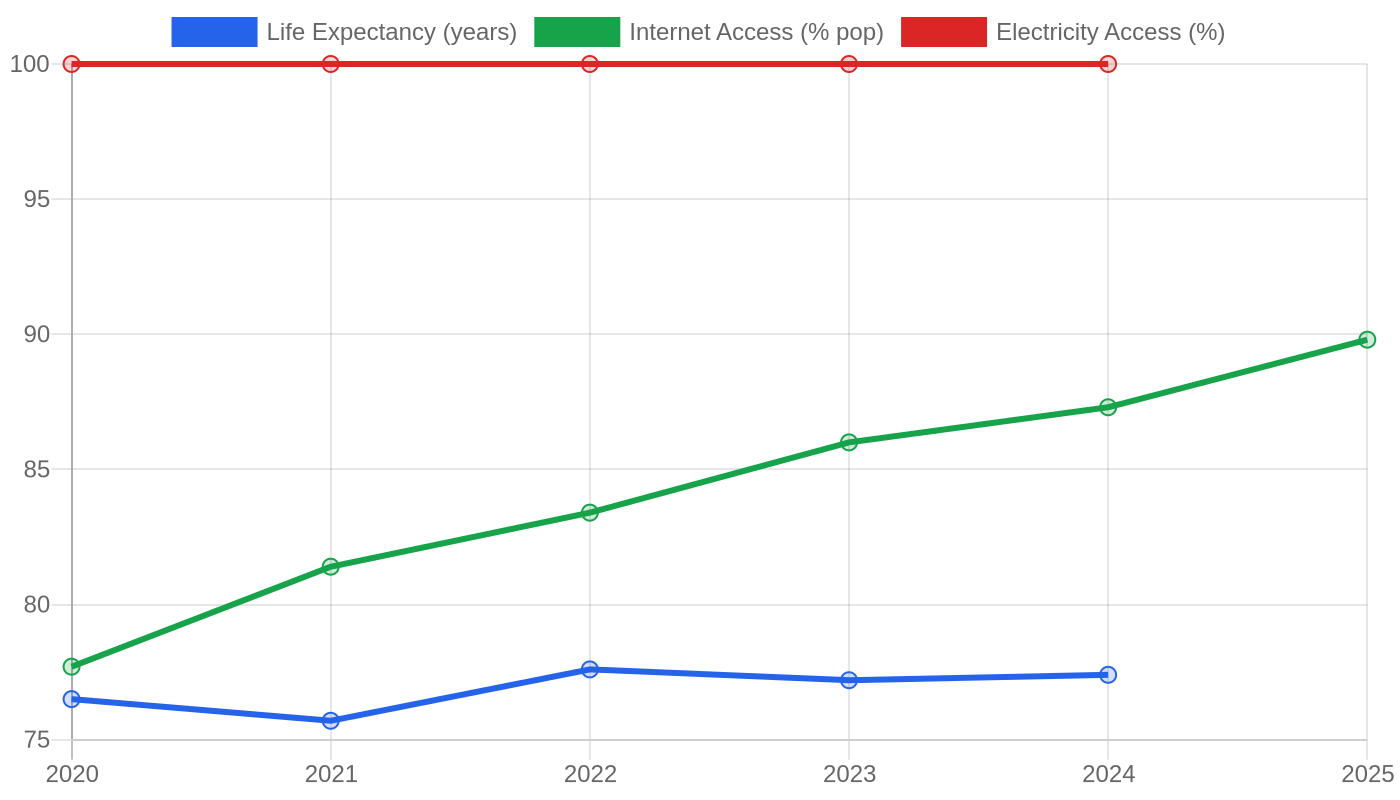
– Turkmenistan remains one of the world’s most opaque economies, with no recent GDP, inflation, or unemployment data published by the World Bank, making independent analysis extraordinarily difficult.
– The economy is overwhelmingly dominated by state-controlled oil and gas giants Türkmengaz and Türkmennebit, which drive export revenues and government budgets.
– After a century under Russian and Soviet rule, independence in 1991 created a political system that prioritizes stability and self-sufficiency over transparency or integration with global markets.
– The country’s vast natural gas reserves — among the largest globally — give it strategic leverage, but a lack of diversification leaves it vulnerable to energy price shocks.
– For investors and analysts, Turkmenistan represents a high-risk, high-uncertainty proposition where data gaps are themselves a form of information.
The Ghost Economy — What the Numbers Don’t Tell You
The World Bank, the most authoritative source for cross-country economic comparisons, publishes no current data on Turkmenistan’s GDP growth, inflation rate, unemployment figures, or even total GDP in US dollars. This absence is not accidental. It reflects a deliberate choice by the Turkmen government to maintain a veil of secrecy over its economic affairs.
For a country sitting on the world’s fourth-largest natural gas reserves, this information vacuum is both a political statement and a practical challenge for anyone trying to understand the nation’s financial health.
What can be inferred from the available data is that Turkmenistan’s economy is a hydrocarbon monoculture. The two dominant state enterprises — Türkmengaz and Türkmennebit — control the extraction, processing, and export of natural gas and oil. These companies are not merely economic actors; they are the financial backbone of the state itself.
Without transparent GDP figures, analysts must rely on proxy indicators: energy export volumes, trading partner data from neighboring countries like China and Russia, and occasional state media announcements. The lack of a published inflation CPI figure means that ordinary Turkmen citizens’ purchasing power is a matter of speculation, though anecdotal reports from regional observers suggest that price controls and subsidies mask underlying inflationary pressures.
The unemployment data gap is perhaps the most politically sensitive: in a country where the state guarantees employment but where underemployment is rampant, the official absence of a number tells its own story.
The Cost of Living in a Closed Economy
Housing costs in Turkmenistan are notoriously difficult to pin down because the state controls much of the housing stock and rental market. The capital, Ashgabat, is famous for its white marble buildings and grandiose architecture, but this aesthetic masks a dual reality: state-provided housing for loyal civil servants exists alongside a black market for rentals that can cost several times the official salary of a typical worker.
Buying property is theoretically possible, but the lack of a transparent land registry and the dominance of state allocation mean that real estate functions more as a political privilege than a market commodity.
Daily expenses for food, utilities, and transportation are heavily subsidized by the government, which keeps basic goods artificially cheap for citizens. However, this comes at a cost: shortages of imported goods are common, and the quality of locally produced items often lags behind regional standards.
Compared to neighboring Central Asian economies such as Kazakhstan or Uzbekistan, Turkmenistan’s official prices appear lower, but the reality for ordinary citizens involves queuing, rationing, and reliance on informal networks. The gap between the subsidized official economy and the black market creates a dual pricing system that makes any single cost-of-living figure misleading.
Investment and Business Climate — Fortress Turkmenistan
For any foreign investor, the first question is not about returns but about access. The top companies operating in Turkmenistan — Demirýollary (railways), MTS Turkmenistan (telecommunications), Türkmengaz, Türkmennebit, and the curiously named O’zbekiston Pochtasi (an Uzbek postal company) — reflect a business environment dominated by state-owned enterprises and a handful of foreign firms willing to navigate the country’s complex regulatory landscape.
The telecommunications sector, represented by MTS Turkmenistan, is one of the few areas where foreign capital has found a foothold, but even here, the operating environment is subject to sudden regulatory changes and state interference.
The sectors to watch are energy and infrastructure. Türkmengaz and Türkmennebit are not just companies; they are instruments of state power, and any investment in Turkmenistan’s hydrocarbon sector requires direct negotiation with the presidential administration. The business climate is characterized by high barriers to entry, opaque contracting processes, and a legal system that offers little recourse for disputes.
For those willing to accept these risks, the rewards can be substantial — Turkmenistan’s gas fields are among the most promising untapped reserves in the world, and the country’s strategic location between China, Iran, and the Caspian Sea gives it export options that few other energy producers possess.
Safety, Politics, and Quality of Life — Stability at a Price
Turkmenistan’s political landscape is defined by its post-Soviet trajectory. After over a century as part of the Russian Empire and then the Soviet Union — including 67 years as a union republic — the country declared independence on 27 October 1991, following the dissolution of the Soviet Union. Since then, it has evolved into one of the world’s most tightly controlled states.
The Crime Index and Safety Index from the World Bank are listed as N/A, but this absence of data is itself a reflection of the political reality: crime statistics are a state secret, and public safety is maintained through pervasive surveillance and a powerful security apparatus.
For ordinary citizens, quality of life is a trade-off. Violent crime is reportedly low, and the streets of Ashgabat are heavily patrolled. Political dissent, however, is not tolerated, and the absence of independent media means that any assessment of happiness or well-being must be filtered through the lens of state propaganda. The government provides free education and healthcare, but the quality of both has deteriorated since independence.
Turkmenistan offers stability — but it is the stability of a system that tolerates no opposition and provides no mechanism for public accountability.
Current Affairs — The Pivot to Asia and the Data Blackout
What is happening in Turkmenistan right now is a quiet but significant strategic recalibration. With traditional export routes to Europe complicated by geopolitical tensions, Ashgabat is deepening its energy relationship with China, which has become the primary buyer of Turkmen natural gas. This pivot is reshaping the country’s economic geography: new pipelines are being discussed, and Chinese state banks have provided financing for infrastructure projects that keep the Turkmen economy afloat.
At the same time, the government has maintained its policy of official neutrality, avoiding entanglement in regional conflicts while maximizing its leverage as a gas supplier.
The data blackout from the World Bank and other international institutions is not accidental. It reflects a deliberate policy of non-transparency that has actually intensified in recent years. Turkmenistan has declined to participate in standard IMF Article IV consultations, and its statistical agency publishes only selective figures.
For the international community, this means that assessments of Turkmenistan’s economy rely increasingly on satellite imagery of gas flaring, trade data from partner countries, and occasional state media announcements. The absence of hard numbers has become a geopolitical tool — a way for Ashgabat to control its own narrative while keeping outsiders guessing about its true economic health.
The Bottom Line
Turkmenistan is a country that demands a different kind of analysis — one that reads the silences as carefully as the data. For energy security analysts and strategic planners, it remains a critical piece of the global gas puzzle, a supplier that can pivot between China, Russia, and potentially South Asia. For investors, it is a high-stakes gamble where due diligence is nearly impossible and where political access matters more than financial metrics.
For the casual observer, Turkmenistan is a reminder that in the 21st century, some economies choose to remain invisible — and that absence of information is itself a form of power. Watch this country if you care about global energy markets or the future of authoritarian state capitalism; ignore it at your own risk.
Sources & Methodology
This article is authored by Economic Pulse Net for informational and research purposes. Economic Pulse Net sources its data from multilateral institutions, national statistics bureaus, and proprietary databases. All data is believed to be current as of the date of publication.
Published: July 20, 2026 | Category: Research — Turkmenistan
Use these signals in your own platform
Economic Pulse publishes its live signal feed through a documented, read-only API. Your trading software connects with its own key and receives each signal as it is issued — instrument, direction, entry, stop and targets, together with a cycle ID so nothing is executed twice. The feed is independent of this website and cannot change it.
Signals are informational only and are not financial advice.