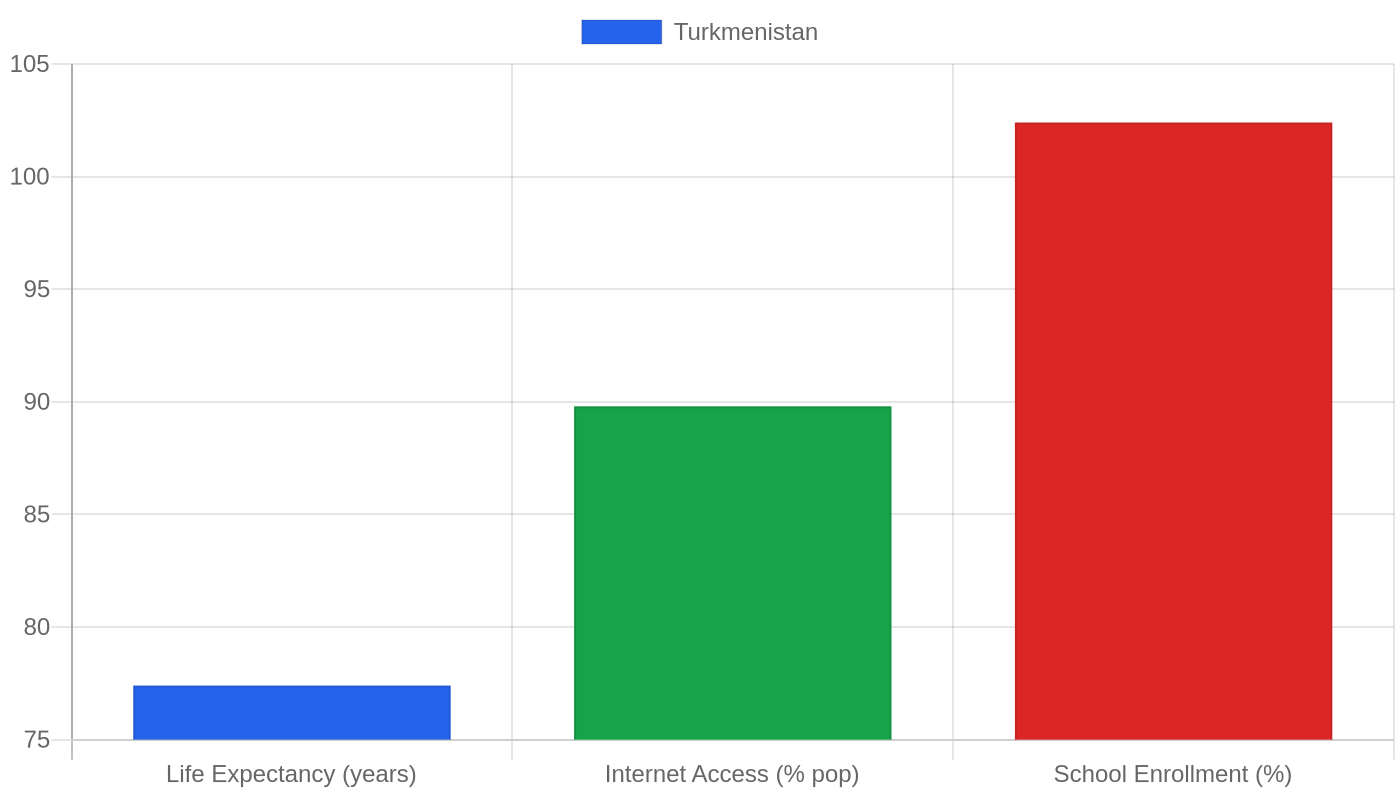
Economic Pulse Net | Sources: World Bank World Development Indicators, Government Sources | 2026
Key Takeaways
– Turkmenistan remains one of the world’s most opaque economies, with the World Bank publishing no recent data on GDP growth, inflation, or unemployment—a telling sign of the country’s isolation from global financial reporting standards.
– The economy is dominated by state-controlled hydrocarbon giants, with Türkmengaz and Türkmennebit anchoring a resource-dependent model that has defined the nation since independence in 1991.
– Despite holding some of the world’s largest natural gas reserves, Turkmenistan’s economic potential remains largely unrealized due to limited international investment and a challenging business climate.
– The country’s post-Soviet trajectory has been shaped by nearly three decades of authoritarian governance, creating a unique economic environment where state priorities supersede market forces.
– For investors and analysts, Turkmenistan represents a high-risk, potentially high-reward frontier market that demands patience and political acumen.
The Numbers Gap: Reading Between the Lines of an Invisible Economy
When the World Bank’s latest country data for Turkmenistan returns a blank slate—no GDP growth figures, no inflation readings, no unemployment statistics—that absence itself tells a compelling story. For economic journalists, Turkmenistan presents a unique challenge: how do you analyze an economy that deliberately keeps its own scorecard hidden?
The available data paints a picture of a nation still finding its footing after seven decades of Soviet central planning and over a century of Russian imperial influence. Since declaring independence on 27 October 1991, following the dissolution of the Soviet Union, Turkmenistan has charted an idiosyncratic path that combines resource nationalism with a cautious, incremental opening to the outside world.
What we do know is that Turkmenistan’s economic identity is inextricably linked to its hydrocarbon wealth. The country sits atop vast natural gas reserves that have made energy exports the cornerstone of national revenue. Yet the absence of reliable macroeconomic data from the World Bank suggests an economy that operates on its own terms, with statistical reporting that serves domestic narratives rather than international transparency standards.
This data vacuum has real consequences. International lenders, foreign investors, and trade partners must navigate a landscape where basic economic indicators are state secrets. The World Bank’s inability to publish figures reflects not a lack of data collection, but rather the deliberate opacity that characterises Turkmenistan’s governance model. For those seeking to understand this market, the numbers that are missing speak as loudly as those that exist.
The Cost of Living Puzzle: Price Tags in a State-Managed Market
Turkmenistan’s cost of living presents another analytical challenge, with no official indices available to compare against regional neighbours. What can be inferred from the country’s economic structure is that the state plays a dominant role in setting prices for essential goods and services, a legacy of its Soviet-era command economy.
The absence of cost-of-living data from international sources suggests that Turkmenistan’s consumer market remains largely insulated from global price signals. Subsidised utilities, state-controlled food prices, and limited import competition have historically kept official inflation artificially low, while parallel markets often tell a different story. For ordinary Turkmen citizens, the gap between official prices and actual availability of goods has been a persistent feature of daily life.
Housing in Turkmenistan’s capital, Ashgabat, presents a stark contrast between grand state-funded construction projects and the lived reality of most residents. The city’s famous white marble buildings stand alongside more modest housing stock, with property prices driven by a combination of state allocation systems and a limited private market. Without reliable rental data, potential expatriates and investors must rely on anecdotal evidence and regional comparisons to gauge living costs.
Business and Investment: The Hydrocarbon Fortress
Turkmenistan’s corporate landscape is dominated by state-owned enterprises that control the country’s strategic economic sectors. Türkmengaz and Türkmennebit, the national oil and gas companies, sit at the apex of this structure, managing the resource wealth that underwrites the entire national economy. These entities operate as extensions of state policy, making them both the most significant business partners and the most challenging to engage with for foreign investors.
The telecommunications sector shows signs of cautious opening, with MTS Turkmenistan operating as a notable player in a market that has historically been tightly controlled. The presence of Demirýollary, the national railway company, alongside O’zbekiston Pochtasi in the industrials sector, points to the continuing importance of transportation infrastructure in a country that serves as a transit corridor between Central Asia and the wider region.
For international businesses, Turkmenistan offers a paradox: significant opportunities in energy, infrastructure, and potentially consumer markets, tempered by a business environment where political connections matter as much as commercial viability. The absence of transparent regulatory frameworks, currency convertibility issues, and the pervasive role of the state in economic decision-making create formidable barriers to entry.
Yet for those willing to navigate these challenges, the potential rewards in a country with substantial natural resources and an underdeveloped private sector remain considerable.
Safety, Politics, and Daily Life: The Sultanate’s Shadow
The political landscape of Turkmenistan is defined by its post-Soviet trajectory and the consolidation of power in a highly personalised presidency. The country’s journey from Russian Empire province to Soviet republic to independent nation has produced a governance model that prioritises stability and control over democratic participation. This political reality shapes every aspect of economic life, from business regulation to individual opportunity.
While crime statistics are unavailable from international sources, Turkmenistan’s tightly controlled society typically exhibits low levels of street crime, a factor that contributes to a sense of personal safety for residents and visitors. However, this security comes at a cost: limited political freedoms, restricted media access, and an environment where economic success often depends on proximity to those in power.
Quality of life in Turkmenistan is a study in contrasts. The state has invested heavily in infrastructure and public amenities, particularly in Ashgabat, creating a superficially modern urban environment. Yet these visible signs of development coexist with significant challenges: limited economic diversification, restricted access to international information, and a brain drain of educated professionals seeking opportunities abroad.
For the Turkmen population, daily life involves navigating a system where state provision and personal initiative must be carefully balanced.
Current Affairs: The Long Road from Isolation
The most significant recent development in Turkmenistan’s economic history remains its declaration of independence on 27 October 1991, following the dissolution of the Soviet Union. This momentous event, coming after more than a century as part of the Russian Empire and subsequently the Soviet Union—including 67 years as a union republic—set the country on its current path of sovereignty and self-determination.
Since independence, Turkmenistan has pursued a foreign policy of positive neutrality, seeking to balance relations between major powers while maintaining its domestic autonomy. This approach has allowed the country to attract some foreign investment in its energy sector while carefully controlling the terms of international engagement. The ongoing development of gas export routes, including pipelines to China and potential connections to South Asia, represents the most dynamic area of economic activity.
The current period appears to be one of cautious transition, as Turkmenistan grapples with the challenges of economic modernisation, generational change, and the need to diversify beyond hydrocarbon exports. The government has signalled interest in developing sectors such as textiles, agriculture, and tourism, though progress remains slow.
For observers, the key question is whether Turkmenistan can gradually open its economy without undermining the political control that has defined its post-independence trajectory.
The Bottom Line
Turkmenistan remains a country that economic analysts watch with a mixture of fascination and frustration—a nation of enormous resource wealth and strategic significance that continues to resist conventional analysis. For energy companies with long-term horizons and risk tolerance, the potential rewards of engaging with Turkmenistan’s hydrocarbon sector are substantial. For investors seeking transparency, predictable regulation, and market-based reforms, this is likely not the right destination.
The country’s path forward will depend on its ability to balance the preservation of political control with the pragmatic need for economic engagement with the wider world.
Sources & Methodology
This article is authored by Economic Pulse Net for informational and research purposes. Economic Pulse Net sources its data from multilateral institutions, national statistics bureaus, and proprietary databases. All data is believed to be current as of the date of publication.
Published: August 06, 2026 | Category: Research — Turkmenistan
Use these signals in your own platform
Economic Pulse publishes its live signal feed through a documented, read-only API. Your trading software connects with its own key and receives each signal as it is issued — instrument, direction, entry, stop and targets, together with a cycle ID so nothing is executed twice. The feed is independent of this website and cannot change it.
Signals are informational only and are not financial advice.