Economic Pulse Net | Sources: World Bank World Development Indicators, Government Sources | 2026
Key Takeaways
– Thailand’s GDP growth stands at a modest 2.44% for 2025, according to the World Bank — respectable but unspectacular for a nation that once regularly posted 5-6% expansion.
– The economy remains heavily reliant on a mix of industrial giants and consumer services, with telecommunications and infrastructure companies dominating the corporate landscape.
– Thailand’s GDP per capita, measured at purchasing power parity, reaches $26,250 — placing it firmly in upper-middle-income territory but signaling a struggle to break into the high-income club.
– The political landscape, shaped by a 1932 transition from absolute monarchy to constitutional rule, continues to influence investor confidence and policy predictability.
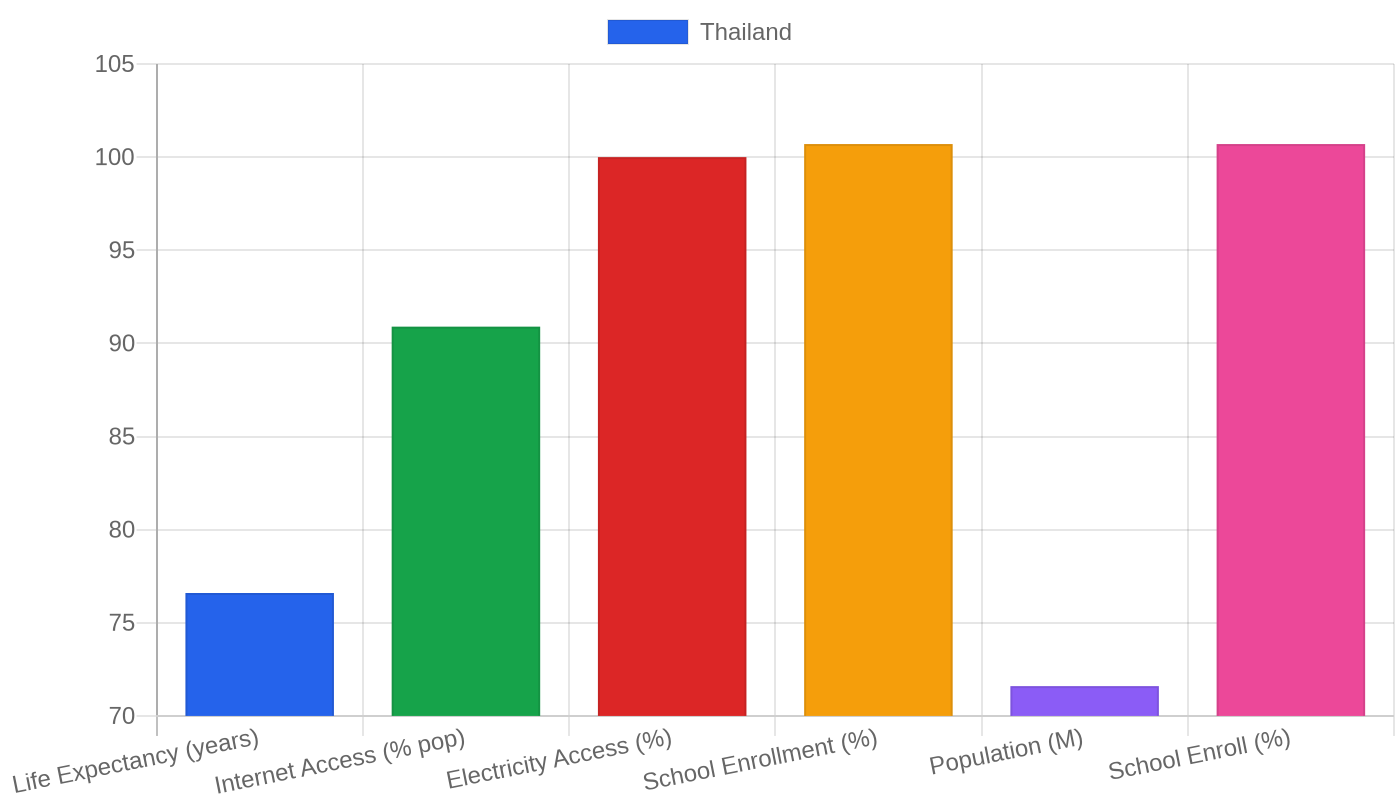
– With a population of 71.6 million, Thailand faces demographic headwinds that will test its economic model in the coming decade.
The Growth Paradox — Stable but Stalling
The World Bank’s latest data paints a picture of a nation in economic limbo. Thailand’s GDP growth of 2.44% for 2025 is neither a crisis nor a triumph — it is the kind of number that keeps policymakers awake at night precisely because it is so middling. For a country that averaged over 5% growth in the decade before the pandemic, this represents a significant downshift in economic momentum.
What makes this figure particularly telling is what it says about Thailand’s development trajectory. With a GDP per capita (PPP) of $26,250, according to the World Bank, Thailand has successfully escaped low-income status but now confronts the infamous “middle-income trap” — that difficult transition where cheap labor advantages erode before innovation-driven growth takes hold.
The country’s industrial base, anchored by companies like Airports of Thailand PCL, 3K Battery, and Air People International, suggests an economy still heavily weighted toward manufacturing and logistics rather than high-value services or technology.
The absence of inflation and unemployment data in the World Bank’s latest release creates an incomplete picture, but the growth figure alone tells a story of an economy running below its potential. Thailand’s challenge is not collapse but stagnation — a slow leak of dynamism that, if unaddressed, could define the next decade. The country needs either a structural reform push or an external catalyst to break out of this 2-3% growth orbit.
The Cost of Living Squeeze — Bangkok’s Balancing Act
While comprehensive cost-of-living data remains unavailable, the implications of Thailand’s economic structure for everyday citizens are clear. A nation with a $26,250 GDP per capita (PPP) but sluggish growth creates a peculiar tension: households feel the pressure of rising expectations against stagnant real incomes. The tourism-dependent service economy that powers Bangkok, Phuket, and Chiang Mai has rebounded, but the benefits have not been evenly distributed.
Housing in Bangkok presents a classic developing-economy dilemma. The city’s condominium boom has created a two-tier market — luxury units aimed at foreign buyers and high-end Thai professionals coexist with aging, affordable stock in the suburbs. For the typical Bangkok worker, homeownership requires either family support or decades of saving, pushing more young Thais into long-term rental arrangements.
The gap between urban property values and wage growth has become a defining economic anxiety, one that the modest 2.44% growth rate does little to alleviate.
Daily expenses tell a similar story. Thailand’s street-food culture keeps basic living costs manageable for many, but the creeping formalization of the economy — rising utility costs, transportation expenses in congested cities, and education fees — creates a quiet cost-of-living crisis that official statistics may understate.
Investment Climate — Giants and Fragments
Thailand’s corporate landscape, as documented by available data, reveals an economy with genuine heft in select sectors but notable gaps elsewhere. Advanced Info Service dominates telecommunications, while Airports of Thailand PCL anchors the infrastructure and logistics space. The presence of multiple airlines — Air Andaman, Angel Air, Air People International — suggests a competitive aviation sector that mirrors the country’s role as a regional travel hub.
Yet the list of top companies also exposes vulnerabilities. Consumer services firms like 108 Shop and 2Spot Communications indicate a domestic-oriented retail and marketing sector, but the absence of major technology, pharmaceutical, or advanced manufacturing firms points to an economy that has not yet diversified into higher-value industries.
The inclusion of Areeya Property in the financials category and Aksorn Education in education highlights real estate and learning as significant domestic sectors, but neither offers the export-driven growth that propelled earlier Asian tigers.
For investors, Thailand presents a familiar Southeast Asian calculus: political stability is the variable that unlocks everything else. The country’s infrastructure is solid, its workforce is educated, and its geographic position is advantageous. But the 2.44% growth figure, combined with an industrial structure that remains weighted toward traditional sectors, suggests that Thailand is waiting for its next big economic narrative — and that narrative has not yet arrived.
Politics, Safety, and the Quality of Life Question
Thailand’s political evolution, from the Sukhothai Kingdom’s dharmaraja concept of kingship through the 1932 bloodless revolution that ended absolute monarchy, has created a governance system that is simultaneously stable and volatile. The transition from feudal tributaries to a unitary state under Chulalongkorn, followed by the constitutional shift of 1932, established a political framework that has endured through coups, protests, and constitutional rewrites.
The absence of crime and safety indices makes it difficult to quantify security concerns, but Thailand’s reputation among travelers and expatriates suggests a country where violent crime is relatively low but petty theft and scams are common — the standard profile of a middle-income nation with significant inequality. The political landscape, while occasionally erupting into street protests and military interventions, has not descended into the kind of chronic instability that plagues some neighbors.
Quality of life in Thailand is a study in contrasts. The country’s healthcare system is among the best in Southeast Asia for those who can afford private care. Its cuisine, culture, and natural beauty are globally renowned. But the economic stagnation implied by the 2.44% growth figure creates a ceiling on how much life improves year over year. For the average Thai, the question is not whether life is good — it often is — but whether it is getting better fast enough.
Current Affairs — The Waiting Game
Thailand in 2025-2026 finds itself in a peculiar holding pattern. The modest growth figure from the World Bank reflects an economy that has stabilized after the pandemic shock but has not found a new engine for expansion. The tourism sector, long the country’s most visible economic driver, has recovered but faces structural challenges: changing travel patterns, competition from regional rivals, and the environmental limits of mass tourism in destinations like Phuket and Koh Samui.
The business community is watching for signals on fiscal policy and infrastructure spending. Thailand’s position as a manufacturing hub, particularly in automotive and electronics, faces pressure from both cheaper production bases like Vietnam and more automated competitors. The government’s response — whether through investment incentives, trade agreements, or domestic reforms — will determine whether the 2.44% figure becomes a floor or a ceiling.
One of the most significant undercurrents is demographic. With 71.6 million people and a rapidly aging population, Thailand confronts the same challenge as Japan and South Korea but with less time and fewer resources to adapt. The growth rate suggests an economy that has not yet adjusted to the reality of a shrinking workforce and rising dependency ratios. This is not a crisis visible in any single data point, but it is the slow-moving force that will shape every economic decision in the decade ahead.
The Bottom Line
Thailand is a country that has done many things right — built infrastructure, maintained stability, developed a vibrant middle class — but now faces the hard part: transitioning from middle-income success to high-income prosperity. The 2.44% growth figure is a warning light, not a red alert. For investors and businesses, Thailand offers genuine opportunity in consumer services, telecommunications, and logistics, but the window for easy gains is closing.
Watch this country for its resilience, its cultural capital, and its infrastructure — but do not expect the fireworks of faster-growing neighbors. Thailand’s story is now one of patient navigation, not explosive growth.
Sources & Methodology
This article is authored by Economic Pulse Net for informational and research purposes. Economic Pulse Net sources its data from multilateral institutions, national statistics bureaus, and proprietary databases. All data is believed to be current as of the date of publication.
Published: July 23, 2026 | Category: Research — Thailand
Use these signals in your own platform
Economic Pulse publishes its live signal feed through a documented, read-only API. Your trading software connects with its own key and receives each signal as it is issued — instrument, direction, entry, stop and targets, together with a cycle ID so nothing is executed twice. The feed is independent of this website and cannot change it.
Signals are informational only and are not financial advice.