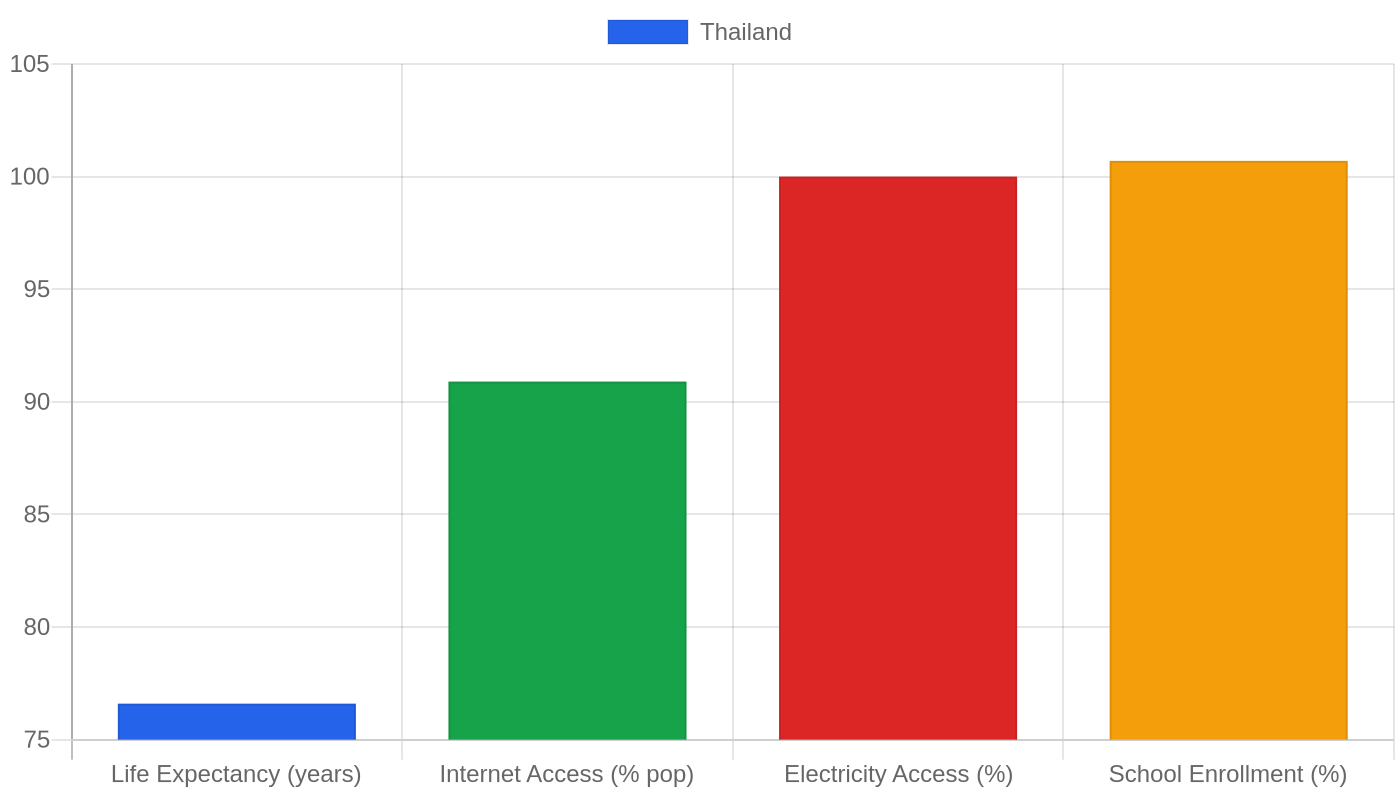
Economic Pulse Net | Sources: World Bank World Development Indicators, Government Sources | 2026
Key Takeaways
– Thailand’s political system has undergone a profound transformation since the bloodless 1932 revolution, moving from absolute monarchy to a constitutional framework—yet the economic landscape remains a work in progress.
– The country’s economic data infrastructure reveals a nation in flux, with key indicators like GDP growth, inflation, and unemployment not currently published in the latest World Bank dataset, suggesting either reporting delays or a period of recalibration.
– Thailand’s corporate sector is anchored by infrastructure and telecommunications giants like Advanced Info Service and Airports of Thailand PCL, signalling that connectivity and aviation remain national priorities.
– The economy shows a distinctive split between modern industrial services and a deep-rooted consumer retail culture, exemplified by companies like 108 Shop and 3K Battery.
– For investors and observers, Thailand’s trajectory hinges on how well it can leverage its strategic position in Southeast Asia while navigating the legacy of its political evolution.
The Economic Engine Room: Growth, Inflation, and the Industrial Backbone
The Thai economy presents a fascinating paradox for analysts: it is a nation with clear industrial strengths, yet the most recent World Bank data shows a gap in headline indicators. GDP growth figures, inflation rates, and unemployment numbers are not available in the latest dataset, which itself tells a story about the challenges of economic measurement in a rapidly changing environment.
What we do know is that Thailand’s industrial composition is heavily weighted toward services and infrastructure, with the country’s top companies spanning telecommunications, aviation, and consumer services. This is not an economy built on raw extraction; it is one that has invested heavily in the connective tissue of modern commerce.
The presence of Advanced Info Service in the telecommunications sector underscores Thailand’s commitment to digital infrastructure, while the prominence of Airports of Thailand PCL and regional carriers like Air Andaman and Angel Air highlights the nation’s role as a travel and logistics hub for Southeast Asia. These industries are the engines that would typically drive GDP growth, create employment, and influence inflation dynamics.
The absence of hard numbers in the World Bank dataset means we must look to the corporate landscape for signals of economic health. When a nation’s leading firms are in consumer services—like 108 Shop and 2Spot Communications—it suggests a domestic demand story that could be resilient even in the face of global headwinds.
The industrial and financial sectors are equally telling. Areeya Property in the financials space indicates a functioning real estate market, while 3K Battery in industrials points to manufacturing capabilities that support both domestic consumption and potential exports. For the average Thai citizen, the economic reality is shaped by these industries’ performance.
If telecommunications and aviation are expanding, it typically translates into jobs and wage growth; if they stall, the effects ripple through the entire economy. The lack of published inflation data is particularly notable, as price stability is the bedrock of consumer confidence. Without it, households may be making spending decisions in an information vacuum, which can dampen economic activity.
The Cost of Living Puzzle: Housing, Retail, and Daily Realities
Housing costs and daily expenses in Thailand are not captured in the current World Bank dataset, but the composition of the country’s top companies offers a window into consumer behaviour. The prominence of 108 Shop in consumer services suggests a retail culture that values convenience and accessibility, likely catering to a broad demographic spectrum from urban professionals to rural households.
In a nation where property development firms like Areeya Property are among the leading financial entities, the housing market is clearly a significant component of household wealth and expenditure. The question of rent versus buy is one that many Thai families grapple with, and the answer often depends on location—Bangkok’s central districts versus provincial towns.
What we can infer is that Thailand’s cost of living is likely shaped by its dual economy: a modern, globalised urban sector and a more traditional, agrarian hinterland. The presence of education companies like Aksorn Education among the top firms indicates that household budgets are also directed toward schooling, a priority for many Thai families.
Daily expenses such as food, transport, and utilities would typically consume a significant portion of income, but without precise data, we must rely on the signals from the corporate sector. The fact that consumer services dominate the top companies list suggests that discretionary spending is alive and well, which in turn implies a middle class with disposable income. For a country at Thailand’s stage of development, this is a healthy sign, even if the exact numbers remain elusive.
Investment and Business Climate: Where the Opportunities Lie
For investors looking at Thailand, the business climate is defined by the sectors that dominate its corporate landscape. Telecommunications, through Advanced Info Service, offers exposure to the digital economy, a sector with long-term growth potential as more Thais come online. Aviation and airports, represented by Airports of Thailand PCL and carriers like Air People International, provide a play on regional travel and tourism, which has historically been a cornerstone of the Thai economy.
The industrial sector, including 3K Battery, suggests opportunities in manufacturing and energy storage, areas that could benefit from global shifts toward electrification and sustainability.
The business environment in Thailand is also shaped by its political history. The transition from absolute monarchy to a constitutional system in 1932 was a watershed moment that set the stage for modern economic governance. For foreign and domestic investors alike, political stability is a key consideration, and Thailand’s long evolution from feudal tributaries to a unitary state under Chulalongkorn has created a complex but navigable regulatory landscape.
The presence of financial firms like Areeya Property indicates that capital markets are functioning, and the diversity of top companies—from education to consumer services—suggests a broad-based economy that can absorb shocks. Sectors to watch include digital infrastructure, aviation, and property development, all of which are represented in the top tier of Thai business.
Safety, Politics, and the Quality of Life
The political landscape in Thailand is a study in contrasts, with the World Bank data painting a picture of a nation that has evolved from feudal and absolute monarchies to a modern state. The Sukhothai Kingdom’s concept of the king as a *dharmaraja*—a ruler who governs in accordance with dharma—is a philosophical foundation that still resonates in Thai society today.
The bloodless revolution of 24 June 1932, carried out by the Khana Ratsadon (People’s Party), marked a definitive break from the past and the beginning of a new political era. This historical context is crucial for understanding the country’s current governance and its approach to economic policy.
Crime and safety indices are not available in the current dataset, which makes it difficult to assess the lived reality of Thai citizens in terms of personal security. However, the stability implied by a functioning corporate sector and a well-established telecommunications infrastructure suggests a society that is not in turmoil. Quality of life in Thailand is likely a mix of urban dynamism and rural tranquillity, with the country’s cultural heritage providing a rich backdrop to daily existence.
The political evolution from absolute monarchy to a more participatory system has been gradual, and the legacy of the 1932 revolution continues to shape national identity. For expatriates and locals alike, Thailand offers a unique blend of tradition and modernity, though the exact metrics of safety and happiness remain unquantified in the available data.
What’s Happening Now: A Nation at a Crossroads
The current moment in Thailand is defined by the interplay between its historical legacy and its future aspirations. The World Bank data gaps are themselves a talking point, as they may reflect a period of economic recalibration or data collection challenges. What is clear is that Thailand’s corporate sector is not standing still.
The continued prominence of Advanced Info Service in telecommunications signals ongoing investment in connectivity, while the presence of multiple aviation companies—from Air Andaman to Angel Air—suggests that the travel sector is preparing for a resurgence. This is a nation that is positioning itself for a post-pandemic world, even if the macroeconomic indicators have not yet been fully reported.
The political landscape, rooted in the 1932 revolution, is evolving in real-time. The transition from a network of tributaries to a unitary state under Chulalongkorn laid the groundwork for modern governance, and the current administration operates within that framework. For businesses, the key question is whether policy shifts will favour the industrial and service sectors that dominate the economy.
The presence of financial and property firms among the top companies indicates that domestic investment is flowing, and the consumer services sector’s strength suggests that household spending remains robust. Thailand is not a nation in crisis; it is a nation in transition, balancing its rich history with the demands of a globalised economy.
The Bottom Line
Thailand is a country that demands attention from investors, policymakers, and observers of Southeast Asia. Its corporate landscape is a testament to its economic potential, with strengths in telecommunications, aviation, and consumer services that position it well for future growth. The political evolution from absolute monarchy to constitutional governance provides a stable foundation, even as the exact economic indicators remain unpublished.
For those looking to understand the region, Thailand offers a compelling case study in how a nation can modernise while preserving its cultural identity. The watchword is patience: as the data catches up with reality, the story of Thailand’s economic transformation will become even clearer.
Sources & Methodology
This article is authored by Economic Pulse Net for informational and research purposes. Economic Pulse Net sources its data from multilateral institutions, national statistics bureaus, and proprietary databases. All data is believed to be current as of the date of publication.
Published: August 10, 2026 | Category: Research — Thailand
Use these signals in your own platform
Economic Pulse publishes its live signal feed through a documented, read-only API. Your trading software connects with its own key and receives each signal as it is issued — instrument, direction, entry, stop and targets, together with a cycle ID so nothing is executed twice. The feed is independent of this website and cannot change it.
Signals are informational only and are not financial advice.