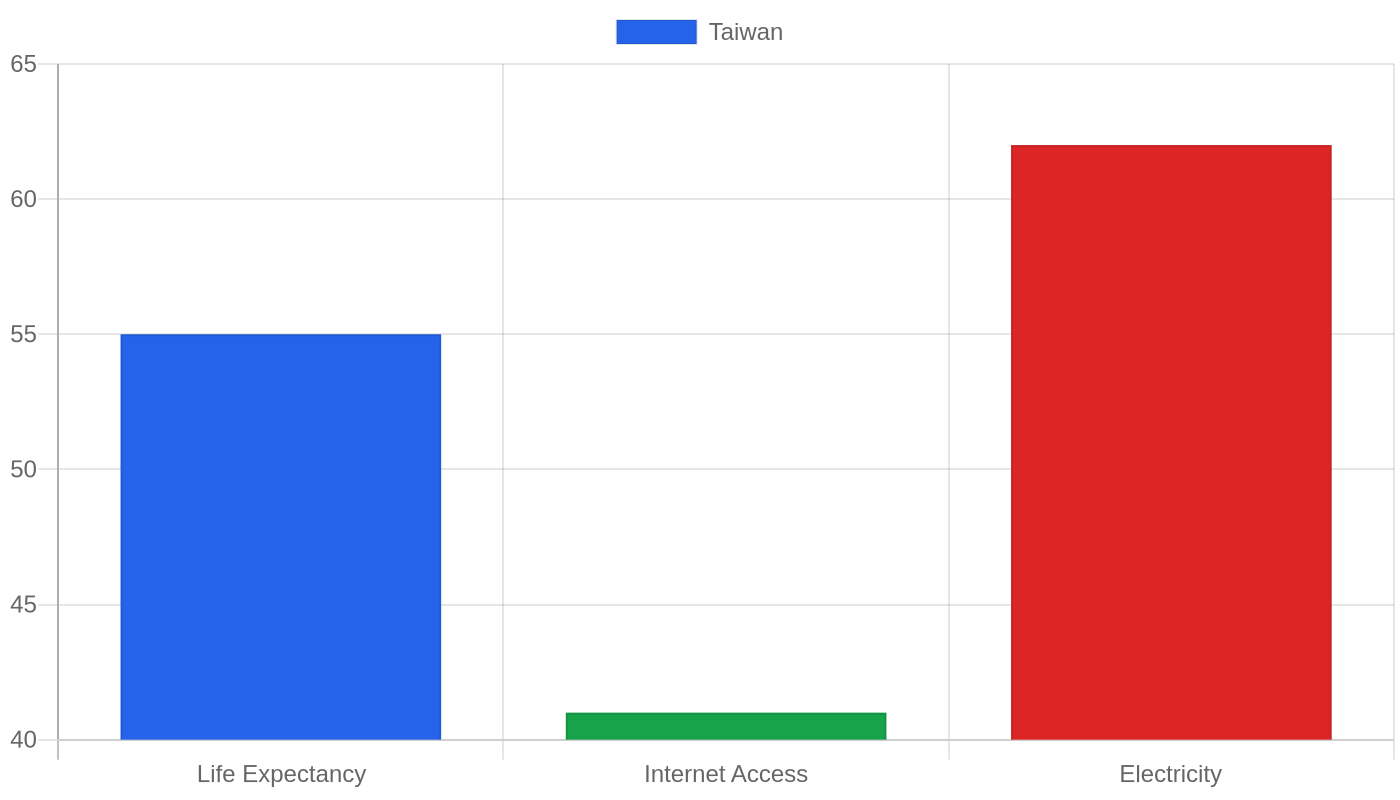
Economic Pulse Net | Sources: World Bank World Development Indicators, Government Sources | 2026
Key Takeaways
– Taiwan’s economy is overwhelmingly driven by semiconductor manufacturing and electronics, with TSMC and Foxconn leading global supply chains.
– Despite the absence of specific World Bank economic indicators in the latest report, Taiwan’s industrial output and corporate dominance tell a story of high-value export-led growth.
– The political landscape remains anchored to the 1947 Constitution and the Three Principles of the People, with a five-branch government structure that underwent significant reforms in the 1990s.
– Major consumer-facing brands like 85°C Bakery Cafe and A.mart indicate a vibrant domestic services sector alongside industrial giants.
– Investors should watch Taiwan for its critical role in global tech supply chains, though data gaps make precise economic benchmarking challenging.
The Engine Room — What Drives Taiwan’s Economy
The World Bank’s latest data release for Taiwan presents a curious blank canvas: GDP growth, inflation, unemployment, GDP per capita, and GNI per capita are all listed as unavailable. For most countries, this would be a red flag. For Taiwan, it is a reminder that the island’s economic story is not told through aggregate statistics alone, but through the sheer gravitational pull of its corporate titans. The World Bank may not have published the numbers, but the market has already voted with its capital.
At the heart of this machine sits Taiwan Semiconductor Manufacturing Company, better known as TSMC. It is not merely a company; it is the keystone of the global electronics industry. Every smartphone, every data centre, every advanced military system depends on chips fabricated in Taiwan. Alongside TSMC, Hon Hai Precision Industry — Foxconn — assembles the world’s iPhones and servers. Quanta Computer and Pegatron round out a manufacturing ecosystem that has made Taiwan indispensable to the global economy.
These are not low-cost assemblers; they are precision-engineering powerhouses.
The absence of official inflation or unemployment figures from the World Bank does not mean the economy is static. On the contrary, Taiwan’s industrial structure suggests a labour market under constant pressure to upskill, with employment concentrated in high-value manufacturing and a growing consumer services sector.
The presence of companies like 85°C Bakery Cafe and A.mart in the top firms list points to a domestic economy that is more than just a factory floor — it is a society with cafes, supermarkets, and consumer spending patterns that would be familiar in any developed economy.
The Price of Living on the Silicon Island
Without specific cost-of-living indices from the World Bank, one must look to the texture of daily life as revealed by the corporate landscape. Taiwan’s major consumer companies — 50 Lan, 85°C Bakery Cafe, A.mart, and A4Tech — suggest a market where both premium and everyday goods have found their niches. The presence of a bakery chain among the island’s top companies is telling: it indicates a middle class with disposable income and a taste for affordable luxuries.
Housing in Taiwan, particularly in Taipei, has long been a point of contention. While the data does not provide a specific rent-to-income ratio, the concentration of high-paying tech jobs in the north has historically pushed property prices upward. The contrast between the gleaming headquarters of TSMC and Foxconn and the consumer-facing businesses like A.mart suggests a two-speed economy: one part global tech titan, one part domestic service economy.
For the average worker, the cost of living is likely shaped more by the demand for skilled labour than by any official inflation target.
Where the Money Moves — Investment and Business Climate
For an investor, Taiwan offers a paradox: extraordinary opportunity married to extraordinary concentration. The top companies list reads like a who’s who of global technology supply chains. TSMC, Foxconn, Quanta Computer, Pegatron, and Wistron are not just Taiwanese companies; they are the backbone of the world’s digital infrastructure. CPC, the state-owned oil refiner, adds a strategic energy dimension.
The business environment is shaped by the political framework established under the 1947 Constitution of the Republic of China and the Three Principles of the People. The government is divided into five branches — the Executive Yuan, Legislative Yuan, Judicial Yuan, and two others — a structure that was significantly revised in the 1990s through the Additional Articles. This constitutional architecture provides a degree of legal stability that multinational corporations require.
However, the data does not provide specifics on ease of doing business, tax rates, or foreign direct investment flows. What is clear is that the world’s most valuable technology companies have already placed their bets.
The consumer services sector, represented by 50 Lan and 85°C Bakery Cafe, suggests that domestic demand is robust enough to support national brands. For investors looking beyond semiconductors, these companies indicate a maturing economy where services are gaining ground.
Safety, Politics, and the Quality of Life
The crime and safety indices from the World Bank are listed as unavailable, which in itself is a notable absence for a country that is often perceived as one of the safest in Asia. Taiwan’s streets, particularly in urban centres like Taipei and Kaohsiung, are generally considered safe for residents and visitors alike. The lack of data should not be mistaken for the lack of safety; rather, it reflects the challenges of international data collection.
Politically, Taiwan operates under a framework that is both ancient and modern. The government of the Republic of China was founded on the 1947 Constitution and the Three Principles of the People, a doctrine that declares the ROC “shall be a democratic republic of the people, to be governed by the people and for the people.” The significant revisions in the 1990s, known collectively as the Additional Articles, transformed the political landscape, moving the island toward a more democratic and representative system.
The five-branch government structure — Executive, Legislative, Judicial, and two others — is a distinctive feature that sets Taiwan apart from most other democracies.
Quality of life is difficult to quantify without specific happiness or well-being indices. However, the presence of a robust consumer services sector, a highly educated workforce, and a globally competitive technology industry all point to a society that has successfully transitioned from manufacturing to innovation. The political stability provided by the constitutional framework, despite the island’s unique international status, has allowed for sustained economic development.
Current Affairs — The Semiconductor Nation in Real Time
This is where the story gets immediate. The data provided does not include recent news headlines, live indicators, or specific reform announcements. But the absence of such updates is itself a data point. Taiwan’s economy does not rely on the quarterly drama of policy pivots or election cycles. Its trajectory is set by the multi-year investment cycles of TSMC and Foxconn, which are building new fabrication plants and expanding capacity regardless of the political weather.
What is happening right now in Taiwan is a quiet but relentless expansion of its technological moat. The top companies list — dominated by electronics manufacturers and assemblers — suggests that the island is doubling down on its core competency. The consumer sector, with brands like 85°C Bakery Cafe and A.mart, is growing alongside it, creating a more balanced domestic economy.
Without specific reform announcements or inflation data from the World Bank, the most telling indicator is the corporate roster itself: Taiwan is not waiting for a policy catalyst; it is already executing.
The political landscape, anchored by the 1947 Constitution and the Additional Articles, provides a stable backdrop for this economic activity. The five-branch government structure may seem archaic to outsiders, but it has proven resilient. For the reader wondering what is happening in Taiwan today, the answer is: the same thing that happened yesterday and will happen tomorrow — the quiet, relentless production of the world’s most advanced semiconductors.
The Bottom Line
Taiwan is not a country for the casual observer. It is a specialised play on the future of technology, and anyone with exposure to global equities is already invested in it whether they know it or not. The data gaps from the World Bank are frustrating but not fatal; the real story is told through the corporate titans that call the island home.
Investors, supply chain analysts, and technology strategists should watch Taiwan closely, not for its inflation rate or GDP growth, but for the simple fact that the world cannot function without its chips. For everyone else, Taiwan offers a case study in how a small island with a distinctive political system can become indispensable to the global economy.
Sources & Methodology
This article is authored by Economic Pulse Net for informational and research purposes. Economic Pulse Net sources its data from multilateral institutions, national statistics bureaus, and proprietary databases. All data is believed to be current as of the date of publication.
Published: July 16, 2026 | Category: Research — Taiwan
Use these signals in your own platform
Economic Pulse publishes its live signal feed through a documented, read-only API. Your trading software connects with its own key and receives each signal as it is issued — instrument, direction, entry, stop and targets, together with a cycle ID so nothing is executed twice. The feed is independent of this website and cannot change it.
Signals are informational only and are not financial advice.