Economic Pulse Net | Sources: World Bank World Development Indicators, Government Sources | 2026
Key Takeaways
– Palestine operates a unique dual governance structure, with the Palestine Liberation Organization (PLO) serving as a government-in-exile while the Palestinian Authority manages day-to-day affairs in the West Bank, creating a complex political landscape that directly impacts economic stability.
– The economy faces profound structural challenges, with key economic indicators such as GDP growth, inflation, and unemployment currently unavailable from the World Bank, reflecting the difficulty of data collection in a fragmented and conflict-affected territory.
– The political system is defined as a unitary, semi-presidential system, with the President appointed by the Palestinian Central Council and the Executive Committee of the PLO functioning as a government-in-exile — a setup that creates both diplomatic continuity and domestic governance tensions.
– Despite the absence of comprehensive economic data, Palestine’s economic reality is shaped by its political status, restricted movement of goods and people, and heavy reliance on international aid and remittances.
– The absence of major corporate listings or formal cost-of-living indices underscores a broader reality: Palestine’s economy operates largely outside conventional metrics, making it a case study in resilience under political uncertainty.
The Phantom Economy — Growth Without Numbers
When the World Bank reports that key economic indicators for Palestine — GDP growth, inflation, unemployment, GDP per capita, and GNI per capita — are all listed as “N/A,” it is not a data failure. It is a statement about the nature of the Palestinian economy itself. The absence of numbers tells a story of fragmentation, occupation, and a political entity that has never fully controlled its own economic borders.
Palestine’s economy is not a conventional national economy. It is a hybrid — part formal state apparatus, part diaspora-funded survival network, part aid-dependent entity. The World Bank’s blank fields reflect the reality that economic activity in the West Bank and Gaza Strip is subject to restrictions that make standard measurement nearly impossible.
Movement of goods is controlled by external forces, labor markets are distorted by permit systems, and the private sector operates under conditions of extreme uncertainty.
The main industries that would typically drive growth — agriculture, manufacturing, construction, and services — all face severe constraints. Palestinian farmers in the West Bank contend with limited access to their land and water resources. The once-thriving citrus and olive oil sectors have been diminished by physical barriers and trade restrictions. Manufacturing, particularly in textiles and food processing, struggles with the inability to reliably import raw materials or export finished goods.
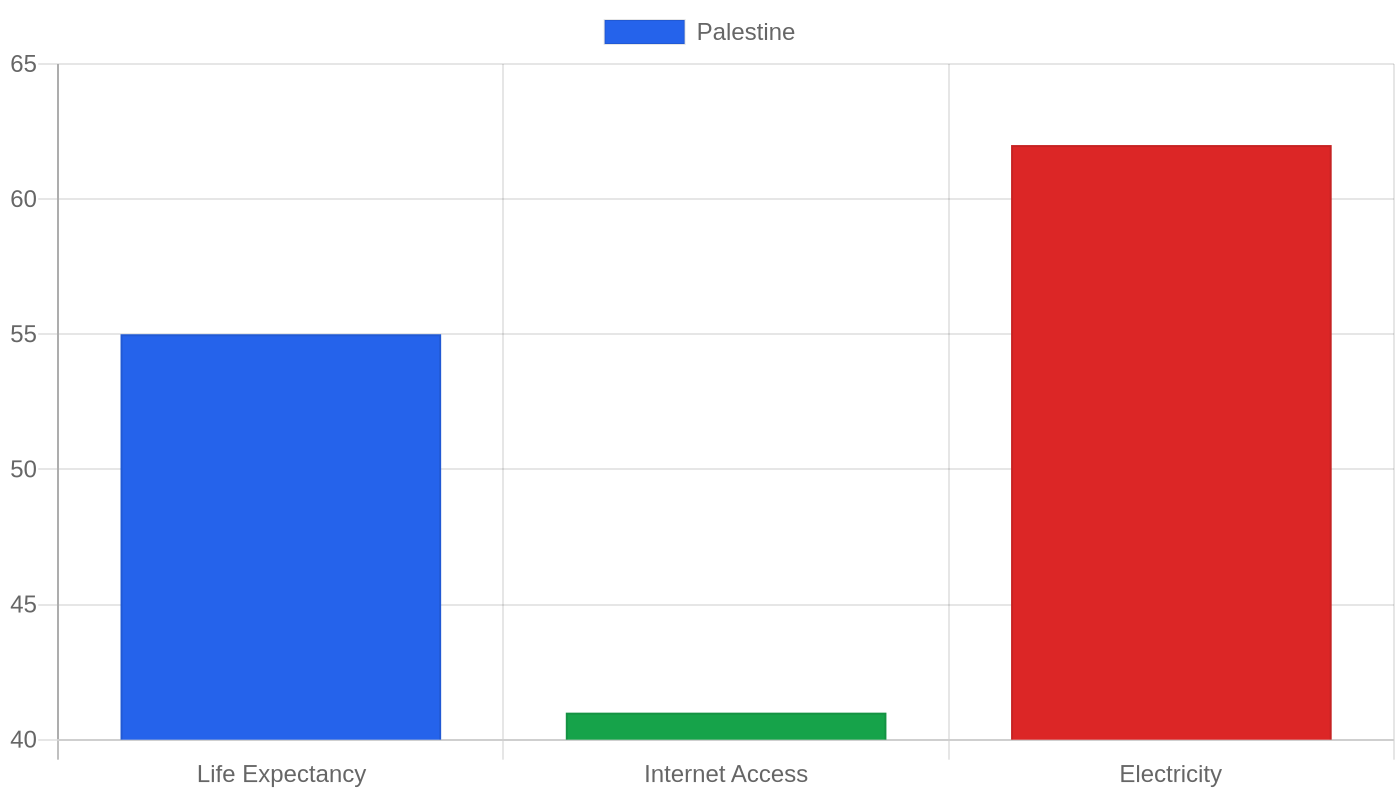
What growth does occur is often informal, cash-based, and difficult to capture. Remittances from the Palestinian diaspora form a critical lifeline, as do international aid flows. The economy that exists is one of small-scale entrepreneurship, family-run businesses, and a public sector that employs a significant portion of the workforce. Without formal GDP figures, economists rely on proxy indicators: electricity consumption, border crossing volumes, and construction permit data.
These tell a story of an economy in constant adaptation, but never quite reaching escape velocity.
The Cost of Living — When Survival Has No Index
There is no formal cost-of-living index for Palestine from the World Bank, and no comprehensive housing data to compare against regional averages. But the absence of these numbers does not mean the cost of living is insignificant — it means the cost of living is experienced differently across the territory.
In Ramallah, the de facto administrative capital of the Palestinian Authority, housing costs are among the highest in the region relative to local incomes. A modest apartment can consume the majority of a government employee’s salary. In Gaza, by contrast, the housing crisis is one of supply, not price — entire neighborhoods have been destroyed in successive conflicts, and reconstruction is slow, expensive, and subject to restrictions on building materials.
Renting is the norm for most Palestinians, as homeownership requires capital that few possess and land that is increasingly difficult to secure. Daily expenses for food, transportation, and utilities are inflated by the costs of importing goods through checkpoints and the unpredictability of supply chains. Fuel prices fluctuate with regional markets but are often higher due to distribution constraints.
The cost of living in Palestine is not merely a matter of affordability — it is a matter of access, mobility, and the ability to plan for tomorrow in an environment where tomorrow is never guaranteed.
Investment and Business Climate — Enterprise Without a Safety Net
The list of top companies in Palestine is not available from the provided data, and for good reason. The Palestinian private sector is not dominated by multinational giants or publicly traded behemoths. It is a landscape of small and medium enterprises, family-owned businesses, and a handful of successful firms in telecommunications, banking, and pharmaceuticals that have managed to thrive despite the constraints.
The business environment is defined by unpredictability. Entrepreneurs in Palestine must navigate a maze of permits, checkpoints, and overlapping jurisdictions. The political structure — with the PLO operating as a government-in-exile and the Palestinian Authority managing internal affairs — creates a dual regulatory environment that can be confusing for investors.
The Executive Committee of the PLO performs functions of a government-in-exile, while the President is appointed by the Palestinian Central Council, meaning that business decisions are often influenced by political calculations as much as market forces.
Sectors with potential include information technology, where a young, educated population has produced a modest but growing startup scene. Agriculture remains a backbone, particularly in the West Bank, where olive farming is both an economic activity and a cultural touchstone. Tourism, centered on Bethlehem and Jericho, has enormous potential but is hostage to political stability.
The absence of a formal stock exchange or comprehensive corporate registry means that investment is often relationship-based, relying on family networks and diaspora capital rather than institutional finance.
Safety, Politics, and Quality of Life — Governing in the Gap
The crime and safety indices for Palestine are listed as “N/A,” but the safety landscape is not a blank slate. The political structure of Palestine — a unitary, semi-presidential system — creates a complex governance environment. The country consists of institutions associated with the PLO, including the President, who is appointed by the Palestinian Central Council. The Palestinian National Council and the Executive Committee of the PLO perform the functions of a government-in-exile.
This political architecture means that security and safety are not simply matters of law enforcement. They are deeply intertwined with the broader political conflict. In the West Bank, the Palestinian Authority maintains security forces that cooperate with international actors. In Gaza, a different authority holds sway. The result is a fragmented security environment where crime rates are difficult to measure and safety is experienced differently depending on location and political context.
Quality of life in Palestine is shaped by these political realities. Access to education and healthcare is relatively high by regional standards, but mobility restrictions limit economic opportunity and family life. The psychological toll of prolonged uncertainty is significant. Yet Palestinians have built a vibrant civil society, a robust media landscape, and a cultural scene that thrives in cafes, galleries, and universities across the West Bank.
The quality of life cannot be captured by indices alone — it is measured in resilience, community, and the daily negotiation of life under extraordinary circumstances.
The Current Moment — Governance in Transition
Right now, Palestine is navigating a period of profound political and institutional flux. The semi-presidential system, with its dual structures of the PLO and the Palestinian Authority, is under strain. The President, appointed by the Palestinian Central Council, faces questions about succession and institutional legitimacy.
The Palestinian National Council, which serves as a parliament-in-exile, has not met in years, and the Executive Committee of the PLO continues to function as a government-in-exile, but its effectiveness is debated.
The political landscape is further complicated by the absence of national elections, which have not been held in over a decade. This has created a governance gap — institutions exist on paper, but their popular legitimacy is eroded by time and stalemate. The Palestinian Central Council, which appoints the President, remains a key body, but its composition and decision-making processes are opaque to many citizens.
Economically, the situation is one of waiting. Without reliable GDP or inflation data, it is impossible to say whether the economy is growing or contracting. What is clear is that the conditions for sustainable economic development — free movement, control over borders, access to international markets — remain elusive. The business community operates in a state of suspended animation, making short-term decisions because long-term planning is impossible.
The international community continues to provide aid, but the amounts are unpredictable and tied to political conditions. Remittances from the diaspora remain a crucial buffer, but they cannot substitute for a functioning national economy. The current moment in Palestine is one of institutional maintenance — keeping the state apparatus alive while the political conditions for genuine sovereignty remain out of reach.
The Bottom Line
Palestine is a country that exists in the gap between political aspiration and economic reality. For investors, it offers a market of educated, entrepreneurial people and untapped potential in technology, agriculture, and tourism — but only for those willing to accept extreme risk. For policymakers and analysts, Palestine is a case study in how political fragmentation shapes economic outcomes, and how institutions can survive even when they cannot thrive.
For anyone seeking to understand the modern Middle East, Palestine is not a footnote — it is a lens through which the region’s most profound challenges and possibilities come into focus.
Sources & Methodology
This article is authored by Economic Pulse Net for informational and research purposes. Economic Pulse Net sources its data from multilateral institutions, national statistics bureaus, and proprietary databases. All data is believed to be current as of the date of publication.
Published: July 18, 2026 | Category: Research — Palestine
Use these signals in your own platform
Economic Pulse publishes its live signal feed through a documented, read-only API. Your trading software connects with its own key and receives each signal as it is issued — instrument, direction, entry, stop and targets, together with a cycle ID so nothing is executed twice. The feed is independent of this website and cannot change it.
Signals are informational only and are not financial advice.