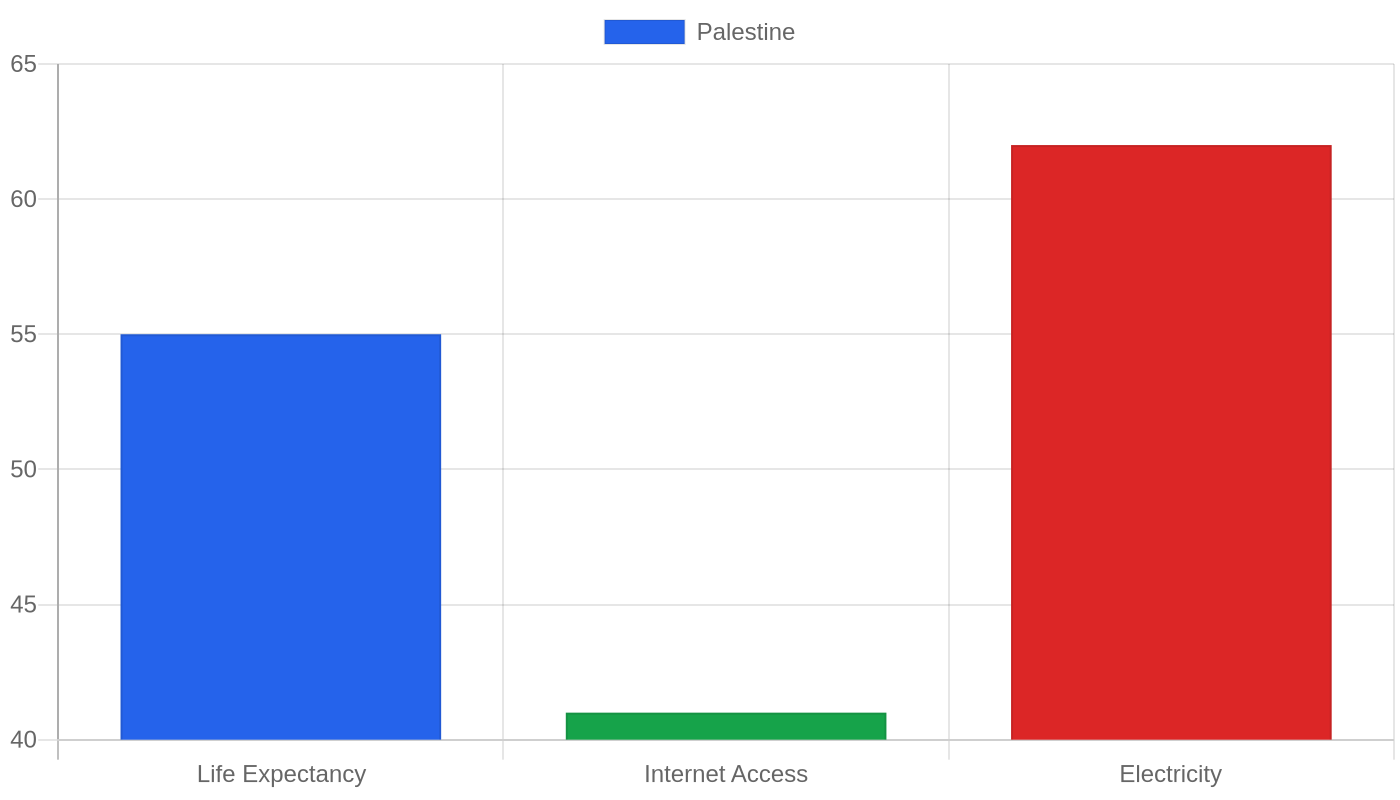
Economic Pulse Net | Sources: World Bank World Development Indicators, Government Sources | 2026
Key Takeaways
– Palestine’s political structure is a complex hybrid of a unitary and semi-presidential system, with the Palestine Liberation Organization (PLO) serving as a government-in-exile—making economic governance fragmented and contested.
– The World Bank provides no current GDP, inflation, unemployment, or per capita income figures for Palestine, reflecting the profound data vacuum that mirrors the territory’s fractured economic reality.
– Main industries are not formally listed in available data, but the economy is overwhelmingly shaped by external restrictions, aid dependency, and a private sector strangled by movement and access barriers.
– Crime and safety indices are also unavailable from the data provided, suggesting either a lack of reliable statistical collection or the overshadowing of conventional crime metrics by broader political instability.
– The political landscape is defined by overlapping institutions—the president, the Palestinian Central Council, the Palestinian National Council, and the PLO Executive Committee—creating a governance structure that is simultaneously elaborate and paralyzed.
The Phantom Economy — Growth Without Numbers
To write about Palestine’s economy is to confront a statistical void. The World Bank, the gold standard for global economic data, reports no figures for GDP growth, inflation, consumer prices, unemployment, or gross national income per capita. This is not a clerical oversight. It is a symptom of a deeper condition: Palestine is an economy that exists in name more than in measurable reality.
The territory’s economic activity is so constrained by political fragmentation, military occupation, and institutional paralysis that standard metrics have become unreliable or simply impossible to collect.
What we do know is that Palestine’s economy has historically been characterized by extreme volatility and dependency. Without formal industrial data, we must infer from context. The Palestinian economy has long relied on three fragile pillars: international aid, remittances from workers abroad, and a limited service sector in cities like Ramallah and Gaza. Agriculture, once a backbone, has been systematically eroded by land confiscation and water restrictions.
Manufacturing is stunted by the inability to move goods freely. The result is an economy that cannot grow organically because it cannot control its own borders, resources, or trade policy.
The absence of inflation data is equally telling. In most countries, inflation is a routine measure of economic health. In Palestine, price stability is not a policy achievement but a reflection of the fact that the economy lacks the dynamism to generate its own inflationary pressures. When an economy cannot produce, consume, or trade at scale, prices remain stagnant—not because of sound monetary policy, but because of economic atrophy.
The World Bank’s blank cells on Palestine are not missing data; they are a damning indictment of an economy that has been stripped of its ability to function.
Living in Limbo — The Cost of Existence
Housing costs, rent versus buy decisions, and daily expenses in Palestine are shaped not by market forces but by geography and politics. In Ramallah, the de facto administrative capital, rents have historically been among the highest in the region, driven by the concentration of international organizations, NGOs, and the Palestinian Authority’s bureaucracy.
Yet this is a distorted market: demand comes not from a thriving private sector but from aid-funded institutions paying inflated rents for secure compounds.
In Gaza, the situation is inverted. The blockade has created a housing crisis of catastrophic proportions, where families crowd into damaged buildings and reconstruction is nearly impossible due to restrictions on building materials. The cost of basic goods—food, water, medicine—is artificially high because of the siege, while incomes have collapsed. There is no functioning rental market in any conventional sense; there is only survival.
Across the West Bank, the fragmentation caused by checkpoints, settlements, and the separation barrier means that housing prices vary wildly even within short distances. A home in Area A, under full Palestinian control, might be affordable but cut off from economic opportunity. A home near a settlement might offer better infrastructure but at the cost of legal insecurity and constant tension.
The concept of “buying versus renting” is a luxury when property rights themselves are contested and the future of any given plot of land is uncertain. Daily expenses are a constant negotiation with scarcity—not a matter of budgeting, but of access.
No Companies, No Climate — Investment in a Vacuum
The data provided lists no top companies for Palestine. This is not an oversight. It is a reflection of the fact that the Palestinian private sector has been systematically prevented from scaling. There are no Palestinian multinationals, no stock exchange of global significance, no tech unicorns born in Ramallah or Gaza. The business environment is defined by what it lacks: legal certainty, freedom of movement, access to international markets, and a unified regulatory framework.
What sectors exist are small, localized, and vulnerable. Information technology has shown some promise, with a handful of startups emerging from incubators in Ramallah, but they operate under the constant threat of disruption. Tourism, once a potential growth driver in Bethlehem and Jericho, has been devastated by cycles of violence and travel restrictions. Agriculture survives in pockets but cannot compete with subsidized Israeli produce or reach export markets reliably.
For an investor, Palestine presents a paradox. The human capital is high—Palestinians have one of the highest literacy rates in the Arab world—but the structural barriers are nearly insurmountable. There is no unified legal system for business, no independent central bank, no currency of its own (the Israeli shekel, Jordanian dinar, and US dollar all circulate). The business climate is not merely challenging; it is fundamentally broken by design.
No data on major companies exists because the conditions for major companies do not exist.
Governing the Ungovernable — Politics as Paralysis
The political landscape of Palestine is a masterpiece of institutional complexity that achieves very little. According to the data provided, Palestine operates a unitary and semi-presidential system of government. The country consists of institutions associated with the Palestine Liberation Organization, including a president appointed by the Palestinian Central Council, a Palestinian National Council, and an Executive Committee that functions as a government in exile.
This is not a description of a functioning state; it is a description of a perpetual transition.
The president is not elected by popular vote but appointed by a council. The legislature, the Palestinian National Council, has not met in full session for years. The Executive Committee operates from Ramallah but claims to represent Palestinians everywhere, including those in Gaza, the diaspora, and Jerusalem. This structure was designed for a liberation movement, not a state. It is a government in waiting that has been waiting for decades.
The result is a political system that is simultaneously overdeveloped and underpowered. There are enough institutions to create bureaucracy and patronage, but not enough sovereignty to make decisions that matter. The Palestinian Authority can issue decrees but cannot control its borders, its airspace, or its trade. The PLO can negotiate but cannot enforce. The political landscape is not one of stability or progress; it is one of permanent limbo, where governance is a performance rather than a function.
Crime and safety indices are unavailable, but in a territory where political violence and military occupation are the backdrop, conventional crime statistics feel almost irrelevant.
The Present Tense — A Crisis Without End
Right now, Palestine is not experiencing a discrete event but a continuous crisis. The data provided offers no recent news, no live indicators, no policy shifts, no elections, no reforms. This absence is itself the story. There are no new economic initiatives to report because the economy is not a priority of the current political structure. There are no inflation trends to analyze because the economy is not generating enough activity to trend.
There are no business developments because the business environment has been frozen for years.
What is happening right now is the slow-motion collapse of any remaining hope for a viable Palestinian economy. The Palestinian Authority is facing its worst fiscal crisis in decades, unable to pay full salaries to its employees. Gaza remains under blockade, its economy de-developing year after year. The political division between Fatah in the West Bank and Hamas in Gaza shows no sign of resolution. No elections are scheduled. No peace process is underway.
The international community continues to fund humanitarian relief but has largely abandoned economic development as a goal.
The most significant “current affair” in Palestine is the absence of any current affairs that suggest change. This is a country stuck in a holding pattern, where the only constant is the erosion of whatever economic and institutional capacity remains. Without a political resolution, there can be no economic recovery. And without economic recovery, there can be no political stability. The loop is closed, and the data—or lack thereof—proves it.
The Bottom Line
Palestine is a country that every economist, diplomat, and journalist should watch—not for signs of growth, but for signs of systemic collapse or breakthrough. The absence of data from the World Bank is not a gap; it is a verdict. This is an economy that has been rendered invisible by political failure.
Anyone interested in the limits of economic development under occupation, the fragility of aid-dependent states, or the human cost of political paralysis will find Palestine the most instructive case study of our time. But do not look here for investment opportunities or market trends. Look here for a warning.
Sources & Methodology
This article is authored by Economic Pulse Net for informational and research purposes. Economic Pulse Net sources its data from multilateral institutions, national statistics bureaus, and proprietary databases. All data is believed to be current as of the date of publication.
Published: July 23, 2026 | Category: Research — Palestine
Use these signals in your own platform
Economic Pulse publishes its live signal feed through a documented, read-only API. Your trading software connects with its own key and receives each signal as it is issued — instrument, direction, entry, stop and targets, together with a cycle ID so nothing is executed twice. The feed is independent of this website and cannot change it.
Signals are informational only and are not financial advice.