Economic Pulse Net | Sources: World Bank World Development Indicators, Government Sources | 2026
Key Takeaways
– Myanmar’s economy is operating under extreme opacity, with no official World Bank data on GDP growth, inflation, or unemployment, reflecting the collapse of transparent economic reporting since the 2021 military takeover.
– The country’s corporate landscape is dominated by military-linked conglomerates—Myanma Economic Holdings Limited, Asia World, and Htoo Group—controlling everything from gems to oil and gas.
– Despite political isolation, Myanmar’s state-owned enterprises in oil, gas, and gems continue to function, suggesting a parallel economy tied to resource extraction rather than broad-based development.
– The political structure enshrines military power permanently, with 25% of parliamentary seats reserved for the armed forces under the 2008 constitution, creating a governance model that prioritizes military interests over market confidence.
– For investors and analysts, Myanmar remains a high-risk, high-opacity environment where the absence of basic economic data is itself the most telling indicator of systemic dysfunction.
The Vanishing Numbers — What the Data Silence Reveals
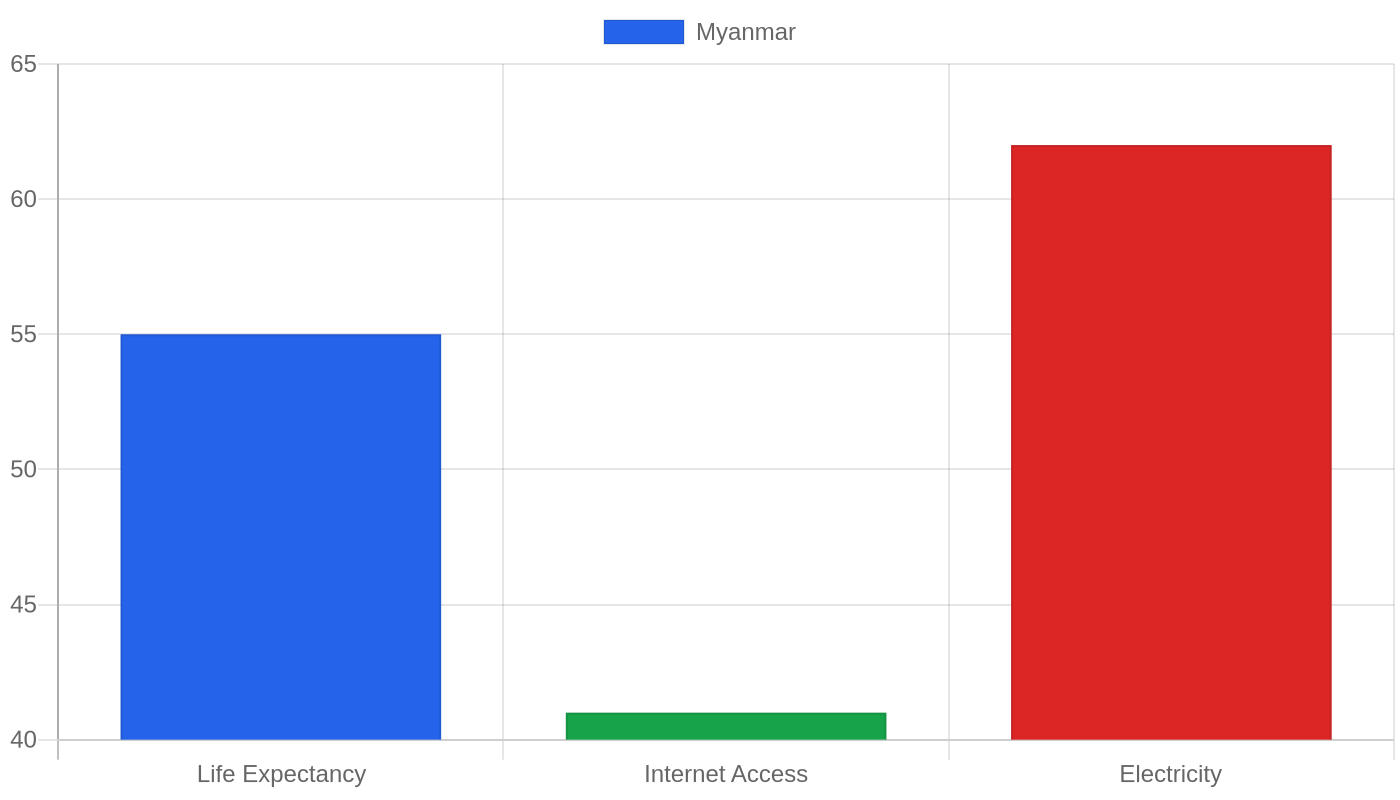
The World Bank, the global benchmark for economic measurement, reports nothing for Myanmar. Not GDP growth. Not inflation. Not unemployment. Not GDP per capita. Not even population. This is not a data gap—it is a data blackout. For a country of more than 50 million people, the absence of these figures from the World Bank’s latest releases tells a story more damning than any negative number could.
When an economy stops reporting, it is usually because the state has lost either the capacity or the will to measure itself. In Myanmar’s case, it is both. The 2021 military coup dismantled not only democratic institutions but also the bureaucratic machinery that tracks national output. Inflation, which was already running high before the takeover, has likely spiraled as the kyat has depreciated and supply chains have fractured.
Unemployment, particularly among the young and urban populations, has soared as foreign investment has fled and domestic consumption has cratered.
Yet the economy has not stopped. It has simply gone underground, into barter systems, black markets, and the cash-only transactions that dominate daily life in Yangon and Mandalay. The main industries—gems, oil and gas, pharmaceuticals, and consumer goods—continue to operate, but they do so under the shadow of military-controlled enterprises that now function as both economic actors and political enforcers.
The GDP number may be missing, but the human cost is not: families are selling assets, skipping meals, and pulling children out of school. The silence of the data is the loudest alarm.
The Cost of Living — When Survival Becomes the Benchmark
With no official cost-of-living index from the World Bank or national statistics bureau, Myanmar’s economic reality must be read through the lens of what is not being measured. Housing costs in Yangon, once the region’s most affordable major city, have become erratic.
Rent for a basic apartment in the city center, which might have cost $200 a month before the coup, now fluctuates wildly depending on the availability of foreign currency and the willingness of landlords to accept kyat payments that lose value by the week.
The cost of daily essentials—rice, cooking oil, fuel—has become a political barometer. When the military regime cannot control inflation, it controls information. Prices for staples have risen sharply, but the government has stopped publishing consumer price data. What is clear is that purchasing power has collapsed for ordinary citizens. A teacher’s salary, if paid at all, buys a fraction of what it did three years ago.
The middle class is being squeezed into poverty, and the poor are being pushed into subsistence.
Renting has become a more precarious option than buying for those with access to hard currency, but property ownership carries its own risks: unclear titles, military confiscation, and a legal system that favors the regime. For the vast majority, homeownership is a distant dream. The housing market, like everything else in Myanmar, operates on trust and connection rather than transparent pricing.
Regional comparisons are impossible without data, but anecdotal evidence from neighboring Thailand and Bangladesh suggests that Myanmar’s urban cost of living, in real terms, has become among the most punishing in Southeast Asia when adjusted for income.
The Corporate Fortress — Military Conglomerates and the Captive Economy
Myanmar’s corporate sector is not a market—it is a network. The top companies listed in available data read like a roll call of military and crony power: Myanma Economic Holdings Limited, the armed forces’ investment arm; Asia World, the conglomerate built by a former drug trafficker turned business magnate; Htoo Group of Companies, controlled by a family with deep ties to the junta. These are not private enterprises in the Western sense.
They are instruments of political control, resource extraction, and wealth consolidation.
The state-owned enterprises tell the same story. Myanma Oil and Gas Enterprise controls the country’s most valuable resource, feeding pipelines to China and Thailand. Myanma Gems Enterprise oversees the jade and ruby trade that has long funded conflict. Myanma Pharmaceutical Industry Enterprise, nominally a healthcare company, operates in a sector where the regime controls both supply and distribution.
Even the consumer-facing companies—Air Bagan, Air Mandalay, Eleven Media Group—are either directly or indirectly tied to the military establishment.
For any foreign investor considering Myanmar, the question is not whether the business environment is favorable. It is whether you can operate without becoming entangled in the military economy. The answer, for most, has been no. Sanctions from Western nations have targeted many of these conglomerates, but the regime has adapted by deepening ties with China, Russia, and other authoritarian states. The business climate is not hostile—it is captured.
There are opportunities in oil, gas, and gems, but they come with reputational, legal, and moral costs that most international firms are unwilling to bear.
Safety, Politics, and the Quality of Life — The Price of Permanent Military Rule
Myanmar operates as a unitary assembly-independent republic under its 2008 constitution, but that description masks a brutal reality. The system is a parliamentary democracy in name only. The military appoints 25% of legislators, holds veto power over constitutional amendments, and controls the key ministries of defense, home affairs, and border affairs. The president, nominally accountable to the legislature, is effectively a military appointee.
The 2021 coup was not a break from the system—it was the system revealing itself.
Crime and safety indices are not available, but in a country where the state is the primary perpetrator of violence against its own citizens, conventional metrics lose meaning. The armed conflict that has raged in ethnic states for decades has intensified since the coup, with the military using airstrikes and artillery against civilian areas. In cities, petty crime has risen as poverty deepens, but the greater threat remains political: arbitrary arrest, torture, and disappearance are tools of governance.
Quality of life, in any meaningful sense, has deteriorated across every dimension. Health care is underfunded and militarized. Education has been disrupted by both the pandemic and the political crisis. Internet access is heavily censored. The happiness data that would quantify this decline is absent, but it is not needed. The exodus of millions of refugees and migrant workers to Thailand, Malaysia, and beyond is the most honest measure of life in Myanmar today.
People are voting with their feet, and the verdict is devastating.
The Current Crisis — An Economy Frozen in Conflict
This is the moment that matters. Myanmar is not in a transition—it is in a stalemate. The military junta, which seized power in February 2021, has been unable to defeat a widespread armed resistance movement that includes both ethnic armed organizations and newly formed People’s Defence Forces. The economy, already fragile before the coup, has been shattered by the combination of conflict, sanctions, COVID-19 aftereffects, and administrative collapse.
The oil and gas sector, long the country’s main source of foreign currency, is under pressure as Western companies divest and revenues are diverted to military spending. The gem trade, once a glittering showcase of Myanmar’s natural wealth, is now a sanctions target. Even the pharmaceutical industry, which should be a lifeline during a health crisis, is struggling to import raw materials as the banking system seizes up.
What is happening now is not reform—it is retrenchment. The regime is doubling down on its relationships with China and Russia, trading resources for diplomatic cover and military hardware. The resistance, meanwhile, is building parallel governance structures in areas it controls, including rudimentary tax systems and dispute resolution mechanisms. The country is effectively splitting into two economies: one under military control, extractive and shrinking; the other in resistance zones, improvised and fragile.
Neither is sustainable.
The Bottom Line
Myanmar is not a country for the conventional investor, the risk-averse analyst, or anyone seeking stable returns. It is a country for the geopolitical strategist, the humanitarian observer, and the long-term thinker who understands that today’s crisis is tomorrow’s reconstruction—if the conflict ever ends. The absence of data is not a bug; it is a feature of a regime that governs through opacity.
Watch Myanmar not for what it is now, but for what it might become when the guns fall silent and the numbers finally return.
Sources & Methodology
This article is authored by Economic Pulse Net for informational and research purposes. Economic Pulse Net sources its data from multilateral institutions, national statistics bureaus, and proprietary databases. All data is believed to be current as of the date of publication.
Published: July 18, 2026 | Category: Research — Myanmar
Use these signals in your own platform
Economic Pulse publishes its live signal feed through a documented, read-only API. Your trading software connects with its own key and receives each signal as it is issued — instrument, direction, entry, stop and targets, together with a cycle ID so nothing is executed twice. The feed is independent of this website and cannot change it.
Signals are informational only and are not financial advice.