Economic Pulse Net | Sources: World Bank World Development Indicators, Government Sources | 2026
Key Takeaways
– Myanmar operates under a unique political system where the military constitutionally controls 25% of parliamentary seats, fundamentally shaping its economic governance
– The country’s economy is dominated by a handful of powerful conglomerates—including Asia World, Htoo Group, and Myanma Economic Holdings Limited—many with deep ties to the military establishment
– Key state-owned enterprises in gems, oil and gas, and pharmaceuticals form the backbone of formal economic activity, alongside a small but notable aviation sector
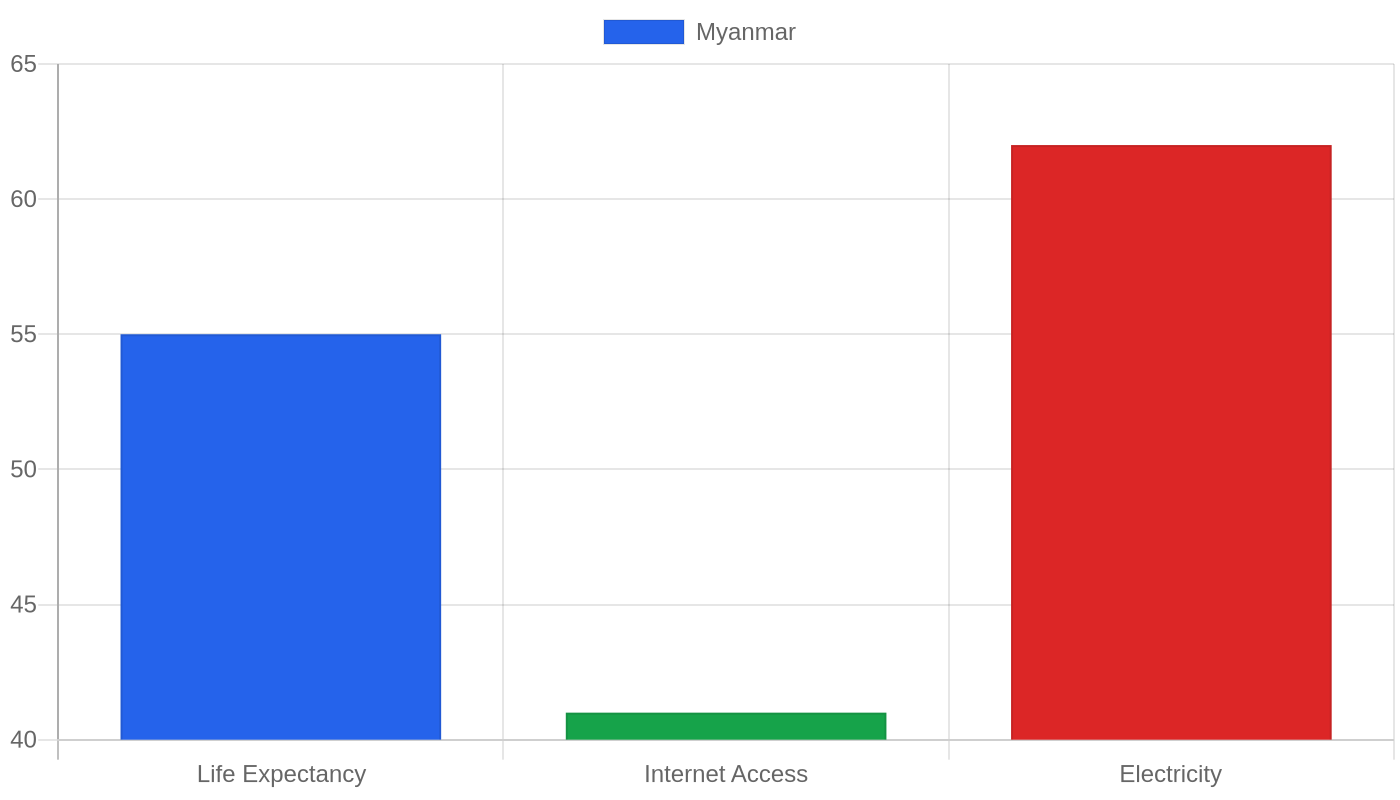
– Despite its resource wealth, Myanmar faces significant data transparency challenges, with the World Bank reporting no current figures for GDP growth, inflation, or unemployment
The Data Void — Reading Myanmar’s Economy Through What Isn’t Said
The World Bank’s latest data on Myanmar presents a stark reality: GDP growth, inflation, unemployment, GDP per capita, GNI per capita, and population figures are all listed as “N/A.” This absence of numbers is itself a powerful economic indicator.
When a nation of Myanmar’s size and strategic importance cannot produce—or will not publish—basic macroeconomic statistics, it speaks to the depth of institutional dysfunction and the opacity that characterizes the country’s economic management.
Myanmar operates as a unitary assembly-independent republic under its 2008 constitution. The country is governed through a parliamentary system with a bicameral legislature, including an executive president accountable to the legislature. Crucially, 25% of legislators are appointed by the military, with the rest elected in general elections. This constitutional carve-out means the military, known as the Tatmadaw, maintains an institutional stranglehold over economic policy regardless of electoral outcomes.
The result is an economy where political power and commercial interests are fused to a degree rarely seen outside of outright command economies.
What we do know comes from the structure of Myanmar’s industrial base. The country’s main industries are not listed in available data, but the roster of top companies tells its own story. State-owned enterprises dominate critical sectors: Myanma Oil and Gas Enterprise controls the energy sector, Myanma Gems Enterprise oversees the world-renowned jade and ruby trade, and Myanma Pharmaceutical Industry Enterprise manages healthcare production.
These are not mere commercial entities—they are revenue-generating arms of the state apparatus.
The Cost of Living — Where Data Silence Masks Real Hardship
Myanmar’s cost of living data is absent from available records, but the country’s economic structure provides clues about daily life for its citizens. The dominance of military-linked conglomerates—Asia World, Htoo Group of Companies, and Myanma Economic Holdings Limited—suggests that key supply chains, from food distribution to construction materials, are controlled by a small number of politically connected entities.
This concentration typically leads to price setting that favors insiders over ordinary consumers.
The consumer services sector shows some signs of normal economic activity. Eleven Media Group operates as a media concern, while Air Bagan and Air Mandalay provide domestic air travel. These companies suggest the existence of a middle class with disposable income, but their scale is limited. Without official inflation data, it is impossible to say how the kyat’s value holds up against regional currencies, though anecdotal evidence from neighboring countries suggests Myanmar faces persistent currency pressure.
Housing costs remain an unknown variable, but in a country where the military controls a quarter of parliament and major conglomerates dominate construction, land rights and property markets are likely shaped by political connections rather than market forces. The absence of data should not be mistaken for stability—it more likely reflects an economy where informal transactions and opaque pricing are the norm.
Investment & Business Climate — The Conglomerate Fortress
Myanmar’s business environment is defined by its corporate landscape. The top companies list reads like a who’s who of military-affiliated capital. Asia World, founded by a former drug trafficker turned business magnate, is a sprawling conglomerate involved in ports, construction, and energy. Htoo Group of Companies, linked to the family of a former junta leader, has interests from tobacco to tourism.
Myanma Economic Holdings Limited is explicitly a military-owned conglomerate, generating revenue for the Tatmadaw.
For foreign investors, this creates a challenging environment. The presence of Aeon Display and Security System in consumer goods suggests some international collaboration, but the overall picture is one of a tightly controlled economy where access to lucrative sectors—oil, gas, gems, pharmaceuticals—requires navigating military-linked gatekeepers.
The aviation sector, with two domestic carriers, offers a rare glimpse of private sector activity, but even here, Air Bagan and Air Mandalay operate under regulatory oversight from a military-influenced government.
Sectors to watch include energy, where Myanma Oil and Gas Enterprise controls significant natural gas reserves that supply regional markets, and gems, where Myanma Gems Enterprise oversees a trade that attracts buyers from China and Thailand. These are high-value, low-transparency industries where international sanctions and due diligence concerns increasingly deter Western investment while attracting Asian state-linked capital.
Safety, Politics & Quality of Life — The Constitutional Cage
Crime and safety indices for Myanmar are listed as “N/A,” but the political landscape provides context. The 2008 constitution created a system where the military’s 25% legislative appointment power acts as a permanent veto over constitutional change. This means that even when civilian governments have held office—as with Aung San Suu Kyi’s National League for Democracy between 2016 and 2021—the military retained control over defense, home affairs, and border security ministries.
The current political reality, following the February 2021 military coup, has fundamentally altered the safety and quality of life equation. Armed conflict has escalated across multiple regions, with resistance forces challenging military control in ethnic states and even central Myanmar. The absence of crime index data likely reflects not a safe society but one where state violence, rather than civilian crime, is the primary threat to personal security.
Quality of life in such an environment is necessarily diminished. The World Bank’s lack of GNI per capita figures may indicate that formal economic activity has contracted so severely that accurate measurement is impossible. For ordinary Myanmar citizens, daily existence involves navigating checkpoints, currency instability, and the constant possibility of displacement.
The country’s famous pagodas and ancient cities may draw the world’s attention, but for those living there, the reality is one of chronic uncertainty.
What’s Happening Now — The Post-Coup Economic Fracture
Myanmar’s current affairs are defined by the ongoing crisis following the military’s seizure of power. The constitutional framework that guaranteed the military 25% of parliament has been effectively superseded by direct military rule. The State Administration Council, as the junta calls itself, faces armed resistance from a loose coalition of pro-democracy forces and ethnic armed organizations.
Economically, the situation is dire. The absence of World Bank data reflects not a data collection failure but a collapse of normal economic reporting. International sanctions have targeted Myanma Oil and Gas Enterprise and other military-linked entities, cutting off revenue streams. The gems trade, once a major foreign exchange earner, faces boycotts from Western markets.
Domestic aviation, represented by Air Bagan and Air Mandalay, has been disrupted by both reduced demand and the diversion of resources to military logistics.
The conglomerates that dominate Myanmar’s economy—Asia World, Htoo Group, Myanma Economic Holdings Limited—are now operating in an environment where their political connections are both an asset and a liability. They maintain access to domestic markets and military contracts but face increasing difficulty in international transactions. The pharmaceutical sector, through Myanma Pharmaceutical Industry Enterprise, faces shortages of imported raw materials as supply chains fracture.
Eleven Media Group, as a consumer services company, operates under tight censorship, its reporting constrained by the very military that holds 25% of the parliamentary seats it once nominally answered to.
The Bottom Line
Myanmar is a country where the economy cannot be understood without the politics, and the politics cannot be understood without the military. For investors, the risks are extreme: sanctions exposure, currency instability, and the possibility of asset seizure. For humanitarian observers, the country represents a slow-motion crisis where data opacity masks human suffering.
Anyone watching Myanmar should do so with clear eyes—this is not an emerging market in the traditional sense but a military-controlled resource state navigating isolation and internal conflict. The only certainty is that the 2008 constitution’s military guarantees will remain the central fact of economic life until fundamental political change occurs.
Sources & Methodology
This article is authored by Economic Pulse Net for informational and research purposes. Economic Pulse Net sources its data from multilateral institutions, national statistics bureaus, and proprietary databases. All data is believed to be current as of the date of publication.
Published: July 20, 2026 | Category: Research — Myanmar
Use these signals in your own platform
Economic Pulse publishes its live signal feed through a documented, read-only API. Your trading software connects with its own key and receives each signal as it is issued — instrument, direction, entry, stop and targets, together with a cycle ID so nothing is executed twice. The feed is independent of this website and cannot change it.
Signals are informational only and are not financial advice.