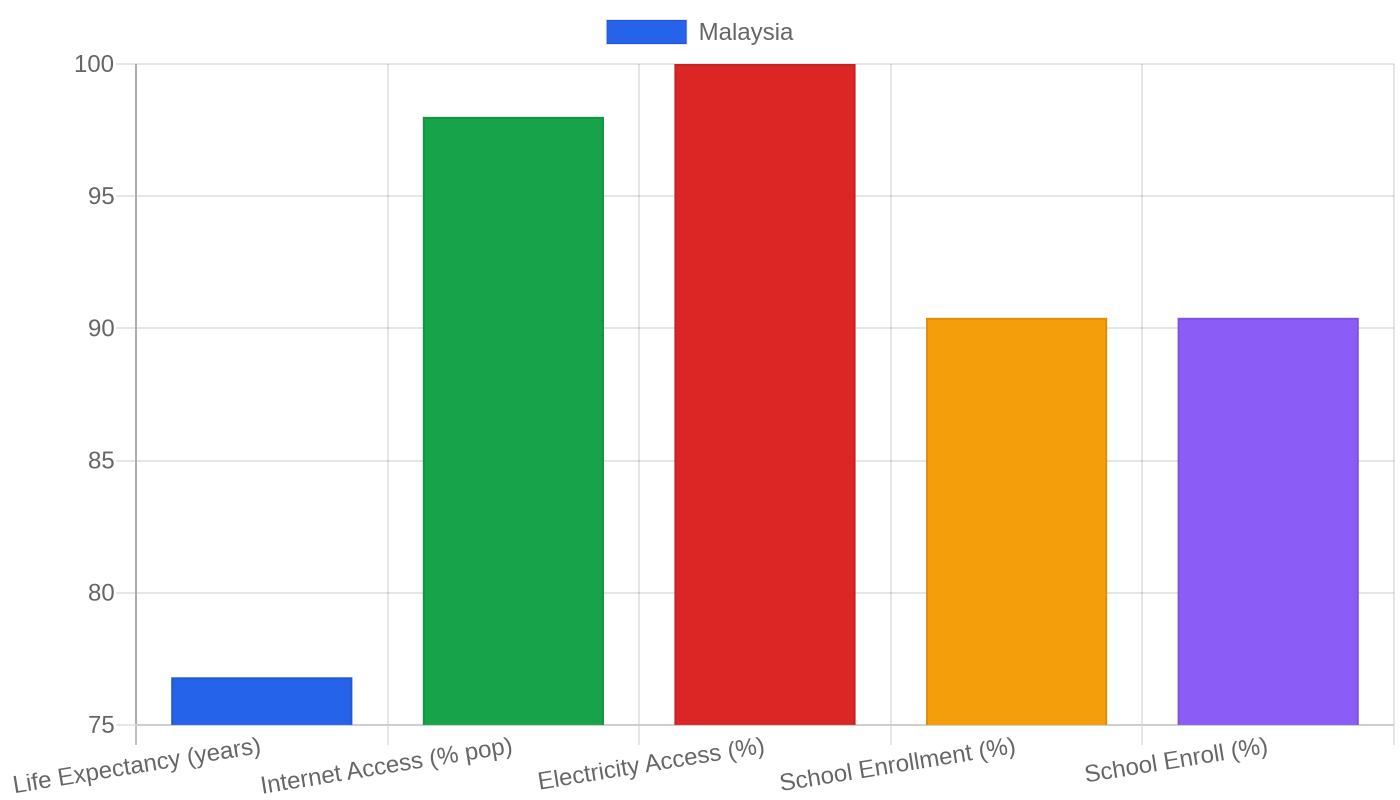
Economic Pulse Net | Sources: World Bank World Development Indicators, Government Sources | 2026
Kuala Lumpur’s skyline is a study in contrasts—glass towers rising beside colonial-era shophouses, a testament to a nation that has mastered the art of balancing tradition with relentless modernization. As the global economy splutters through another year of uncertainty, Malaysia is quietly posting numbers that would make many of its regional peers envious. The World Bank’s latest data shows GDP growth at a robust 5.17 percent for 2025, a figure that signals not just recovery, but genuine momentum.
This is not the boom-and-bust volatility of an emerging market caught in the crosswinds of global finance; this is the steady, deliberate climb of a country that has learned to play the long game. For investors, policymakers, and casual observers alike, Malaysia in 2026 is a story worth reading closely.
Key Takeaways
– Growth is genuine: The World Bank reports GDP growth of 5.17 percent for 2025, placing Malaysia among the faster-growing economies in the region.
– A unique political model: Malaysia operates as a federal constitutional elective monarchy—the only one of its kind in Southeast Asia—with a King elected every five years from among nine hereditary state rulers.
– Corporate diversity is a strength: From budget aviation pioneer AirAsia to telecommunications giant Axiata, Malaysia’s corporate landscape spans multiple sectors, offering a diversified investment story.
– British colonial legacy shapes governance: The Westminster parliamentary system remains the backbone of Malaysian political institutions, providing continuity and institutional familiarity for foreign investors.
– A consumer economy in motion: With major players in healthcare, financials, and consumer services, the domestic market is both deep and dynamic.
The Growth Engine — Reading Malaysia’s 5.17 Percent Story
Let’s talk about that number: 5.17 percent. In the world of macroeconomics, this is what analysts call a “Goldilocks” figure—not too hot to trigger inflation fears, not too cold to cause anxiety about stagnation. The World Bank’s data for 2025 tells us that Malaysia has found a sweet spot. To put this in perspective, many developed economies would consider 2 percent growth a triumph; Malaysia is growing at more than double that pace. But what’s driving this expansion?
The country’s industrial base is remarkably broad. Healthcare is a significant pillar, with companies like Adventa making their mark. Consumer services are booming, led by household names like AirAsia, which has transformed from a low-cost carrier into a regional lifestyle brand, and Astro Malaysia Holdings, which dominates the broadcasting landscape. Telecommunications is another cornerstone, with Axiata providing the digital backbone for an increasingly connected population.
The financial sector adds another layer of resilience. AmBank and the Berjaya Group represent a banking and investment community that is sophisticated and well-capitalized. This diversity matters because it insulates the economy from sector-specific shocks. When one industry sneezes, the others don’t necessarily catch a cold. The growth rate also reflects strong domestic consumption—a middle class that is spending, investing, and building.
Unlike export-dependent neighbors that can be held hostage by global supply chain disruptions, Malaysia’s internal market provides a stabilizing counterweight. The GDP figure is not just a number; it’s a statement of intent. It says that Malaysia has moved beyond the “developing nation” narrative and is now competing on a global stage with confidence and competence.
The Cost of Living — Navigating the New Normal
For the millions of Malaysians living in Kuala Lumpur, Penang, and Johor Bahru, the cost of living is a daily negotiation between aspiration and reality. While comprehensive inflation data is not available in the current World Bank dataset, the structure of the economy offers clues about household pressures.
The presence of major consumer goods companies like BSA Manufacturing and Bonia suggests a market where discretionary spending is alive and well—people are buying branded goods, they’re traveling, and they’re upgrading their lifestyles. Housing in Malaysia’s urban centers remains more affordable than in neighboring Singapore or Hong Kong, but prices have been climbing steadily over the past decade.
The rental market is robust, particularly in the Klang Valley, where young professionals flock for job opportunities in the services and tech sectors.
The government has long championed affordable housing initiatives, and the “rumah selangorku” scheme in the country’s most populous state is indicative of a broader policy push to keep homeownership within reach. Daily expenses—food, transportation, utilities—remain moderate compared to regional hubs, and the hawker culture ensures that eating well doesn’t require a fortune.
For expatriates, Malaysia consistently ranks as one of the most cost-effective places to live in Asia, offering a first-world lifestyle at a fraction of the cost. The real challenge is income disparity; while the middle class thrives, lower-income households feel the pinch of rising prices. The government’s subsidy programs, particularly for fuel and essential goods, have been a political mainstay, though their long-term sustainability remains a topic of heated debate.
Investment and Business — Where the Smart Money Looks
Malaysia’s corporate landscape reads like a who’s who of Asian enterprise. AirAsia, now operating as Capital A, has redefined what a budget airline can be, expanding into logistics and digital services. Axiata has become one of the region’s largest telecommunications operators, with significant holdings across South and Southeast Asia. AmBank represents a financial sector that is both stable and innovative, increasingly embracing fintech and digital banking solutions.
For foreign investors, the appeal is multifaceted. The country offers a well-developed infrastructure, a multilingual workforce, and a legal system based on English common law—a legacy of British rule that provides a familiar framework for international business. The political stability, underpinned by the unique monarchical system, has historically been a draw for long-term capital.
The healthcare sector deserves special attention. With Adventa and other players expanding their capabilities, Malaysia has positioned itself as a medical tourism destination, attracting patients from across the region for quality care at competitive prices. Consumer services continue to flourish, with Astro Radio and Astro Malaysia Holdings dominating the media landscape, while Berjaya Group’s diversified portfolio spans gaming, food, and property.
The conglomerate model remains strong here, allowing companies to weather sector-specific downturns through diversification. For startups and SMEs, the ecosystem is maturing, with increasing government support for innovation and digitalization. The business climate is not without its challenges—bureaucracy can be frustrating, and certain sectors have restrictions on foreign ownership—but the overall trajectory is positive. Malaysia is open for business, and the world is taking notice.
Safety, Politics, and the Malaysian Quality of Life
Malaysia’s political system is a fascinating anomaly. As the only federal constitutional elective monarchy in Southeast Asia, it operates on a model that blends tradition with democratic governance. The King, known as the Yang di-Pertuan Agong, is elected to a five-year term by and from among the nine hereditary rulers of the Malay states. The other four states, which have titular Governors, do not participate in the selection.
This system, closely modeled on the Westminster parliamentary system as a legacy of British rule, provides a unique check and balance. The monarchy serves as a stabilizing force, above the fray of partisan politics, while elected representatives handle the day-to-day business of governance.
In terms of safety, Malaysia generally enjoys a reputation as a peaceful and orderly society. While specific crime indices are not available in the current data, the country’s urban centers are considered safe by regional standards, with a visible police presence and a community-oriented approach to law enforcement.
The quality of life is enhanced by a rich cultural tapestry—Malay, Chinese, Indian, and indigenous traditions coexist in a vibrant mosaic that is celebrated through festivals, cuisine, and architecture. The food scene is legendary, the natural environment is stunning, from rainforests to pristine beaches, and the people are known for their warmth and hospitality. For families, the education system offers both national and international options, and healthcare is accessible and affordable.
Malaysia is not just a place to do business; it’s a place to live well.
What’s Happening Now — The 2026 Pulse
As 2026 unfolds, Malaysia is in a moment of dynamic transformation. The 5.17 percent growth rate reported by the World Bank is not a static achievement but a launching pad for further development. The government is actively courting foreign direct investment, particularly in high-tech manufacturing, green energy, and digital infrastructure. The semiconductor industry, already a significant player, is expanding its footprint as global companies seek to diversify their supply chains.
The services sector is being digitized at breakneck speed, with e-commerce and fintech reshaping how Malaysians shop, bank, and communicate. There is a palpable sense of optimism in the business community, buoyed by policy stability and a clear vision for the future.
The political landscape remains stable, with the monarchical system providing continuity even as coalition governments form and reform. The current administration is focused on economic reform, with an emphasis on improving the ease of doing business and reducing bureaucratic red tape. Socially, the country is engaged in a thoughtful conversation about its future—balancing economic progress with environmental sustainability, and modernization with cultural preservation.
The rise of the digital economy is creating new opportunities for young Malaysians, while the government’s focus on upskilling and education aims to ensure that no one is left behind. For those watching from abroad, the message is clear: Malaysia is not waiting for the future to arrive; it is actively building it, and the 5.17 percent growth rate is just the beginning of the story.
The Bottom Line
Malaysia in 2026 is a country that has learned to harness its strengths. The 5.17 percent GDP growth reported by the World Bank is a testament to sound economic management, a diversified industrial base, and a resilient domestic market. For investors, the corporate landscape offers opportunities across healthcare, telecommunications, consumer services, and finance. For expatriates and families, the quality of life is exceptional—safe, affordable, and culturally rich.
For policymakers in other emerging markets, Malaysia offers a model of how to balance tradition with modernity, stability with growth. This is a country on the move, and the window of opportunity is wide open. Watch this space.
Sources & Methodology
This article is authored by Economic Pulse Net for informational and research purposes. Economic Pulse Net sources its data from multilateral institutions, national statistics bureaus, and proprietary databases. All data is believed to be current as of the date of publication.
Published: August 06, 2026 | Category: Research — Malaysia
Use these signals in your own platform
Economic Pulse publishes its live signal feed through a documented, read-only API. Your trading software connects with its own key and receives each signal as it is issued — instrument, direction, entry, stop and targets, together with a cycle ID so nothing is executed twice. The feed is independent of this website and cannot change it.
Signals are informational only and are not financial advice.