Economic Pulse Net | Sources: World Bank World Development Indicators, Government Sources | 2026
Key Takeaways
– Japan’s economy, the world’s fourth-largest at $4.4 trillion GDP according to the World Bank, faces persistent inflationary pressure with CPI running at 3.17%, challenging decades of deflationary psychology.
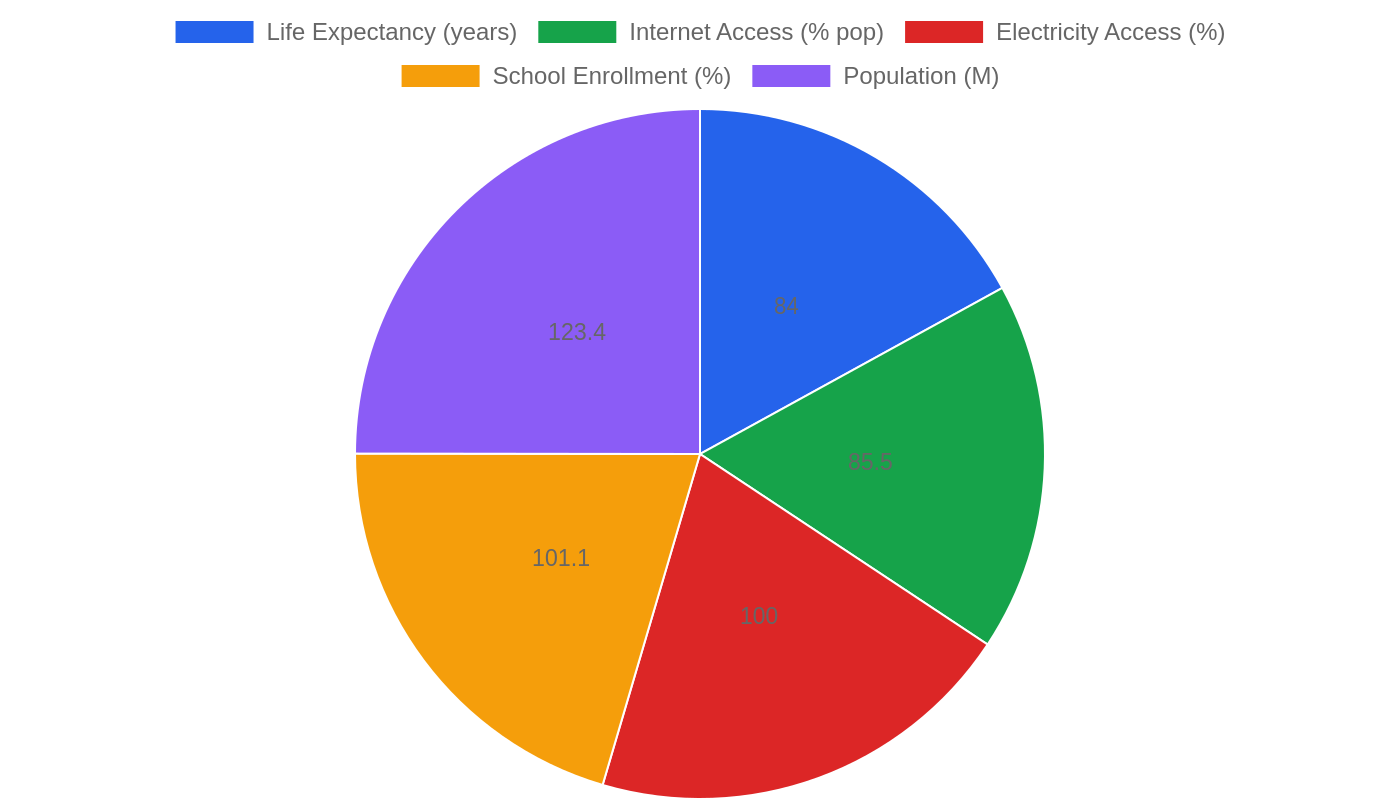
– The population of 123.4 million continues its slow decline, creating structural headwinds for labor markets, consumer demand, and long-term fiscal sustainability.
– Japan’s trade deficits are widening, driven by the AI boom’s demand for imported components and geopolitical tensions including the Iran conflict, as reported by Nikkei Asia.
– The political system remains stable under a constitutional monarchy, with Emperor Naruhito serving in a ceremonial role while the prime minister and cabinet wield executive power.
– Major corporations like Aeon, Aisin Seiki, and Advantest anchor a diverse industrial base, though the full list of top companies suggests a banking-heavy corporate landscape.
The Yen and the Years — Japan’s Economic Paradox
Japan presents a fascinating economic contradiction. With a GDP of $4.435 trillion, according to the World Bank, it remains an industrial powerhouse despite decades of sluggish growth. The economy that once seemed destined to overtake the United States now grapples with a more modest reality — but modest by Japanese standards still means formidable by global ones.
The most telling number in the current data is inflation: consumer prices rose 3.17% in the latest reading from the World Bank. For most developed economies, this would be unremarkable. For Japan, it is historic. After nearly three decades of deflation or near-zero price growth, this persistent inflation represents a psychological and economic shift. Households that built their financial strategies around falling prices must now adapt to a world where savings lose value in real terms.
Workers who never expected meaningful wage increases are suddenly confronting a cost-of-living squeeze.
The employment picture remains opaque without specific unemployment data from the World Bank, but Japan’s famously tight labor market — a consequence of demographic decline — has traditionally kept joblessness low. The challenge is not finding workers but finding enough of them. The population of 123.4 million is shrinking, and with it the domestic consumer base that once powered the world’s second-largest economy.
Japan’s industrial structure, while not detailed in the available data, has long been defined by automotive manufacturing, electronics, precision machinery, and chemicals. Companies like Aisin Seiki and Advantest represent the export-oriented manufacturing that built Japan’s postwar prosperity. Yet the widening trade deficit reported by Nikkei Asia suggests that even these traditional strengths face headwinds.
The AI boom, while creating demand for Japanese semiconductor equipment and advanced components, also requires imported technology and raw materials. The Iran conflict adds fuel to this fire, disrupting energy supplies and raising costs for a nation that imports nearly all its fossil fuels.
The Price of Living in the Land of the Rising Sun
Japan’s cost of living tells a story of two economies. In major metropolitan centers like Tokyo, Osaka, and Yokohama, housing costs remain among the highest in the developed world, particularly for rental properties in desirable neighborhoods. The gap between renting and buying has narrowed in recent years as ultra-low mortgage rates made homeownership more accessible, but the upfront capital required for a down payment — often 20% or more — remains a barrier for younger households.
Daily expenses in Japan have historically been moderate compared to other wealthy nations, but the 3.17% inflation rate is changing that calculus. Grocery prices, utility bills, and transportation costs are all rising. The famous convenience stores — ubiquitous from Hokkaido to Okinawa — now charge noticeably more for onigiri and coffee than they did just two years ago. Dining out, a cornerstone of Japanese social life, has become a luxury that more households are reconsidering.
Regional comparisons are difficult without specific data, but Japan’s cost of living has traditionally stood below Singapore or Hong Kong while exceeding most of Southeast Asia. The key variable is location: a family in rural Tohoku lives on a fraction of what their Tokyo counterparts spend, but faces limited job opportunities and aging infrastructure. The urban-rural divide, already stark, is widening as inflation hits fixed-income pensioners in the countryside hardest.
Corporate Titans and the Business Landscape
Japan’s corporate sector remains a study in endurance and adaptation. The list of top companies provided reads like a who’s who of Japanese capitalism: 77 Bank represents the regional banking sector that survived the bubble collapse; Aeon dominates retail with a network stretching from convenience stores to shopping malls; Aisin Seiki and Advantest compete globally in automotive parts and semiconductor testing equipment respectively.
The presence of multiple banks — 77 Bank, Aichi Bank, Acom, Aiful — underscores the centrality of finance to Japan’s economic model. These institutions have spent years cleaning up non-performing loans from the 1990s bubble and now sit on substantial capital reserves. The challenge is finding profitable lending opportunities in an economy where corporate borrowing is weak and the population is aging.
For investors, Japan offers a mixed picture. The corporate governance reforms of recent years have pushed companies to improve shareholder returns, and many now pay dividends and buy back shares with a frequency that would have been unthinkable a decade ago. Yet the business environment remains difficult for foreign entrants, with complex regulations, language barriers, and a corporate culture that prizes long-term relationships over transactional efficiency.
The sectors to watch are those tied to Japan’s demographic reality: healthcare, robotics, automation, and services for the elderly. Companies that can export these solutions to aging societies elsewhere in Asia will find ready markets.
Stability in an Unstable World
Japan’s political landscape is a model of continuity. As a unitary state and constitutional monarchy, the country has not experienced a political coup or major constitutional crisis in the modern era. Emperor Naruhito, who ascended the Chrysanthemum Throne in 2019, performs the ceremonial duties expected of the imperial family while the prime minister and cabinet exercise actual governance. This arrangement, codified after World War II, has proven remarkably durable.
The safety situation in Japan is exceptional by global standards, even without specific crime index data from the sources provided. Violent crime is rare, gun ownership is all but nonexistent, and public spaces feel secure at any hour. This safety is a quality-of-life factor that cannot be overstated — it allows children to walk to school alone, women to use public transit late at night, and elderly residents to maintain independence longer than in many other developed nations.
Quality of life in Japan is shaped by these safety conditions, but also by the pressures of work, social conformity, and an aging society. The famous Japanese work ethic has softened somewhat in recent years, with labor reforms limiting overtime and encouraging vacation use, but long hours and workplace stress remain significant issues. The happiness data, while not available in the provided information, would likely show a nation content with its material comforts but anxious about the future.
The Storm Clouds Gather — Trade, Tensions, and Transformation
The most current news from Japan paints a picture of a nation navigating choppy waters. According to Nikkei Asia, trade deficits are widening for Japan and the Philippines alike, driven by two powerful forces: the artificial intelligence boom and the Iran conflict. The AI boom is a double-edged sword — it creates demand for Japan’s advanced semiconductor equipment and precision manufacturing, but also requires massive imports of data center infrastructure, graphics processing units, and energy resources.
The Iran conflict, meanwhile, threatens the stability of energy markets on which Japan depends heavily.
Japan’s trade relationship with Europe is also in flux. A Nikkei Asia report on Europe’s China strategy suggests that tariffs alone may not be sufficient to manage the complex economic relationship between Brussels and Beijing. For Japan, this matters enormously — as a major trading partner with both Europe and China, Tokyo must navigate competing pressures.
The European Union’s moves to de-risk from China could create opportunities for Japanese companies to fill supply chain gaps, but could also trigger retaliatory trade measures that disrupt Japanese exports.
The Japan Times business coverage, while not detailed in the provided data, likely reflects these tensions. Japanese manufacturers are watching the global trade environment with concern, particularly as protectionist sentiment rises in multiple markets. The yen’s weakness, which has boosted exporters’ profits in yen terms, also raises the cost of imports and contributes to the inflation that Japanese households are now feeling.
The Bottom Line
Japan in 2026 is a nation of paradoxes: wealthy but aging, stable but anxious, technologically advanced but demographically challenged. Investors should watch Japan for opportunities in automation, healthcare, and companies that can export solutions to other aging societies. Policymakers should study how Japan manages the transition from deflation to inflation without triggering social unrest.
And anyone interested in the future of developed economies should pay attention — because Japan’s demographic and economic challenges are coming to Europe and parts of Asia sooner than many realize. The quiet giant may not roar, but it endures, adapts, and continues to matter enormously.
Sources & Methodology
This article is authored by Economic Pulse Net for informational and research purposes. Economic Pulse Net sources its data from multilateral institutions, national statistics bureaus, and proprietary databases. All data is believed to be current as of the date of publication.
Published: July 30, 2026 | Category: Research — Japan
Use these signals in your own platform
Economic Pulse publishes its live signal feed through a documented, read-only API. Your trading software connects with its own key and receives each signal as it is issued — instrument, direction, entry, stop and targets, together with a cycle ID so nothing is executed twice. The feed is independent of this website and cannot change it.
Signals are informational only and are not financial advice.