Economic Pulse Net | Sources: World Bank World Development Indicators, Government Sources | 2026
Key Takeaways
– Indonesia’s economy is expanding at a resilient 5.1% in 2025, a rate that places it among the more consistent performers in emerging Asia, even as global headwinds persist.
– Inflation is remarkably subdued at 1.9%, giving policymakers rare breathing room to focus on structural reforms rather than crisis management.
– Unemployment stands at just 3.2%, a figure that hints at a tight labour market, though the quality and formality of employment remain open questions.
– The country’s banking sector is dominated by state-owned and private giants like Bank Mandiri, Bank Rakyat Indonesia, and Bank Central Asia, which together form the backbone of a financial system that has proven surprisingly stable.
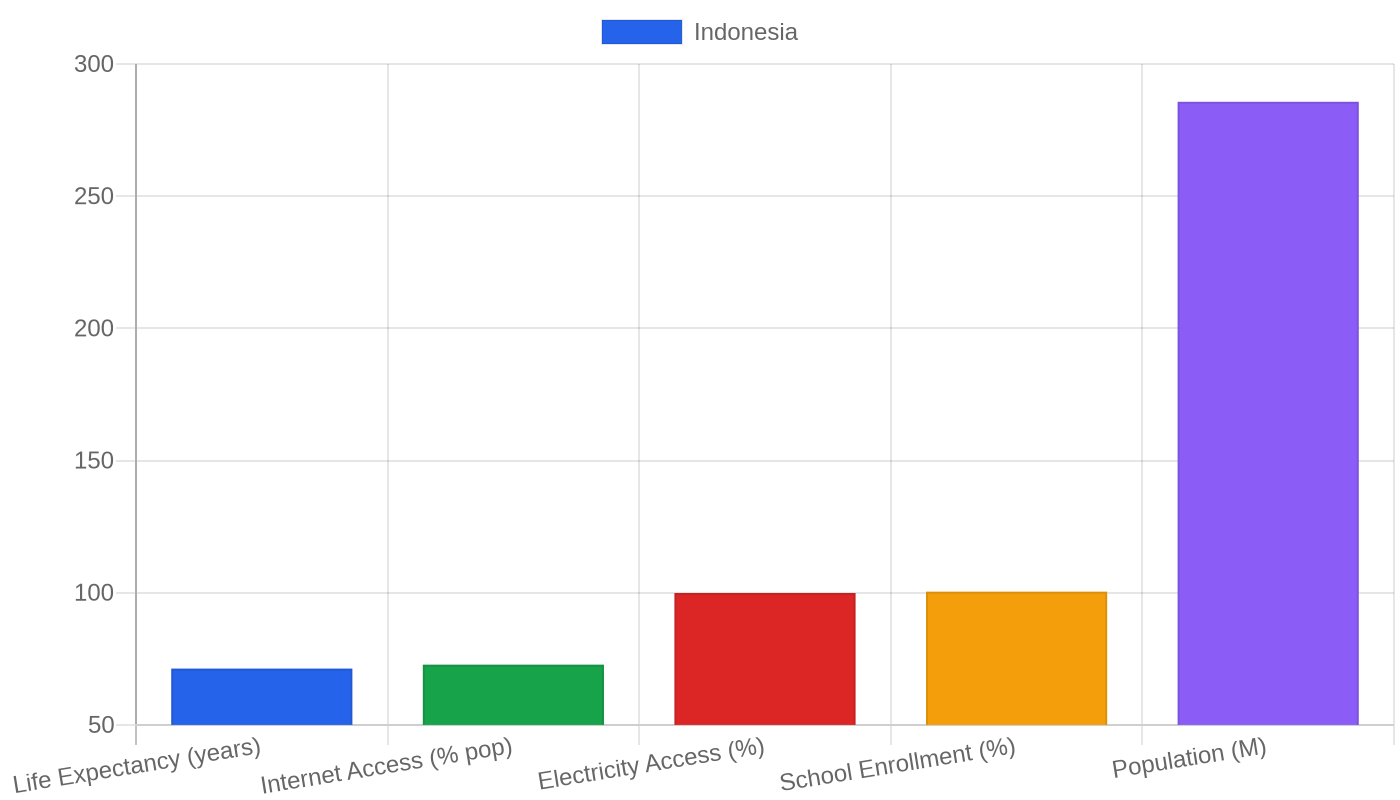
– With a population approaching 286 million and a GDP per capita (PPP) of $17,660, Indonesia sits at a critical inflection point: no longer low-income, but not yet comfortably middle-income — a transition that will define the next decade.
The 5% Puzzle — Why Indonesia’s Growth Defies Easy Labels
At first glance, Indonesia’s GDP growth of 5.1% in 2025, as recorded by the World Bank, looks almost boring. It is not the double-digit sprint of Vietnam in its heyday, nor the volatile boom-bust of commodity-dependent peers. But that steady, unspectacular number is precisely what makes Indonesia interesting. For a country of nearly 286 million people, sustaining 5% growth year after year is an organisational achievement that few nations have managed.
The inflation figure of 1.9% is arguably more telling. Across much of the developing world, central banks have been fighting to contain price pressures that erode purchasing power and destabilise politics. Indonesia’s inflation is not just low — it is enviably low. This allows Bank Indonesia to keep monetary policy accommodative without the fear of capital flight or currency collapse that haunts other emerging markets.
The World Bank data shows a GNI per capita of $5,120, which places Indonesia squarely in the lower-middle-income bracket, but the PPP-adjusted figure of $17,660 tells a different story: the average Indonesian has more purchasing power than the nominal income suggests, thanks to a relatively efficient domestic economy.
Unemployment at 3.2% is a figure that would make many European finance ministers weep with envy. But here, the nuance matters. Indonesia’s labour market is characterised by a large informal sector, and official unemployment numbers often mask underemployment. Still, the headline figure suggests that the economy is generating enough jobs to absorb new entrants into the workforce — no small feat for a country whose population is still growing.
The industrial backbone of the economy is visible in the list of top companies: financial institutions dominate. Bank Mandiri, Bank Rakyat Indonesia, Bank Central Asia, Bank Negara Indonesia, and Bank Tabungan Negara are not just banks; they are the circulatory system of the nation’s commerce. Alongside them sit industrial giants like Badak LNG and Astra International, a conglomerate whose tentacles reach into everything from automotive to agribusiness.
This concentration of corporate power in financials and industrials reflects an economy that is still heavily driven by domestic consumption and resource processing, rather than high-tech exports.
The Cost of Living — Where the Rupiah Stretches and Where It Doesn’t
The World Bank data does not provide specific cost-of-living figures for Indonesia, but the macroeconomic numbers offer clues. With a GNI per capita of $5,120, the average annual income is roughly $427 per month — a figure that immediately contextualises the lived reality of most Indonesians. Housing, food, and transport absorb the bulk of household spending, and the gap between Jakarta and the rest of the archipelago is vast.
In the capital, a modest apartment in a decent neighbourhood can consume 40% or more of a formal-sector salary. Outside Java, housing costs drop sharply, but so do economic opportunities. The inflation rate of 1.9% is a blessing for households, particularly for staple goods like rice and cooking oil, which have historically been politically sensitive. The stability of consumer prices is one reason why social discontent has remained manageable, even as inequality persists.
For the millions of Indonesians working in the informal economy, the cost of living is not just a number — it is a daily negotiation between earnings that are irregular and expenses that are not.
The Business Climate — Banks, Conglomerates, and the Waiting Game
Indonesia’s corporate landscape is dominated by a handful of names that recur across sectors. Astra International is the quintessential Indonesian conglomerate, with interests spanning automotive, heavy equipment, mining, agribusiness, and financial services. Its presence on the list of top companies alongside Badak LNG, a major player in liquefied natural gas, and Angkasa Pura, which manages the country’s airports, underscores the extent to which the economy remains state-connected and resource-linked.
The banking sector is the real story. Bank Mandiri, Bank Rakyat Indonesia, Bank Central Asia, Bank Negara Indonesia, and Bank Tabungan Negara are not just lenders; they are instruments of economic policy. BRI, for instance, has an extensive micro-banking network that reaches into rural areas where formal credit was once non-existent. This financial deepening has been a quiet driver of consumption growth.
For foreign investors, the challenge is navigating a regulatory environment that has improved but remains opaque. The dominance of state-linked entities means that the private sector often plays second fiddle to parastatal priorities. Still, the stability of the banking system, the low inflation, and the sheer size of the domestic market make Indonesia hard to ignore.
Politics, Safety, and the Quality of Life — Stability as a Scarce Commodity
Indonesia’s political system, as outlined in the provided data, is a unitary republic with a presidential system rooted in the 1945 Constitution. The five principles of Pancasila — belief in one God, just and civilised humanity, national unity, democracy, and social justice — are taught in schools and embedded in civic life. The post-1998 reforms introduced direct presidential elections, reduced the power of the People’s Consultative Assembly (MPR), and granted regional autonomy.
This has created a political environment that, while messy and often transactional, is remarkably stable compared to many of its neighbours.
The Crime Index and Safety Index are listed as N/A in the data, which makes it impossible to offer specific figures. What can be said is that Indonesia is not generally considered a high-crime country by regional standards, though petty crime in urban centres is a reality. The quality of life varies enormously: Jakarta offers world-class amenities for the wealthy, while rural areas in eastern Indonesia lack basic infrastructure. The political stability, however, is a genuine asset.
In a region where democratic backsliding and military interventions are not uncommon, Indonesia’s commitment to electoral democracy — however imperfect — provides a predictability that investors value.
What’s Happening Now — Jakarta’s Balancing Act
The most recent news on Indonesia’s economy comes from The Jakarta Post, the country’s leading English-language newspaper, which covers both the broader economy and the markets. The fact that the data points to a single source for current affairs is telling: the conversation in Jakarta right now is about sustaining growth without stoking inflation, managing the fiscal pressures from subsidy spending, and navigating the global slowdown in commodity demand.
Indonesia is not immune to external shocks. The 5.1% growth rate, while respectable, is below the 7% targets that policymakers once dreamed of. The government is walking a tightrope: it needs to maintain fuel and food subsidies to keep inflation low and social peace intact, but those subsidies eat into the fiscal space needed for infrastructure and education spending.
The banking sector, dominated by the state-owned giants, is well-capitalised and liquid, but credit growth has been tepid as businesses wait for clearer signals on regulation and tax policy. The markets, as reported by The Jakarta Post, are watching for signs of reform momentum — particularly around the omnibus law on job creation, which remains controversial but is seen by many economists as essential for attracting foreign direct investment.
The Bottom Line
Indonesia is not a flashy story. It is not a turnaround tale or a crisis narrative. It is a story of steady, grinding progress in a country that is too large to ignore and too complex to simplify. For investors looking for exposure to domestic consumption in Southeast Asia, for businesses seeking a manufacturing alternative to China, and for anyone interested in the politics of democratic development in the Muslim world, Indonesia is the most important country you are not reading enough about.
Watch it not for the drama, but for the endurance.
Sources & Methodology
This article is authored by Economic Pulse Net for informational and research purposes. Economic Pulse Net sources its data from multilateral institutions, national statistics bureaus, and proprietary databases. All data is believed to be current as of the date of publication.
Published: July 19, 2026 | Category: Research — Indonesia
Use these signals in your own platform
Economic Pulse publishes its live signal feed through a documented, read-only API. Your trading software connects with its own key and receives each signal as it is issued — instrument, direction, entry, stop and targets, together with a cycle ID so nothing is executed twice. The feed is independent of this website and cannot change it.
Signals are informational only and are not financial advice.