Economic Pulse Net | Sources: World Bank World Development Indicators, Government Sources | 2026
Key Takeaways
– China’s GDP growth is holding at roughly 5 percent, a figure that would be the envy of most major economies but represents a slowdown from the country’s historical double-digit expansion. The World Bank recorded growth of 4.96 percent in 2025.
– Inflation is virtually nonexistent at just 0.06 percent, a double-edged sword that signals weak domestic demand even as it keeps consumer prices stable.
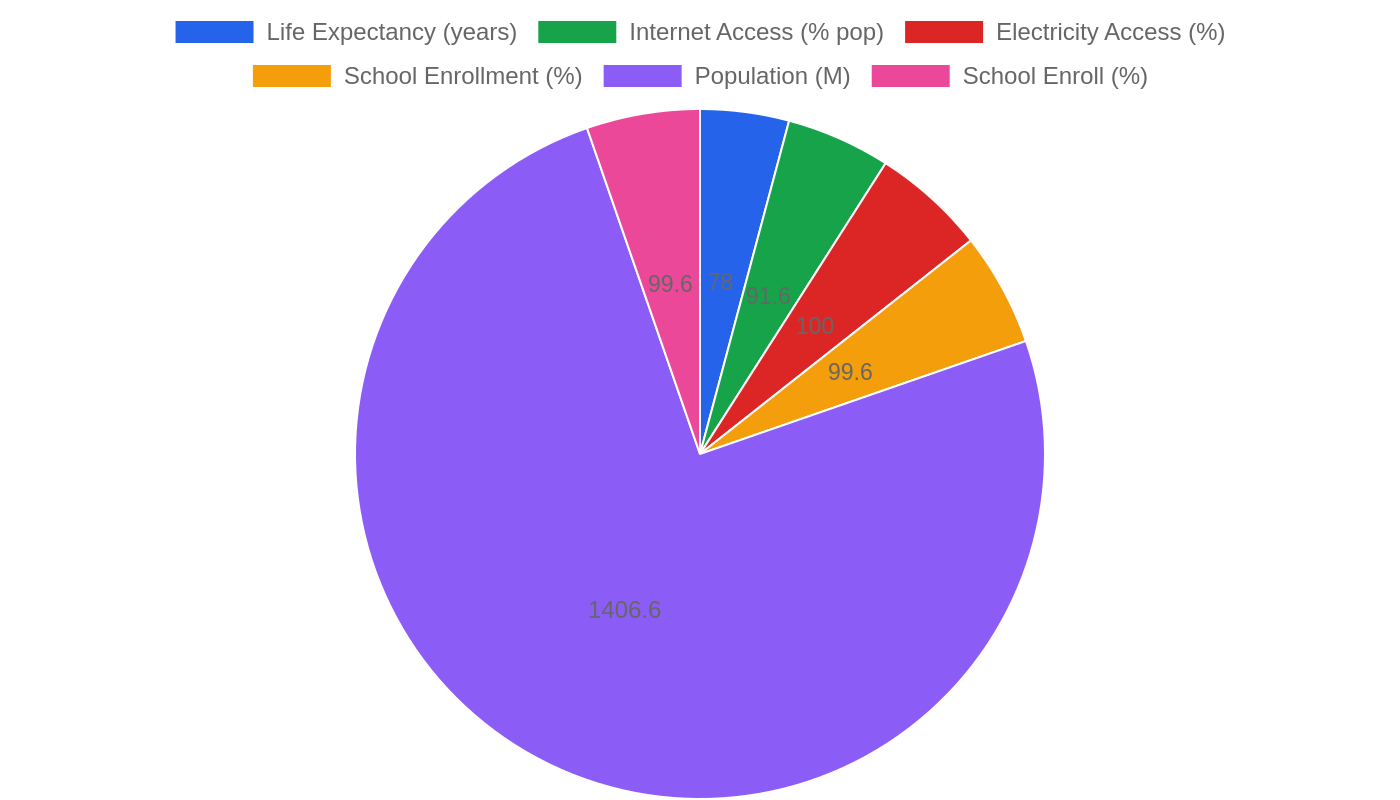
– The world’s most populous nation, with 1.4 billion people, continues to pivot from an export-driven model toward domestic consumption and high-tech self-sufficiency, though the transition remains uneven.
– Chinese electric vehicle manufacturers are aggressively pushing into global markets, with analysts suggesting their affordable models could force open even the most protectionist economies.
– The political landscape remains defined by absolute CCP leadership, with the ruling party framing its economic approach as “socialism with Chinese characteristics” — a hybrid model blending state control with market mechanisms.
The Growth Engine: Slowing, But Still Mighty
Let’s start with the headline number: 4.96 percent GDP growth in 2025, according to the World Bank. In any other context, that would be a spectacular performance. For China, it represents a mature economy finding its footing after decades of breakneck expansion. The country’s GDP now stands at approximately $19.5 trillion, making it the second-largest economy on the planet by nominal output.
Per capita GNI sits at $14,230 — a figure that places China firmly in upper-middle-income territory, though still well below the wealth levels of the developed world.
What makes this growth particularly interesting is what’s driving it. The near-zero inflation rate of 0.06 percent tells a complex story. On one hand, stable prices are a gift to consumers and policymakers alike. On the other, such minimal price growth suggests that domestic demand remains sluggish — consumers are saving rather than spending, and businesses are cautious about raising prices in a soft market.
This is the paradox of modern China: the factories are running, the exports are flowing, but the average household’s willingness to open its wallet hasn’t fully caught up with the country’s productive capacity.
The structural challenges are significant. China’s demographic dividend is fading, with an aging population and a workforce that is no longer growing. The property sector, once the engine of local government finances and household wealth, remains under pressure. And the global trading environment has become increasingly hostile, with tariffs and trade barriers emerging in key markets.
Yet the World Bank’s data suggests the economy is still finding ways to grow — a testament to the scale of China’s manufacturing base, its massive infrastructure investment, and the sheer productive energy of 1.4 billion people.
The Cost of Living Puzzle: Cheap Goods, Cautious Consumers
With inflation at just 0.06 percent, the cost of living in China has remained remarkably stable. For the average urban worker, this means that wages — even if they’re not rising quickly — are maintaining their purchasing power. Food prices, transportation costs, and consumer goods have all remained broadly flat, which is good news for household budgets.
But the picture is more nuanced than the inflation data suggests. Housing costs, which are the single largest expense for most Chinese families, remain a source of anxiety. In major cities like Beijing, Shanghai, and Shenzhen, property prices are still high relative to average incomes, even after several years of correction in the real estate market.
The traditional expectation that property values would rise indefinitely has been shattered, leaving many middle-class families feeling less wealthy than they did a decade ago.
The rental market tells a similar story. In tier-one cities, rents have stabilised but remain a significant monthly outlay, often consuming 30 to 40 percent of a young professional’s income. For the millions of migrant workers who have moved to cities for factory or service jobs, the cost of living is a daily calculation — how much of their earnings can they send home to their families in rural provinces? The answer, in many cases, is less than they’d hoped, as urban living costs eat into their savings.

Business and Investment: Giants in Transition
The corporate landscape in China is dominated by names that are becoming increasingly familiar to global audiences. Alibaba Group leads the technology sector, having transformed from an e-commerce platform into a sprawling ecosystem spanning cloud computing, digital payments, and artificial intelligence. The Agricultural Bank of China represents the financial sector’s immense scale, with assets that rival the largest banks in the world.
In consumer goods, companies like Anta Sports and 361 Degrees have moved beyond their domestic strongholds to challenge established global brands in sportswear and athletic equipment.
The industrial sector remains the backbone of the economy, with AVIC leading in aerospace and defense, and Aluminum Corporation of China Limited (Chalco) dominating basic materials. Air China connects the country to the world, while Anker has become a global powerhouse in consumer electronics accessories. These companies collectively illustrate the breadth of China’s economic ambition — from raw materials to finished consumer products, from domestic services to global exports.
For investors, the Chinese market offers both opportunity and risk. The government’s push for technological self-reliance has created a boom in semiconductor manufacturing, electric vehicles, and renewable energy. But navigating the regulatory environment requires patience and local knowledge.
The business climate is one of state-guided capitalism, where companies that align with national priorities — such as the “Made in China 2025” initiative — can find substantial support, while those that fall out of favour can face sudden regulatory headwinds.
Politics, Safety, and Daily Life: Stability at a Price
China’s political system is unambiguous: the Chinese Communist Party exercises absolute leadership over the state, a structure that has remained unchanged since the founding of the People’s Republic. The party describes its governing philosophy as “socialism with Chinese characteristics,” a framework that seeks to combine a market economy with strong state direction.
Many academic observers characterise the system as authoritarian, though the government prefers the term “people’s democratic dictatorship.”
For the average citizen, the implications are clear. Political stability is the system’s primary achievement — there have been no major civil disturbances, no coup attempts, no political paralysis. Crime rates are low by global standards, and the government maintains a strong security presence in urban areas. The trade-off is a political environment that tolerates little dissent and where the boundaries of acceptable public discourse are tightly drawn.
Quality of life, meanwhile, is improving in measurable ways. The country’s infrastructure — high-speed rail, airports, highways, and digital connectivity — is world-class. Access to education and healthcare has expanded dramatically over the past two decades. Yet the pressures of modern Chinese life are real: intense competition for good jobs, the stress of caring for aging parents, and the anxiety of raising children in an education system that is famously demanding.
What’s Happening Now: Trade Wars, EVs, and the Ceuta Warning
The most immediate story in China today is the escalating trade confrontation with Western markets. A recent analysis from the South China Morning Post asks whether Europe can remain united in its trade battle with China, citing the Ceuta crisis as a cautionary tale. The message is clear: when economic pressures mount, political unity tends to fracture. Chinese policymakers are watching these dynamics closely, calculating that European resolve may weaken as the costs of decoupling become apparent.
In the automotive sector, the pressure is building for Chinese electric vehicle manufacturers to gain access to the US market. Analysts cited by the South China Morning Post argue that demand for affordable EVs will eventually force open even protected markets. The logic is simple: Chinese EVs offer comparable quality at significantly lower prices, and consumers will eventually demand access.
As Mexico and Canada — the United States’ neighbouring markets — begin adopting Chinese EVs, the pressure on protectionist policies will only intensify.
Meanwhile, China Daily reports that foreign trade is on a “steady growth track,” suggesting that despite the trade tensions, Chinese exporters are finding ways to adapt. Diversification into new markets, value-added products, and digital trade platforms are all helping to maintain momentum. The government’s “Business+” initiative appears to be part of this strategy, promoting new models of international commerce that go beyond traditional goods trade.
The Bottom Line
China in 2026 is a country managing a delicate balancing act: maintaining growth in a mature economy, managing the transition from investment-led to consumption-led development, and navigating an increasingly hostile global trade environment. The near-zero inflation rate is both a symptom of the challenges and a tool for policymakers — there is room to stimulate demand if needed.
For investors, the opportunities are in companies that align with national strategic priorities, particularly in technology, green energy, and advanced manufacturing. For policymakers in other countries, the lesson is that China’s economic weight is too large to ignore and too complex to fully decouple from. This is a country to watch closely, not because it is about to collapse — it isn’t — but because the choices it makes in the next few years will shape the global economy for decades to come.
Sources & Methodology
This article is authored by Economic Pulse Net for informational and research purposes. Economic Pulse Net sources its data from multilateral institutions, national statistics bureaus, and proprietary databases. All data is believed to be current as of the date of publication.
Published: August 09, 2026 | Category: Research — China
Use these signals in your own platform
Economic Pulse publishes its live signal feed through a documented, read-only API. Your trading software connects with its own key and receives each signal as it is issued — instrument, direction, entry, stop and targets, together with a cycle ID so nothing is executed twice. The feed is independent of this website and cannot change it.
Signals are informational only and are not financial advice.