Economic Pulse Net | Sources: World Bank World Development Indicators, Government Sources | 2026
Key Takeaways
– Cambodia operates as a constitutional monarchy with a parliamentary system, but political power remains heavily concentrated, creating a stable yet tightly controlled environment for investors.
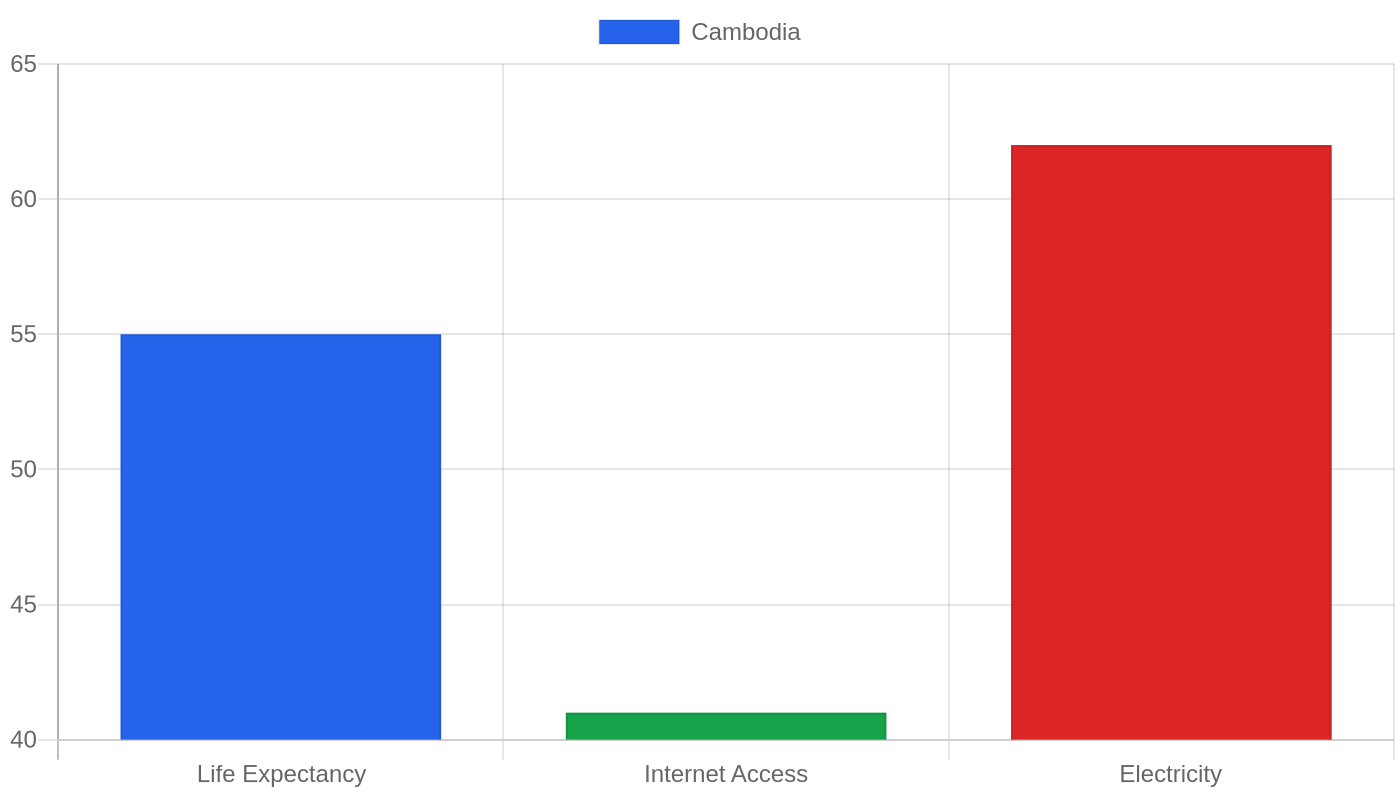
– The country’s economic data is conspicuously absent from the World Bank’s latest reporting, raising questions about transparency and the reliability of official statistics in a fast-changing economy.
– Major financial institutions dominate the corporate landscape, with ACLEDA Bank, ANZ Royal Bank, and several other banks leading a sector that is the backbone of formal economic activity.
– Tourism remains a critical industry, reflected in the presence of four airlines among the top companies, though the sector faces headwinds from global competition and regional dynamics.
– Cambodia presents a high-risk, high-uncertainty profile for investors, where political continuity offers predictability but the lack of transparent economic data makes independent risk assessment difficult.
The Phantom Economy — Where Did the Numbers Go?
The most striking feature of Cambodia’s current economic profile is what is missing. The World Bank, typically a reliable source for cross-country comparisons, reports no data on GDP growth, inflation, unemployment, GDP per capita, or GNI per capita for the kingdom. This data vacuum is not merely an administrative oversight; it signals deeper questions about the country’s economic governance and the reliability of information available to investors and policymakers.
Without inflation figures, it is impossible to gauge the real purchasing power of the Cambodian riel or the cost pressures facing households. Without unemployment data, the health of the labor market remains a matter of anecdote rather than analysis. The absence of GDP per capita and GNI per capita figures means that Cambodia’s place in the regional development hierarchy — whether it is catching up to neighbors like Vietnam and Thailand or falling behind — cannot be independently verified.
What we do know is that Cambodia’s economy has historically relied on three pillars: garment manufacturing, tourism, and agriculture. The garment sector, which accounts for a significant share of exports, faces intense competition from lower-cost producers and pressure from international buyers demanding better labor standards.
Tourism, centered on the Angkor Wat temple complex, has been a major foreign exchange earner, but the presence of four airlines among the top companies — ABOUTAsia Travel, Angkor Airways, Cambodia Airlines, and Cambodia Angkor Air — suggests the sector is both crowded and competitive.
The banking sector, led by ACLEDA Bank, ANZ Royal Bank, Cambodia Asia Bank, and Cambodia Commercial Bank, reflects a financial system that has grown rapidly but may be reaching saturation. Cambrew Brewery, the lone consumer goods company on the list, hints at a domestic consumer market that is developing but still narrow. The Cambodian National Insurance Company points to a nascent insurance industry, a sign of growing sophistication but also of the risks that come with economic expansion.
The World Bank’s silence on key indicators is itself a story. It suggests either that data collection systems are inadequate, that the government is not sharing information, or that the economy is in a state of flux that makes traditional metrics difficult to calculate. For an investor, this is a red flag: you cannot manage what you cannot measure.
The Cost of Living in the Kingdom of Wonder — Housing, Rice, and the Daily Grind
Housing costs in Cambodia vary dramatically depending on location. In Phnom Penh, the capital, a one-bedroom apartment in a central district can command rents that rival those in secondary cities in neighboring Thailand, while rural areas remain among the cheapest in Southeast Asia. The gap between rent and buy is stark: property ownership is often restricted for foreigners, who can own buildings but not land, creating a market dominated by long-term leases and condominium purchases.
Daily expenses reflect a dual economy. Street food and local markets offer meals for a dollar or two, while Western-style restaurants and supermarkets cater to expatriates and wealthy Cambodians at prices comparable to Bangkok or Ho Chi Minh City. Utilities, particularly electricity, are relatively expensive due to reliance on imported energy and aging infrastructure, adding a hidden cost to everyday life.
The cost of transportation is a significant factor. Motorcycles dominate the roads, and fuel prices, though not reported in the available data, are subject to global fluctuations and government subsidies. For most Cambodians, the biggest expense after food and housing is transportation to work, often in the garment factories on the outskirts of Phnom Penh or in the service sector in tourist hubs like Siem Reap.
Compared to regional averages, Cambodia’s cost of living is low in absolute terms but high relative to income levels. Without GNI per capita data, it is impossible to say exactly how far the average wage stretches, but the prevalence of microfinance institutions and informal lending suggests that many households live on the edge of financial precarity.
Banking on the Future — Investment Climate in a One-Party State
The list of top companies in Cambodia reads like a who’s who of the financial sector. ACLEDA Bank, ANZ Royal Bank, Cambodia Asia Bank, and Cambodia Commercial Bank dominate, alongside the Cambodian National Insurance Company. This concentration tells a clear story: the formal economy runs on credit, and the banking sector is the gateway to growth.
ACLEDA Bank, originally a microfinance institution, has grown into a universal bank with a branch network that reaches into rural areas. ANZ Royal Bank, a joint venture between Australia’s ANZ and Cambodian interests, represents the foreign investment that has flowed into the sector. These banks are not just lenders; they are the infrastructure of the modern economy, financing everything from motorcycle purchases to real estate development.
The consumer services sector, represented by ABOUTAsia Travel and the airlines, highlights the importance of tourism as a growth driver. However, the presence of four airlines in a relatively small market suggests overcapacity and intense competition. Cambodia Angkor Air, the national carrier, competes with Cambodia Airlines and Angkor Airways for a limited pool of tourists and business travelers.
For investors, the key question is political risk. Cambodia is a constitutional monarchy with a parliamentary system, as defined by the constitution. The king is the head of state and a symbol of national unity, while legislative powers are shared between the executive and the bicameral parliament, consisting of the National Assembly and the Senate. In practice, power is heavily centralized, and the political opposition has been systematically marginalized.
This provides stability for long-term investors but raises concerns about rule of law, contract enforcement, and the potential for sudden policy shifts.
Sectors to watch include financial services, where the banking sector is still underpenetrated relative to the population, and tourism, where infrastructure improvements could unlock more visitor spending. Agribusiness and food processing also offer potential, given Cambodia’s agricultural base and the presence of Cambrew Brewery as a successful domestic consumer brand.
Safety, Politics, and the Quality of Life in a Controlled State
The crime and safety indices for Cambodia are not reported in the available data, which is itself a concern. In the absence of official statistics, anecdotal evidence suggests that petty crime, particularly bag snatching and pickpocketing, is common in urban areas, while violent crime is less frequent but not unknown. The safety situation varies greatly by location: tourist areas are heavily policed, while remote regions may have little to no law enforcement presence.
Politically, Cambodia is a study in controlled stability. The constitutional monarchy provides a veneer of democratic process, with a bicameral parliament that includes an elected National Assembly and an appointed Senate. However, the dominant party, the Cambodian People’s Party, has held power for decades, and dissent is not tolerated.
The political landscape is thus stable but brittle: there is no mechanism for peaceful transfer of power through elections, and the opposition has been effectively neutralized.
Quality of life is a mixed picture. For the wealthy elite, Phnom Penh offers luxury apartments, international schools, and high-end restaurants. For the majority, life is a struggle for basic services: clean water, reliable electricity, and adequate healthcare are not guaranteed. The happiness data, like so much else, is absent from the available information, but the high rate of migration to Thailand and other neighbors suggests that many Cambodians are voting with their feet.
The political system’s stability is both a blessing and a curse. It provides predictability for businesses that can work within the system, but it also means that corruption, nepotism, and lack of accountability are embedded features, not bugs. For the average citizen, quality of life depends on connections and luck as much as on hard work.
The Great Unknown — What’s Happening Now in Cambodia
The most urgent story in Cambodia today is the data blackout. Without current economic indicators, policymakers, investors, and citizens are flying blind. The World Bank’s silence on GDP growth, inflation, and unemployment is not just a statistical gap; it is a governance failure. In a region where neighboring countries publish detailed quarterly data, Cambodia’s opacity stands out.
The banking sector, dominated by ACLEDA Bank and others, is facing pressure from rising non-performing loans and a slowdown in credit growth. After years of rapid expansion, the microfinance sector in particular has come under scrutiny for over-indebting rural households. The government has taken some steps to regulate the industry, but enforcement remains weak.
Tourism, the other pillar of the economy, is struggling to recover to pre-pandemic levels. The airlines on the top companies list — Cambodia Angkor Air, Cambodia Airlines, Angkor Airways, and ABOUTAsia Travel — are competing for a shrinking pool of international visitors. China, once the largest source of tourists, has not returned in the numbers expected, and the region faces competition from new destinations.
Politically, the government is focused on maintaining stability ahead of the next election cycle. The constitutional monarchy provides a framework, but real power rests with the executive. The opposition is fragmented and suppressed, and civil society is under pressure. For investors, the question is whether this stability can be sustained without economic growth to provide jobs and opportunities for a young, increasingly educated population.
The Bottom Line
Cambodia is a country of contradictions: a constitutional monarchy with one-party rule, a fast-growing economy with no reliable data, a tourist paradise with a fragile safety net. For the risk-tolerant investor with local connections and a long time horizon, the kingdom offers opportunities in banking, tourism, and consumer goods. For the cautious observer, the lack of transparency and the concentration of political power are deal-breakers.
Watch Cambodia if you are interested in the frontier markets of Southeast Asia, but do not expect to know where you are stepping until you are already there.
Sources & Methodology
This article is authored by Economic Pulse Net for informational and research purposes. Economic Pulse Net sources its data from multilateral institutions, national statistics bureaus, and proprietary databases. All data is believed to be current as of the date of publication.
Published: July 22, 2026 | Category: Research — Cambodia
Use these signals in your own platform
Economic Pulse publishes its live signal feed through a documented, read-only API. Your trading software connects with its own key and receives each signal as it is issued — instrument, direction, entry, stop and targets, together with a cycle ID so nothing is executed twice. The feed is independent of this website and cannot change it.
Signals are informational only and are not financial advice.