Economic Pulse Net | Sources: World Bank World Development Indicators, Government Sources | 2026
Key Takeaways
– Brunei remains one of the world’s few absolute monarchies, governed by the Malay Islamic Monarchy (MIB) framework, with no elections and a parliament entirely appointed by the Sultan.
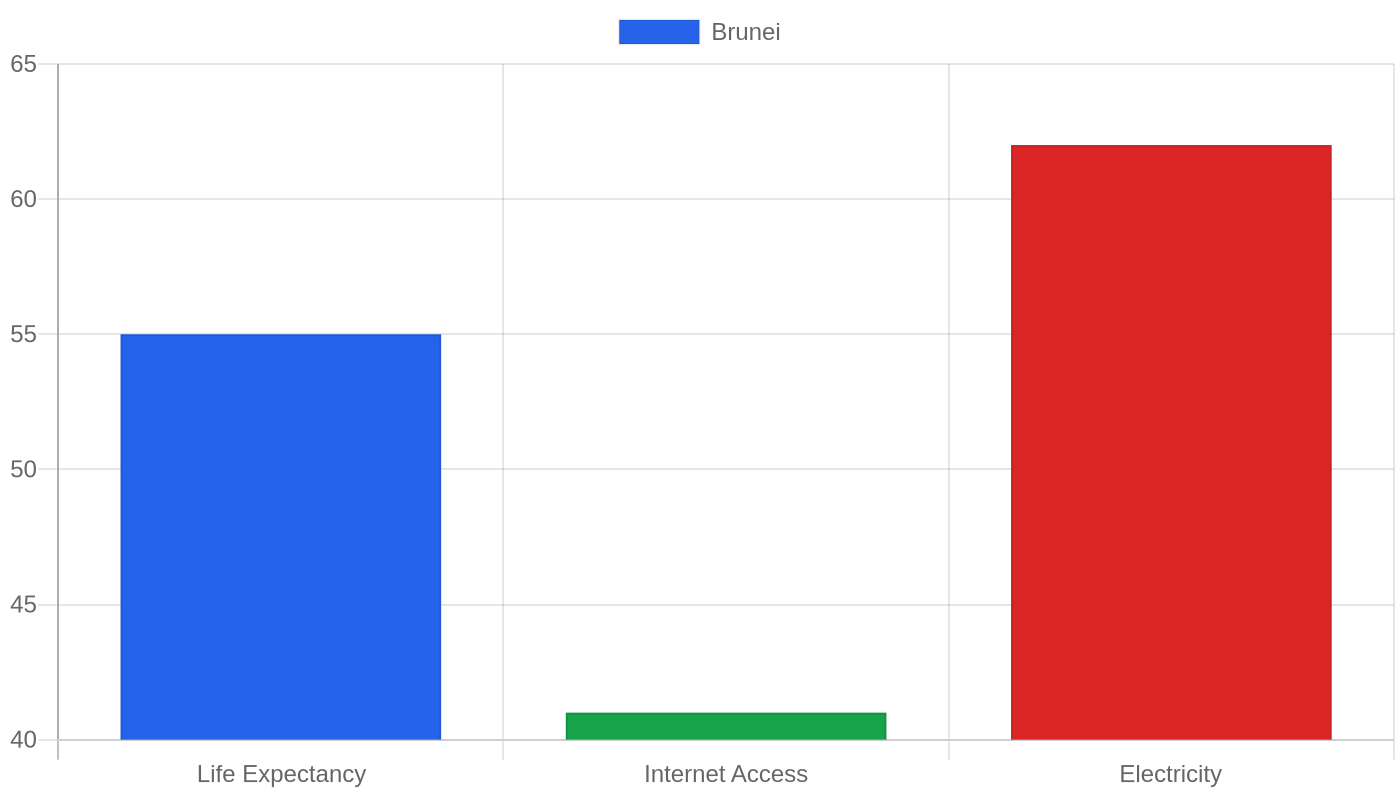
– The economy is overwhelmingly dependent on oil and gas, with major state-linked players like Brunei Shell Petroleum and Brunei LNG dominating the landscape—yet no recent GDP, inflation, or unemployment figures are available from the World Bank.
– The financial sector is the second most visible industry, anchored by Baiduri Bank, Bank Islam Brunei Darussalam, and the Brunei Investment Agency, but data on cost of living, crime, and safety indices is absent from public international datasets.
– Political stability is absolute under the Sultan’s rule, but the absence of electoral politics and the imposition of Sharia law in certain cases create a unique—and for some, restrictive—social environment.
– For investors, the story is one of cautious opportunity: energy remains king, but fertilizer, methanol, and services companies hint at a slow pivot away from hydrocarbons.
The Petro-State Paradox: Growth Without Numbers
Brunei Darussalam, a small, oil-rich sultanate on the island of Borneo, presents a peculiar challenge for the economic journalist: the latest World Bank data offers no GDP growth figure, no inflation rate, no unemployment statistic, and no GDP per capita (PPP) reading. This absence is not a data failure—it is a statement. Brunei, for all its wealth, operates with a level of statistical opacity that mirrors its political insularity.
The country’s economy is dominated by hydrocarbons, and the major players are state-linked or state-owned: Brunei Shell Petroleum, Brunei LNG, and Brunei Methanol Company form the backbone of export revenues. The Brunei Investment Agency manages the nation’s sovereign wealth, while Brunei Energy Services and Trading supports the upstream sector.
Without hard numbers, one must rely on structural observation. The economy is small, heavily subsidized, and vulnerable to global oil price swings. The government provides free education, healthcare, and no personal income tax—a social contract funded by petroleum rents. But the lack of recent World Bank data suggests either a reporting lag or a deliberate opaqueness. What is clear is that diversification efforts are real, if slow.
Brunei Fertilizer Industries and the methanol plant represent attempts to move downstream, adding value before export. Yet the dominance of energy means that when oil prices fall, the entire economy feels the pressure. The absence of inflation and employment figures makes it impossible to gauge domestic stress, but the stability of the monarchy suggests that, for now, the system holds.
Living in the Sultan’s Shadow: Housing, Subsidies, and the Cost of Calm
On cost of living, the World Bank provides no data. This is not unusual for Brunei—the government heavily subsidizes fuel, rice, and housing, meaning market prices do not reflect true costs. Rent and property are generally affordable for citizens, who benefit from state-backed mortgage schemes and land grants. For expatriates, however, the picture is different. Housing in the capital, Bandar Seri Begawan, is limited and relatively expensive compared to neighboring Malaysian cities like Kota Kinabalu or Miri.
Daily expenses for imported goods are high due to the country’s reliance on foreign supply chains, but utilities and transport remain cheap thanks to subsidies.
The absence of a formal rental index or CPI data from the World Bank means one must infer from regional patterns. Brunei shares many characteristics with Gulf petro-states: low taxes, high subsidies, and a bifurcated economy where locals enjoy state support while foreign workers face higher costs and fewer rights. The cost of living is likely stable but not transparent—a reflection of a system that prioritizes social peace over market efficiency.
For the average Bruneian, life is comfortable but constrained; for the foreign investor or worker, it is functional but expensive.
Banking on Stability: The Business Climate in a No-Election State
The top companies list reads like a who’s who of state capitalism. Baiduri Bank and Bank Islam Brunei Darussalam dominate the financial sector, alongside the Brunei Darussalam Central Bank. The Brunei Investment Agency manages the country’s external assets, likely worth tens of billions, though exact figures are state secrets.
In the industrial sphere, Brunei Fertilizer Industries and Brunei Methanol Company represent the non-oil manufacturing base, while Hua Ho Department Store stands as a rare consumer-facing private enterprise.
For investors, the business climate is defined by stability and control. There are no elections, no political uncertainty, and no labor strikes. The legal system is based on English common law, though Sharia law supersedes it in certain cases, creating a dual-track legal environment that can be confusing for foreign firms. The government welcomes foreign direct investment in downstream energy, halal food production, and tourism, but the bureaucracy is slow and the market is tiny.
The real opportunity lies in using Brunei as a base for regional trade, not as a domestic market. The presence of a sovereign wealth fund and a central bank that is also a top company signals that finance, not just oil, is a strategic priority.
The Politics of Permanence: Safety, Sharia, and Social Control
Brunei’s political system is governed by the constitution and the national tradition of the Malay Islamic Monarchy (Melayu Islam Beraja; MIB). As the World Bank data notes, the three components of MIB cover Malay culture, Islamic religion, and the political framework under the monarchy. There is a parliament, but there are no elections; instead, the members are appointed by the Sultan. The last election was—and the sentence ends there, because there is no recent electoral history to report.
This is a country where politics is not contested; it is inherited.
The crime index and safety index are absent from the data, but anecdotal evidence suggests Brunei is extremely safe. Petty crime is low, violent crime is rare, and the police presence is visible. However, safety comes at a cost: the imposition of Sharia law in certain cases, including for moral offenses, means that personal freedoms are sharply curtailed, particularly for women and LGBTQ+ individuals.
The quality of life for those who conform to MIB values is high—free healthcare, free education, subsidized housing—but for those who do not, life can be restrictive. The happiness data is missing, but one suspects it is a quiet, compliant happiness, not a boisterous one.
The Slow Drift: What’s Happening Now in Brunei
The most recent data point is the political structure itself, which has not changed. The Sultan, Hassanal Bolkiah, remains one of the world’s longest-serving monarchs, and there is no visible succession crisis or reform movement. The economy continues to rely on oil and gas, but the government has quietly pushed for diversification. Brunei Fertilizer Industries and Brunei Methanol Company are operational, and the energy services sector, represented by Brunei Energy Services and Trading, is growing.
The financial sector, anchored by Baiduri Bank and Bank Islam Brunei Darussalam, is stable but not dynamic.
What is happening now is a slow, managed transition. The government is aware that oil reserves are finite, and it is using the sovereign wealth fund—managed by the Brunei Investment Agency—to build a post-oil future. But the pace is glacial, and the lack of transparency makes it hard to assess progress. There are no protests, no political debates, no economic shocks. Brunei is, in many ways, the most stable country in Southeast Asia—and also the most stagnant.
The question for 2026 is whether this stability is a foundation for gradual reform or a gilded cage.
The Bottom Line
Brunei is a country for patient, risk-averse investors who want exposure to Southeast Asian energy and finance without political volatility. It is not a market for entrepreneurs seeking rapid growth or democratic reform. The absence of data is itself a signal: this is a state that does not feel compelled to explain itself. For those who value predictability over freedom, and stability over transparency, Brunei offers a quiet, prosperous corner of the world.
For everyone else, it remains a fascinating but closed book.
Sources & Methodology
This article is authored by Economic Pulse Net for informational and research purposes. Economic Pulse Net sources its data from multilateral institutions, national statistics bureaus, and proprietary databases. All data is believed to be current as of the date of publication.
Published: July 22, 2026 | Category: Research — Brunei
Use these signals in your own platform
Economic Pulse publishes its live signal feed through a documented, read-only API. Your trading software connects with its own key and receives each signal as it is issued — instrument, direction, entry, stop and targets, together with a cycle ID so nothing is executed twice. The feed is independent of this website and cannot change it.
Signals are informational only and are not financial advice.