Economic Pulse Net | Sources: World Bank World Development Indicators, Government Sources | 2026
Key Takeaways
– Brunei’s economy remains overwhelmingly dependent on hydrocarbons, with state-linked giants like Brunei Shell Petroleum and Brunei LNG dominating the landscape, leaving the country highly vulnerable to global energy price swings.
– The financial sector is emerging as a quiet pillar of diversification, anchored by major institutions like Baiduri Bank and Bank Islam Brunei Darussalam, suggesting a strategic shift toward services.
– The political system is uniquely stable but unelected, operating under the Malay Islamic Monarchy (MIB) philosophy where the Sultan holds executive authority and appoints all parliament members.
– Islamic finance and sharia law are integral to the business environment, creating a distinct operational framework that investors must navigate carefully.
– The country is positioning itself in downstream petrochemicals, with ventures like Brunei Methanol Company and Brunei Fertilizer Industries signaling an attempt to extract more value from its natural resources.
The Hydrocarbon Heartbeat: Reading Brunei’s Economic Vital Signs
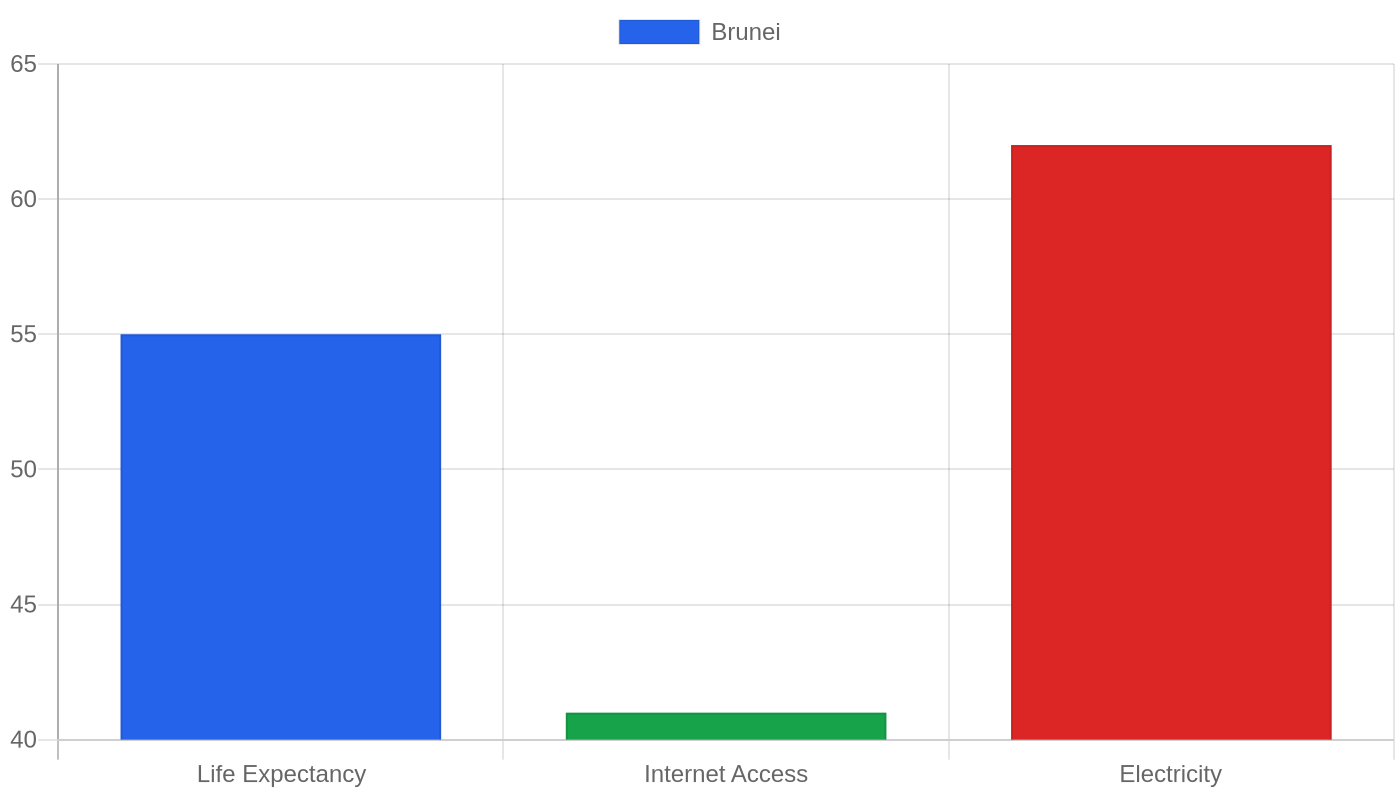
Brunei’s economic narrative is written in the language of oil and gas. The World Bank’s latest data presents a frustratingly opaque picture—with GDP growth, inflation, unemployment, and per-capita income all listed as unavailable in the most recent reporting cycle. This data vacuum itself tells a story: Brunei is a country that has historically been shielded from the statistical scrutiny that comes with international borrowing or crisis management. It is wealthy, small, and self-contained.
Yet the contours of the economy are unmistakable. The main industries are dominated by a vertical chain of energy enterprises—from exploration and extraction through Brunei Shell Petroleum, to liquefaction and export via Brunei LNG, to value-added processing through Brunei Methanol Company and Brunei Fertilizer Industries. This is not merely an industry cluster; it is the economic lifeblood of the nation.
When global energy prices surge, Brunei’s state coffers swell; when they slump, the country faces budget tightening despite its sovereign wealth buffers managed through the Brunei Investment Agency.
The presence of Brunei Energy Services and Trading alongside these giants suggests a deliberate effort to build local capacity in the energy services sector—training a domestic workforce and capturing more of the value chain within national borders. Meanwhile, the financial sector’s prominence among the top companies—including the Brunei Darussalam Central Bank acting as regulator—reveals a quiet but persistent push toward economic diversification.
The strategy appears to be leveraging hydrocarbon wealth to build parallel industries that can eventually sustain the economy when fossil fuel demand inevitably declines.
The Cost of Living: A Petrol-State Paradox
For a country with substantial hydrocarbon wealth, Brunei presents a peculiar cost-of-living environment. The absence of comprehensive data from the World Bank makes precise comparisons difficult, but the structural features are telling. The presence of Hua Ho Department Store among the nation’s top companies signals a consumer economy that is domestic-focused, with retail playing a significant role in daily life.
Brunei’s economic model has traditionally cushioned citizens from the harsh realities of market economies. Housing, in particular, has been shaped by state intervention—the monarchy has historically provided land and housing support to citizens as part of the social contract inherent in the MIB philosophy. This is not a free-market free-for-all; it is a managed economy where the state plays a paternalistic role in ensuring basic welfare.
The cost of living is likely moderated by energy subsidies and the absence of certain taxes, though the country imports a significant portion of its food and consumer goods, which pushes prices higher than regional peers. For expatriates and foreign workers—who form a substantial portion of the private sector workforce—housing costs in urban areas like Bandar Seri Begawan can be significant.
The rent-versus-buy calculation is skewed by restricted land ownership rules, which historically have limited foreign property ownership, making rental markets more dynamic than sales markets.
Investment & Business Climate: Navigating the MIB Framework
The business environment in Brunei is defined by its unique political and legal architecture. The Malay Islamic Monarchy (MIB) philosophy is not merely a cultural concept; it is the operating system for economic activity. Companies must navigate a landscape where English common law provides the legal foundation, but sharia law supersedes it in certain cases—a dual system that requires sophisticated legal counsel and cultural sensitivity.
The dominant corporate players reflect this reality. Bank Islam Brunei Darussalam is not just a financial institution; it is a vehicle for Islamic finance, operating under sharia principles that prohibit interest and require asset-backed transactions. For international investors, this means understanding that financial instruments must comply with religious principles, which can be both a constraint and an opportunity for those serving the Muslim-majority population.
The Brunei Investment Agency manages the country’s sovereign wealth—the accumulated savings from decades of hydrocarbon revenues. This institution is critical to the investment climate, as it deploys capital both domestically and internationally. For foreign businesses, the key question is access: while the Sultanate welcomes foreign investment in certain sectors, the energy industry remains firmly under state control through Brunei Shell Petroleum and related entities.
The downstream petrochemical sector, however, presents opportunities for joint ventures and technology partnerships.
Safety, Politics & Quality of Life: The Sultan’s Social Contract
Brunei offers one of the most politically stable environments in Southeast Asia, but it is a stability purchased at the price of democratic participation. The political system is governed by the constitution and the MIB tradition, with the Sultan serving as head of state, head of government, and religious leader. There is a parliament, but its members are appointed by the Sultan; the last election occurred so long ago that it has faded from contemporary political discourse.
This arrangement delivers tangible benefits. The crime index and safety index data are unavailable, but Brunei’s reputation as a low-crime society is well-established—a reflection of both strict laws and the social cohesion fostered by MIB values. The quality of life is enhanced by the state’s provision of services, from healthcare to education, funded by hydrocarbon revenues.
However, the introduction of sharia law provisions has raised concerns among non-Muslim minorities and international observers about religious freedom and legal protections.
The safety of Brunei is not merely a matter of policing; it is embedded in the social contract. The Sultan’s legitimacy rests on delivering prosperity and stability. So long as the oil revenues flow, this bargain holds. The challenge will come when the energy transition forces a renegotiation of this social contract—a moment that the country’s diversification efforts are designed to postpone, if not prevent.
What’s Happening Now: The Quiet Urgency of Diversification
The most significant current development in Brunei is the acceleration of downstream industrial projects. The Brunei Fertilizer Industries plant—one of the largest such facilities in Southeast Asia—represents a bet on the idea that Brunei can transition from exporting raw energy to exporting manufactured chemical products. This is not merely a business venture; it is a national strategy to create jobs for a young population and build industrial capacity that outlasts oil reserves.
The financial sector is also undergoing modernization, with the Brunei Darussalam Central Bank pushing digital transformation and Islamic fintech solutions. The aim is to position Brunei as a hub for Islamic finance in the Asia-Pacific region, leveraging its existing institutional infrastructure and religious credibility. This is a long-term play, but one that could reshape the country’s economic identity.
Simultaneously, there is visible pressure on the fiscal front. With global energy markets experiencing volatility and the long-term trajectory pointing toward decarbonization, Brunei’s leadership is acutely aware that the current model has an expiration date. The Brunei Investment Agency has been increasingly active in global markets, seeking returns that can supplement declining hydrocarbon revenues.
For the population, the most tangible changes are in the labor market. The government has been pushing “Bruneization”—policies to increase local employment in the private sector, reducing reliance on foreign workers. This is a delicate balancing act: the economy needs skilled foreign labor, but there is political pressure to create opportunities for citizens. The outcome of this tension will define Brunei’s economic trajectory in the coming decade.
The Bottom Line
Brunei is a country at a crossroads, though the crossroads are obscured by the comfortable wealth of the present. The nation’s hydrocarbon inheritance has provided a standard of living and social stability that most of Southeast Asia envies, but it has also created a dependency that will not survive the global energy transition. The companies to watch are the petrochemical ventures and financial institutions that represent the country’s best hope for a post-oil future.
For investors, Brunei offers stability and capital-rich partners, but the rewards come with constraints—religious legal frameworks, limited democratic oversight, and a state that remains the ultimate arbiter of economic activity. For policymakers and scholars, Brunei is a fascinating case study in how monarchies adapt their social contracts to the pressures of the modern global economy.
Sources & Methodology
This article is authored by Economic Pulse Net for informational and research purposes. Economic Pulse Net sources its data from multilateral institutions, national statistics bureaus, and proprietary databases. All data is believed to be current as of the date of publication.
Published: August 05, 2026 | Category: Research — Brunei
Use these signals in your own platform
Economic Pulse publishes its live signal feed through a documented, read-only API. Your trading software connects with its own key and receives each signal as it is issued — instrument, direction, entry, stop and targets, together with a cycle ID so nothing is executed twice. The feed is independent of this website and cannot change it.
Signals are informational only and are not financial advice.