Economic Pulse Net | Sources: World Bank World Development Indicators, Government Sources | 2026
Key Takeaways
– Bangladesh’s economy grew by just 3.49% in 2025, a dramatic slowdown that raises questions about the country’s post-pandemic recovery trajectory.
– Inflation remains stubbornly high at 8.77%, squeezing household purchasing power and eroding real incomes for millions.
– The political landscape remains dominated by the Awami League and Bangladesh Nationalist Party, with governance stability a key variable for investor confidence.
– Despite the macro headwinds, Bangladesh boasts a GDP of $456 billion and a GDP per capita (PPP) of $10,154, placing it firmly in lower-middle-income territory.
– The country’s top companies span conglomerates, consumer goods, and financials, suggesting a diversified private sector that could weather the current storm.
The Growth Paradox — 3.5% Expansion in a High-Inflation Fog
Bangladesh’s economy is sending mixed signals. According to the World Bank, GDP growth clocked in at 3.49% in 2025 — a figure that would be respectable for many developed economies but represents a significant deceleration for a country that has routinely posted 6–8% expansion over the past decade. The headline number masks a deeper tension: the economy is still expanding, but not nearly fast enough to absorb the millions of young Bangladeshis entering the labor force each year.
The inflation picture is far more alarming. Consumer prices rose by 8.77% in 2025, according to the World Bank, a rate that has been eating into household budgets and squeezing the middle class. Food inflation, energy costs, and supply chain disruptions have all played a role. For a country where a significant portion of the population lives on modest incomes, this inflation rate is not an abstract statistic — it means families are making painful trade-offs between food, healthcare, and education.
The real GDP growth figure, when adjusted for inflation, suggests that the purchasing power of ordinary Bangladeshis is actually shrinking in many sectors.
The World Bank data also shows a GDP of $456.3 billion and a GDP per capita (PPP) of $10,154. That PPP figure is crucial: it means the average Bangladeshi’s purchasing power, when adjusted for local prices, is roughly equivalent to what $10,154 would buy in the United States. This places Bangladesh ahead of many of its South Asian neighbors but still well behind the region’s upper-middle-income economies.
The GNI per capita of $2,840 tells a slightly different story — on a nominal basis, average incomes remain modest, underscoring the gap between headline GDP figures and lived reality.
The Cost of Living Squeeze — When 8.77% Inflation Rewrites the Household Budget
The cost of living in Bangladesh has become a daily battleground for millions of families. With inflation running at 8.77% according to the World Bank, the price of essentials — rice, cooking oil, vegetables, and fuel — has risen sharply. For a typical urban household in Dhaka or Chittagong, the share of income spent on food has likely increased significantly over the past year, leaving less room for discretionary spending, savings, or investment in children’s education.
Rental markets have not been immune. While specific housing cost data is not available in the provided figures, anecdotal evidence from Bangladeshi media and household surveys suggests that urban rents have risen in tandem with broader inflation. The gap between homeownership and renting remains wide, with most urban families renting rather than owning.
For young professionals and newly married couples, the dream of homeownership is increasingly distant as real estate prices in major cities continue to climb faster than wages.
When compared to regional averages, Bangladesh’s inflation rate stands out as particularly painful. While many South Asian economies have struggled with price pressures, the 8.77% figure places Bangladesh in a cohort of countries where central bank policy has struggled to contain price growth. The Bangladesh Bank has raised interest rates, but the transmission to consumer prices has been slow, leaving households exposed to persistent cost-of-living pressures that show no immediate signs of abating.
Investment and Business Climate — Conglomerates and Consumer Giants Navigate the Storm
Bangladesh’s corporate landscape is dominated by a mix of family-run conglomerates and publicly listed companies that have deep roots in the economy. The top companies list reads like a who’s who of Bangladeshi business: A K Khan & Company, Akij Group, Abul Khair Group, and Advanced Chemical Industries (ACI) all operate across multiple sectors, from textiles to pharmaceuticals to consumer goods.
Aarong, the consumer goods retailer, has become a household name, while Airtel Bangladesh represents the country’s vibrant telecommunications sector.
The presence of Agrani Bank among the top companies highlights the importance of the financial sector in Bangladesh’s development story. Banks have been the primary engines of credit growth, financing everything from garment factories to small businesses. However, the high inflation environment presents challenges for the banking sector: non-performing loans could rise as borrowers struggle with higher input costs and weaker consumer demand.
For foreign investors, the business climate is a mixed bag. Bangladesh offers a large, young workforce, competitive labor costs, and preferential trade access to European and North American markets. The garment sector remains the crown jewel, accounting for the vast majority of export earnings.
However, infrastructure bottlenecks, bureaucratic red tape, and political uncertainty — particularly around the rivalry between the Awami League and the Bangladesh Nationalist Party — create headwinds that investors must carefully navigate.
Safety, Politics, and Quality of Life — Democracy’s Unfinished Business
Bangladesh is, by constitution, a unitary state and a de jure representative democracy with a Westminster-style parliamentary system and universal suffrage, according to the country’s founding documents. The government is divided into three pillars — executive, legislative, and judiciary — designed to ensure accountability, transparency, and checks and balances.
In practice, however, the political landscape has been dominated by two parties: the Awami League and the Bangladesh Nationalist Party, whose rivalry has at times turned violent and destabilizing.
The quality of life for ordinary Bangladeshis is shaped by this political backdrop. While specific crime and safety indices are not available in the provided data, the political environment creates an undercurrent of uncertainty. Elections are often contested, and periods of political transition can be accompanied by strikes, protests, and disruptions to daily life.
For the average citizen, this means that economic anxieties are compounded by political ones — a toxic combination that erodes confidence in the future.
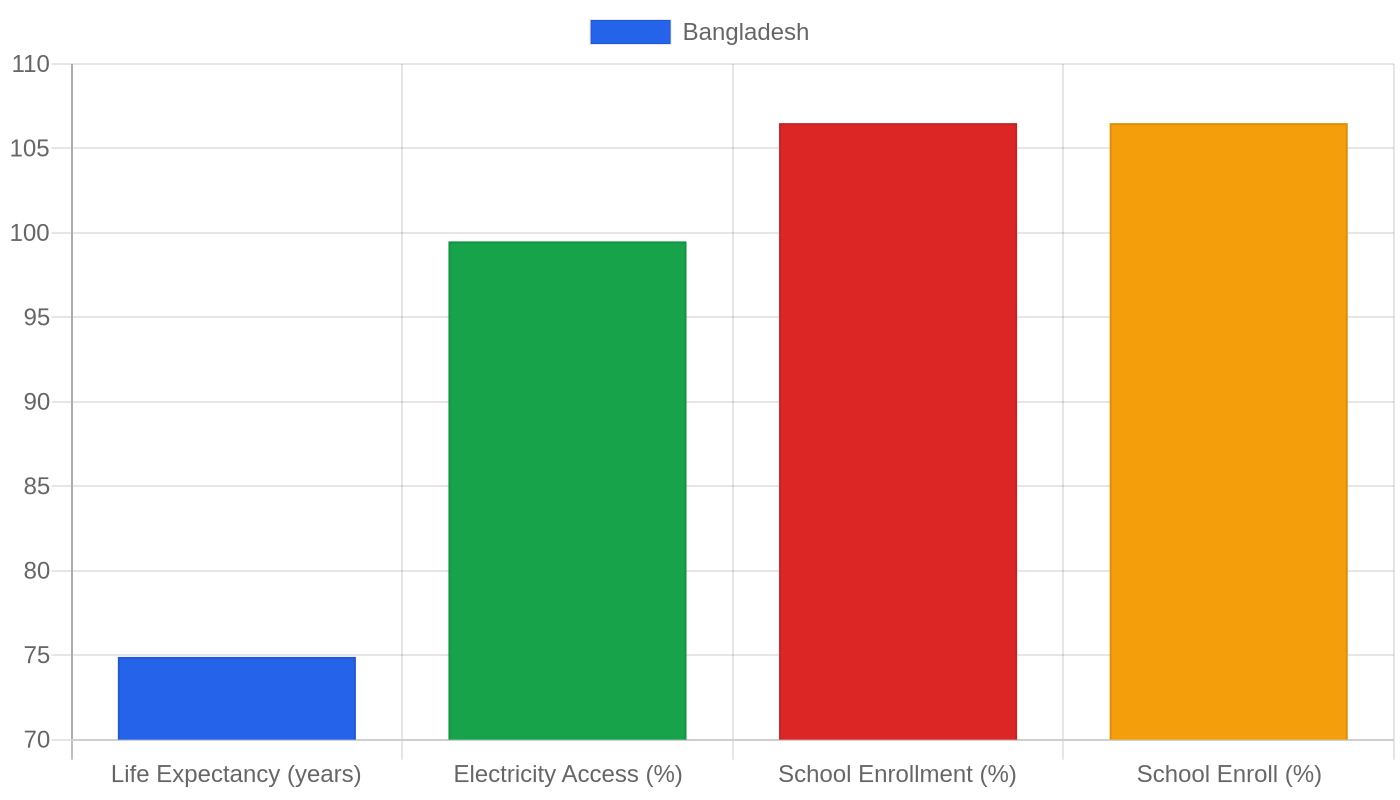
Despite these challenges, Bangladesh has made significant progress in human development over the past two decades. Life expectancy has risen, literacy rates have improved, and access to electricity has expanded dramatically. The GDP per capita (PPP) figure of $10,154, provided by the World Bank, suggests that the average Bangladeshi enjoys a standard of living that, while modest by global standards, represents a genuine improvement over previous generations.
The question is whether the current economic headwinds will stall or reverse these gains.
What’s Happening Now — Inflation, Political Jockeying, and the Search for Stability
As of 2026, Bangladesh finds itself at a critical juncture. The 3.49% GDP growth rate reported by the World Bank for 2025 is the slowest in recent memory, and the 8.77% inflation rate shows no signs of rapid decline. The Bangladesh Bank faces a difficult balancing act: raise interest rates aggressively to tame inflation, risking further economic slowdown, or hold steady and hope that supply-side pressures ease on their own.
Politically, the rivalry between the Awami League and the Bangladesh Nationalist Party continues to shape the country’s trajectory. With elections on the horizon, both parties are positioning themselves as the solution to the economic malaise. The Awami League, which has governed for much of the past decade, points to the country’s infrastructure improvements and export growth. The BNP, meanwhile, criticizes the government’s handling of inflation and corruption, calling for a change in direction.
On the business front, the conglomerates that dominate the economy are adapting to the new reality. Companies like Akij Group and ACI are diversifying their product lines, investing in technology, and seeking new export markets to offset weakness in domestic demand. The garment sector, still the backbone of the economy, is facing pressure from global buyers demanding lower prices and faster delivery times.
For Bangladesh to return to its previous high-growth trajectory, it will need to address these structural challenges while managing the immediate inflation crisis.
The Bottom Line
Bangladesh in 2026 is a country of contradictions: a growing economy that feels stagnant to many of its citizens, a democracy that struggles with political polarization, and a nation of immense potential that is currently being tested by inflation and slowing growth. Investors should watch Bangladesh for its long-term demographic dividend and strategic position in global supply chains, but they should also be prepared for short-term volatility.
For policymakers, the message is clear: bring inflation under control, stabilize the political environment, and the underlying strengths of the Bangladeshi economy will reassert themselves.
Sources & Methodology
This article is authored by Economic Pulse Net for informational and research purposes. Economic Pulse Net sources its data from multilateral institutions, national statistics bureaus, and proprietary databases. All data is believed to be current as of the date of publication.
Published: July 18, 2026 | Category: Research — Bangladesh
Use these signals in your own platform
Economic Pulse publishes its live signal feed through a documented, read-only API. Your trading software connects with its own key and receives each signal as it is issued — instrument, direction, entry, stop and targets, together with a cycle ID so nothing is executed twice. The feed is independent of this website and cannot change it.
Signals are informational only and are not financial advice.