Economic Pulse Net | Sources: World Bank World Development Indicators, Government Sources | 2026
Key Takeaways
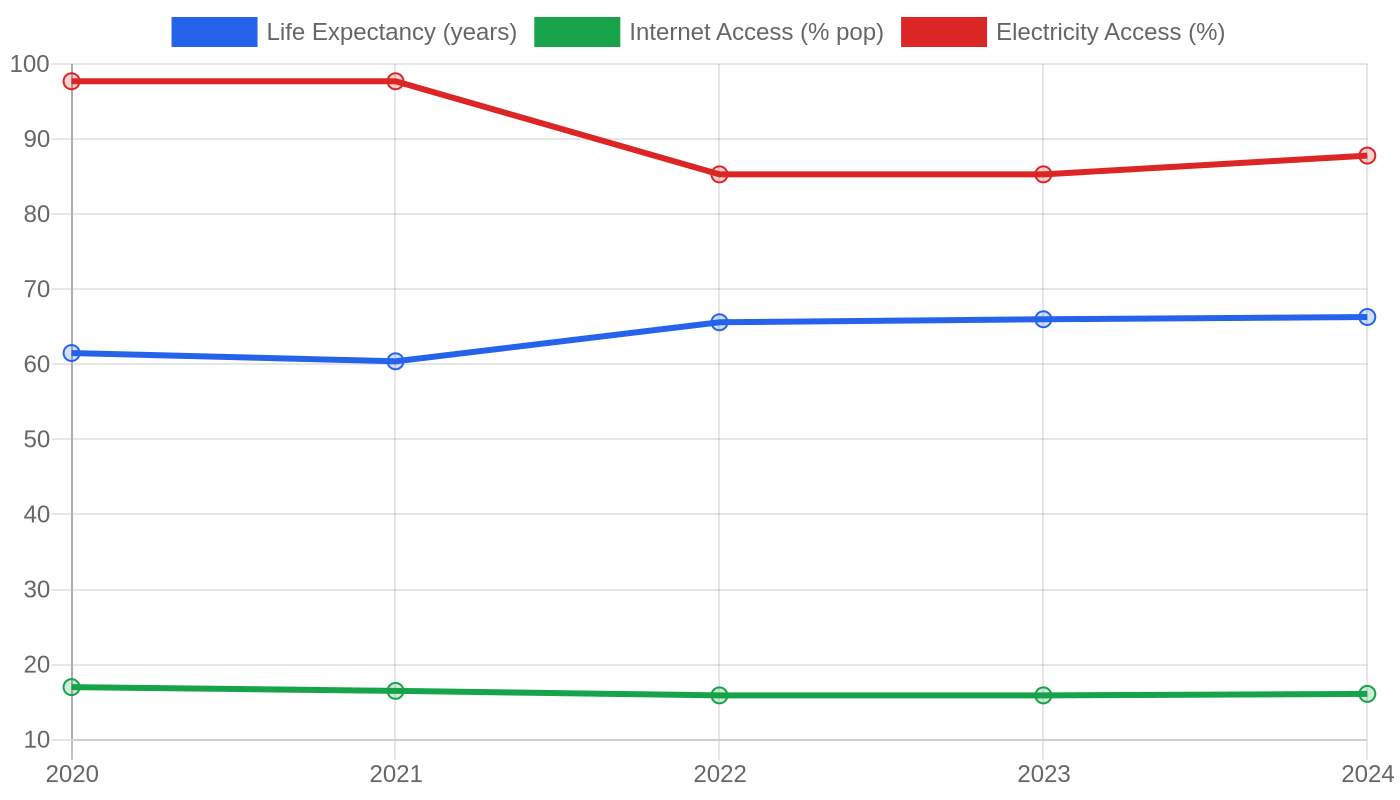
– Afghanistan’s economy operates in a state of profound uncertainty, with the World Bank unable to report core indicators including GDP growth, inflation, and unemployment — a stark signal of the data vacuum facing international observers.
– The country has transitioned from the Islamic Republic to a Taliban-declared Islamic Emirate, yet as of July 2025, only Russia has formally recognized the new government, leaving Afghanistan in diplomatic and economic isolation.
– Afghanistan’s corporate landscape remains dominated by telecommunications, financial services, and media companies, suggesting these sectors retain some resilience despite the broader collapse of formal economic institutions.
– The V-Dem Democracy Indices rank Afghanistan among the world’s most closed autocracies, placing the country at 176th and 177th out of 179 nations — a dramatic deterioration in governance metrics.
– International businesses and investors face an environment where the World Bank’s standard economic measurements are unavailable, making risk assessment exceptionally challenging.
The Invisible Economy — What We Don’t Know Matters Most
When the World Bank cannot publish GDP growth figures, inflation rates, or unemployment data for a country of Afghanistan’s strategic importance, the silence itself becomes the headline. The absence of these fundamental indicators — typically the bedrock of any economic analysis — tells a story of institutional collapse, disrupted data collection, and an economy operating largely outside formal tracking mechanisms.
The last available World Bank data paints a picture of an economy in freefall following the Taliban’s 2021 offensive, which effectively dismantled the Islamic Republic. International aid, which once constituted a substantial portion of government revenue and GDP, was frozen or redirected. The banking sector faced severe liquidity constraints, and the country’s currency experienced significant volatility.
Yet without current World Bank data, economists are left to piece together a narrative from fragments — the persistence of major companies, the resilience of certain sectors, and the daily reality of Afghans navigating a cash-based economy.
What makes this data vacuum particularly consequential is that Afghanistan’s economic trajectory is now shaped more by geopolitics than by traditional market forces. The question of international recognition — with Russia standing alone in recognizing the Islamic Emirate as the de jure government — directly impacts everything from trade agreements to humanitarian funding to the ability of Afghan businesses to access global financial systems.
The World Bank’s inability to report standard metrics is not merely an administrative gap; it is a reflection of a country suspended between regimes, between recognition and isolation, between the formal economy that once existed and whatever new economic order is emerging.
The Cost of Living Crisis — Survival in a Cash Economy
For ordinary Afghans, the economic collapse has translated into a daily struggle measured not in percentages but in basic necessities. Without official World Bank data on housing costs, rent versus purchase dynamics, or consumer prices, the reality on the ground must be understood through the lens of what is known: the formal economy has contracted dramatically, and households have adapted through informal mechanisms, remittances, and subsistence strategies.
The absence of reliable inflation data is particularly telling. In economies experiencing political transition and aid withdrawal, inflation typically spikes as currencies depreciate and supply chains fracture. Afghanistan’s situation is complicated by the fact that much of the economy operates outside formal banking channels, with many transactions conducted in cash or through informal value transfer systems.
Housing in major urban centers like Kabul has seen significant shifts, with property values initially plummeting after the 2021 transition before stabilizing in certain districts as the security situation evolved.
What is clear is that the cost of living crisis in Afghanistan is not a statistical abstraction but a lived reality. Families that once relied on government salaries or international NGO employment have seen their incomes evaporate. The comparison to regional averages is difficult to establish without official data, but anecdotal evidence and humanitarian reports consistently indicate that Afghanistan remains one of the most challenging environments in the region for ordinary households to meet basic needs.
The resilience of Afghan communities in the face of these pressures is remarkable, but it is a resilience born of necessity, not choice.
Investment and Business Climate — Surviving in the Shadows
Afghanistan’s corporate landscape offers a fascinating window into which sectors have managed to maintain operations despite the political earthquake. The list of top companies reveals a familiar pattern: telecommunications giants like Afghan Telecom and Afghan Wireless continue to operate, recognizing that connectivity is not a luxury but a necessity for both the population and the new administration.
Financial institutions including Afghanistan International Bank and Azizi Bank persist, though they operate in a regulatory environment that remains uncertain and with limited access to international correspondent banking relationships.
The media sector shows surprising vitality, with Afghan Film, Ariana TV, and Bakhtar News Agency maintaining their presence. This persistence suggests that even in a closed autocracy, there remains demand for information and cultural production — though the parameters of acceptable content have certainly narrowed.
The aviation sector, represented by Ariana Afghan Airlines and Bakhtar Afghan Airlines, continues to function, connecting Afghanistan to regional hubs and serving the limited international traffic that still flows through Kabul.
For potential investors, the business climate is defined by profound ambiguity. The lack of international recognition creates legal uncertainties around contracts, property rights, and dispute resolution. The World Bank’s inability to provide economic data compounds these challenges, making due diligence exceptionally difficult.
Yet for companies willing to navigate these complexities, there are opportunities — particularly in sectors aligned with the Taliban government’s priorities, such as infrastructure, telecommunications, and extractive industries. The calculus for investment in Afghanistan is no longer purely economic; it is deeply political.
Safety, Politics, and the Quality of Life — Life Under Closed Autocracy
The V-Dem Democracy Indices ranking of Afghanistan at 176th and 177th out of 179 countries as a “closed autocracy” provides the essential context for understanding quality of life under the current regime.
This is not a ranking that measures happiness or well-being directly, but it captures the political environment in which all other aspects of life unfold — a system where there are no meaningful democratic mechanisms for accountability, where political participation is severely restricted, and where the rule of law is subordinate to the will of the ruling authorities.
Crime and safety indices are unavailable, which is itself a notable gap. In many post-conflict settings, the immediate aftermath of a transition sees a reduction in certain types of crime as new authorities impose order, but this is often accompanied by increases in other forms of insecurity, including targeted violence, gender-based violence, and extrajudicial actions by security forces.
The Taliban’s takeover brought an end to the large-scale military conflict that had characterized the previous two decades, but it also brought a different kind of insecurity — one rooted in political repression, restrictions on civil liberties, and the systematic exclusion of women from public life.
The political landscape is defined by the stark reality of diplomatic isolation. With only Russia recognizing the Islamic Emirate as the de jure government, Afghanistan exists in a liminal space — governed by authorities that most of the world does not formally acknowledge. This has profound implications for everything from international travel to humanitarian access to the ability of Afghan citizens to participate in global institutions.
For the Afghan people, the quality of life is shaped not only by economic hardship but by this political isolation, which limits opportunities for education abroad, medical treatment, and international engagement.
The Current Moment — Afghanistan’s Precarious Present
As of mid-2025, Afghanistan stands at a critical juncture defined by a paradox: the Taliban government has achieved a level of internal control that was unimaginable during the previous two decades, yet the country remains fundamentally unstable. The Russian Federation’s recognition of the Islamic Emirate marks a significant diplomatic development, potentially opening channels for trade, investment, and political engagement that have been closed since 2021.
This recognition could serve as a template for other nations seeking pragmatic engagement with the Taliban, though most Western countries remain deeply hesitant.
The World Bank’s continued inability to report economic data suggests that the formal economy remains in a state of suspended animation. The major companies that continue to operate — from Afghan Wireless to Azizi Bank — are navigating an environment where the rules are being written in real time, where international sanctions and counter-terrorism regulations complicate basic financial transactions, and where the future of the country’s economic model remains unresolved.
The humanitarian situation continues to demand international attention, even as political engagement remains limited. The Taliban government’s policies, particularly regarding women’s education and employment, have created additional barriers to economic recovery and international assistance.
Yet there are also signs of pragmatic adaptation — the government has shown interest in attracting foreign investment in infrastructure and natural resources, and there are ongoing discussions about regional connectivity projects that could integrate Afghanistan more fully into Central and South Asian economic networks.
The Bottom Line
Afghanistan presents one of the most complex economic and political environments in the contemporary world — a country where the absence of data speaks as loudly as any statistics could. For policymakers, humanitarian organizations, and investors willing to look beyond the conventional metrics, Afghanistan offers a case study in economic resilience under extraordinary constraints.
The country is not for the faint of heart, but for those who understand that Afghanistan’s stability matters for regional security and global humanitarian concerns, it remains a critical watchpoint. The path forward is uncertain, but the current moment — defined by Russia’s recognition and the ongoing evolution of the Taliban’s governance — represents a potential inflection point that deserves close attention.
Sources & Methodology
This article is authored by Economic Pulse Net for informational and research purposes. Economic Pulse Net sources its data from multilateral institutions, national statistics bureaus, and proprietary databases. All data is believed to be current as of the date of publication.
Published: August 11, 2026 | Category: Research — Afghanistan
Use these signals in your own platform
Economic Pulse publishes its live signal feed through a documented, read-only API. Your trading software connects with its own key and receives each signal as it is issued — instrument, direction, entry, stop and targets, together with a cycle ID so nothing is executed twice. The feed is independent of this website and cannot change it.
Signals are informational only and are not financial advice.