Economic Pulse Net | Sources: World Bank World Development Indicators, Government Sources | 2026
Key Takeaways
– Afghanistan’s economy operates largely without formal international recognition, with only Russia recognizing the Taliban’s Islamic Emirate as the de jure government as of mid-2025, according to the political landscape data.
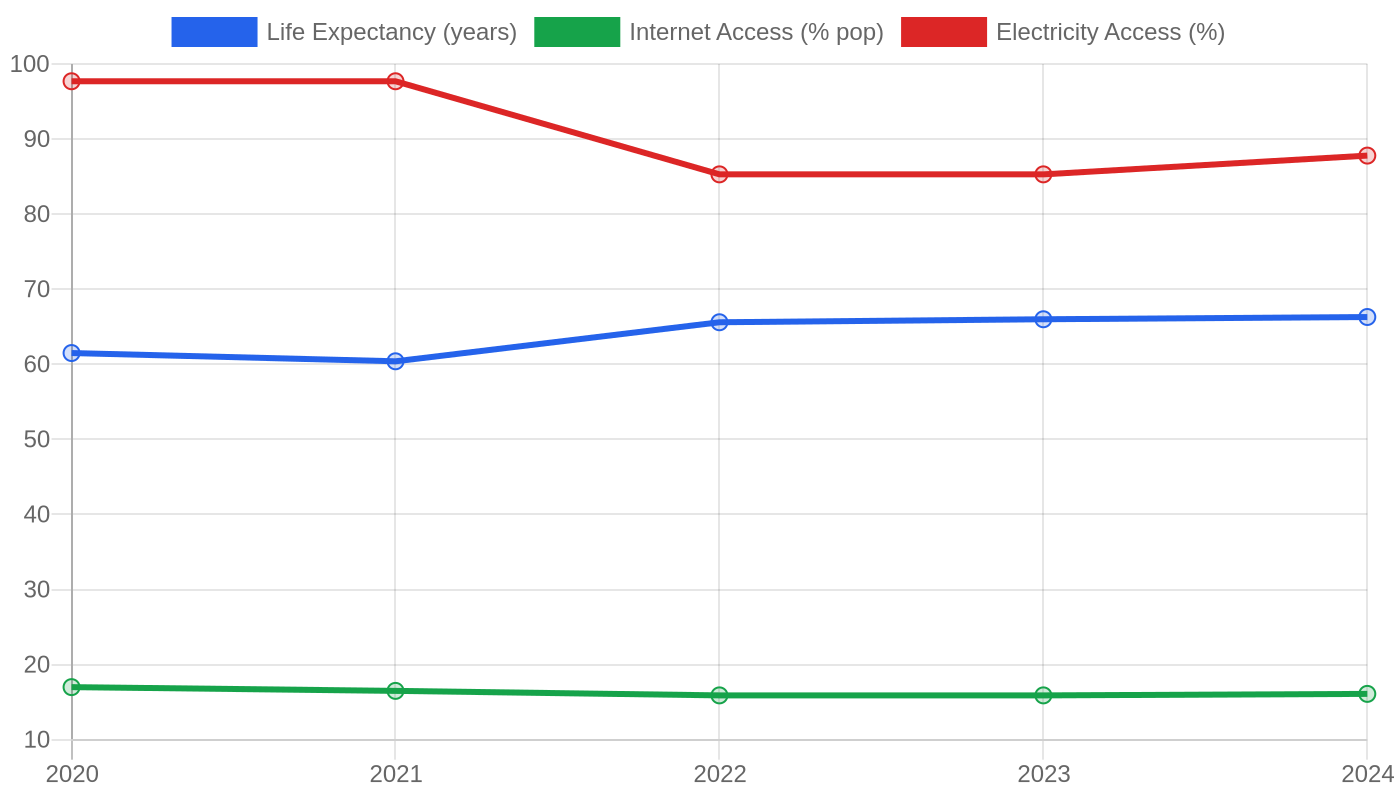
– The World Bank provides no current economic indicators for Afghanistan — no GDP growth, inflation, unemployment, or per capita income figures — reflecting the collapse of formal data collection and international monitoring.
– Afghanistan’s main industries are not listed in available data, suggesting a fragmented, informal, and largely agricultural economy operating outside official channels.
– The country ranks among the world’s lowest in democratic governance, classified as a “closed autocracy” at 176th and 177th out of 179 countries in the V-Dem Democracy Indices.
– Despite the absence of formal economic data, a handful of companies — including Afghan Telecom, Afghan Wireless, and Afghanistan International Bank — continue to operate, signaling pockets of surviving infrastructure.
The Economic Vacuum — When the Numbers Go Silent
The most striking feature of Afghanistan’s current economic reality is not a number, but the absence of numbers. The World Bank, the world’s premier repository of cross-country economic data, reports nothing for Afghanistan’s GDP growth, inflation, unemployment, GDP per capita, or GNI per capita. This is not a data gap — it is a statement. When a country’s economic statistics disappear from global databases, it signals a breakdown in the very machinery of economic governance.
Afghanistan’s economy has effectively fallen off the international map. Without a functioning central bank recognized by the global financial system, without consistent customs revenue collection, and without international development partners on the ground, the formal economy has contracted to a shadow of its pre-2021 self. The collapse of the Islamic Republic during the 2021 Taliban offensive, as noted in the political landscape data, triggered not just a political transition but an economic implosion.
International aid — which once accounted for an estimated 40 percent of GDP — was frozen. Central bank reserves held abroad were blocked. The formal banking system seized up.
What remains is an economy driven by subsistence agriculture, informal cross-border trade, and remittances from the Afghan diaspora. The absence of official inflation data does not mean prices are stable; it means no one is reliably tracking how much a family must spend on bread, cooking oil, or medicine. The absence of unemployment figures does not mean Afghans are working; it means the concept of formal employment has become nearly meaningless for the vast majority of the population.
Afghanistan’s economy today is best understood not through spreadsheets, but through the lived reality of scarcity, adaptation, and survival.
The Price of Daily Life — Living Without a Safety Net
Without official cost of living data from the World Bank, one must look at the fragments of available information to understand what it costs to exist in Afghanistan today. The country’s main industries are not listed in the provided data, which itself is telling: the formal economy has retreated to such an extent that even basic sectoral classification has become difficult.
Agriculture — particularly opium poppy cultivation, wheat, and fruits — likely remains the backbone of rural livelihoods, but export channels have been disrupted by sanctions, border closures, and the collapse of banking relationships.
For an Afghan family in Kabul or Herat, daily expenses are a brutal arithmetic. Rent in urban areas, while lower than in neighboring Pakistan or Iran, consumes a growing share of household income as salaries — where they exist at all — have stagnated or disappeared. The cost of imported goods, from cooking oil to medicine, has risen sharply due to the collapse of the afghani against foreign currencies in the immediate aftermath of the Taliban takeover.
Fuel prices, tied to global markets but distorted by smuggling and informal supply chains, fluctuate unpredictably.
The comparison to regional averages is stark. While Pakistan and Iran have their own economic crises, they maintain functioning central banks, social safety nets, and international trade relationships. Afghanistan has none of these. The vast majority of Afghans now live below the poverty line, according to previous UN estimates predating the data gap. To buy food, families sell assets — livestock, jewelry, even their own labor in markets where wages have plummeted.
The cost of living in Afghanistan is not measured in a basket of goods; it is measured in the erosion of dignity and the narrowing of hope.
Business in a Broken State — The Companies That Remain
Remarkably, a handful of companies continue to operate in Afghanistan, their names listed in the provided data like survivors of a shipwreck. Afghan Telecom and Afghan Wireless represent the telecommunications sector, which has proven remarkably resilient. Mobile phone penetration remains relatively high, and the demand for connectivity — for remittances, for news, for contact with family abroad — has kept these companies afloat.
Afghanistan International Bank and Azizi Bank continue to function, though under severe constraints. Without access to the SWIFT international payment system and with correspondent banking relationships largely severed, these banks operate in a financial isolation that would cripple most institutions.
Ariana Afghan Airlines and Bakhtar Afghan Airlines still fly, connecting Kabul to a handful of international destinations. Their continued operation is a logistical and diplomatic marvel, given the lack of recognized government authority over airspace and landing rights. Afghan Film, a consumer services company, and Ariana TV and Bakhtar News Agency represent the cultural and media sector, operating under the tight constraints of Taliban censorship but still producing content.
For an investor, the business climate in Afghanistan is not merely challenging — it is nearly incomprehensible. There is no functioning legal framework for contract enforcement. There is no reliable banking system for moving money in or out. There is no recognized government with which to register a business or resolve a dispute. The only sectors attracting investment are those that operate outside formal regulation: opium production, gemstone mining, and cross-border smuggling.
For legitimate businesses, survival depends on relationships, cash transactions, and a willingness to operate in legal grey zones. The companies listed above are the exceptions, not the rule — and their continued existence is a testament to entrepreneurial grit rather than a functioning business environment.
The Politics of Survival — Autocracy Without Recognition
Afghanistan’s political landscape, as described in the provided data, is one of profound isolation. The Taliban’s caretaker government, announced on 7 September 2021, has received de jure recognition from only one country: the Russian Federation, as of July 2025. No other nation has formally recognized the Islamic Emirate as the legitimate government of Afghanistan. This diplomatic vacuum has direct economic consequences.
Without recognition, Afghanistan cannot access International Monetary Fund financing, World Bank development loans, or bilateral aid from major donor countries. It cannot legally export goods under trade agreements. Its central bank cannot hold reserves abroad or engage in normal currency swaps.
The V-Dem Democracy Indices rank Afghanistan among the world’s lowest as a “closed autocracy,” placing it at 176th and 177th out of 179 countries. This classification reflects the Taliban’s consolidation of power: no elections, no opposition parties, no independent judiciary, and severe restrictions on women’s rights to work, travel, and education.
For the economy, this political closure means that even if international sanctions were lifted, the institutional foundations for a market economy — property rights, contract enforcement, regulatory transparency — do not exist.
Crime and safety indices are listed as not available in the provided data, but the absence of data should not be mistaken for the absence of danger. The Taliban have imposed a brutal form of order, reducing street crime through harsh punishments while simultaneously creating an environment of fear for anyone outside their ideological framework.
For ordinary Afghans, safety is relative: the risk of terrorist attacks by ISIS-K remains high, but the chaos of the final months of the Republic has given way to a grim stability. Quality of life, however, has deteriorated across every measurable dimension — food security, healthcare access, education, and personal freedom.
What’s Happening Now — The Long Wait for Normalcy
As of mid-2025, Afghanistan exists in a state of suspended animation. The Taliban government has consolidated internal control but remains unable to translate that control into economic recovery. The Russian Federation’s recognition, while diplomatically significant, has not opened the floodgates of international engagement. Other major powers, including China and the Gulf states, have maintained consular presence and limited humanitarian engagement but have stopped short of full recognition.
The economic situation on the ground remains dire. Humanitarian organizations, including the United Nations and various NGOs, continue to provide food assistance to millions of Afghans, but funding shortfalls have forced ration cuts. The banking system remains frozen in a state of semi-functionality: domestic transactions occur, but international transfers are severely restricted.
The afghani has stabilized against major currencies after its initial collapse, but this stability reflects the absence of trade rather than economic strength.
There are no signs of reform from the Taliban government. No economic policy announcements, no budget transparency, no efforts to re-engage with international financial institutions. The caretaker government appears focused on internal consolidation and ideological enforcement rather than economic reconstruction. For the Afghan people, the immediate future offers more of the same: survival through informal networks, remittances from abroad, and the slow erosion of the remaining middle class.
The Bottom Line
Afghanistan is not a country for investors, tourists, or those seeking opportunity. It is a country for humanitarian organizations, geopolitical analysts, and the Afghan diaspora. The economy has not collapsed so much as it has evaporated from the formal record — a ghost economy operating without data, without institutions, and without international legitimacy.
Anyone watching Afghanistan should do so with a clear understanding: this is a nation in survival mode, where the primary economic activity is enduring another day. The only question that matters is whether the international community will eventually find a way to re-engage, or whether Afghanistan will remain in this frozen state of unrecognized autarky for years to come.
Sources & Methodology
This article is authored by Economic Pulse Net for informational and research purposes. Economic Pulse Net sources its data from multilateral institutions, national statistics bureaus, and proprietary databases. All data is believed to be current as of the date of publication.
Published: July 23, 2026 | Category: Research — Afghanistan
Use these signals in your own platform
Economic Pulse publishes its live signal feed through a documented, read-only API. Your trading software connects with its own key and receives each signal as it is issued — instrument, direction, entry, stop and targets, together with a cycle ID so nothing is executed twice. The feed is independent of this website and cannot change it.
Signals are informational only and are not financial advice.